PART 2:
The gray SUV fishtailed to a stop on the gravel shoulder, throwing a cloud of dust and loose stone against the guardrail. The door flew open before the engine died. A man in his mid-forties stumbled out, suit jacket flapping, tie yanked loose like he’d been strangling himself in the cab. His face was pale, eyes wide, scanning the chaos until they landed on the blue sedan.
— Ethan! — he shouted. His voice cracked on the name.
He ran. Not a jog, not a fast walk — a blind sprint toward the wreckage, dress shoes slipping on gravel. The trooper intercepted him five yards from the paramedics, catching him with both hands on his chest.
— Sir, you can’t go in there. Medics are working.
— That’s my son. That’s my boy. Let me through.
The father tried to push past. His voice had that raw edge of a man who’d already imagined the worst and was now fighting to undo it. The trooper held firm, speaking in low, practiced tones. I couldn’t hear the words, but I knew the rhythm — calm, repetitive, designed to anchor someone who was drowning on dry land.
I stayed where I was, on one knee, watching.
The paramedics had cut away the driver’s side door. One of them was inside the car now, stabilizing Ethan’s neck. Another was prepping a backboard. Their movements were quick but deliberate, the choreography of professionals who’d done this a hundred times and knew that speed without precision killed faster than hesitation.
The father looked over the trooper’s shoulder and saw his son’s face — pale, blood drying at the temple, head lolling as they fitted the cervical collar. He let out a sound I’ve heard only a few times in my life. Not a scream. Not a sob. Something in between. The noise a man makes when the bottom drops out of his world.
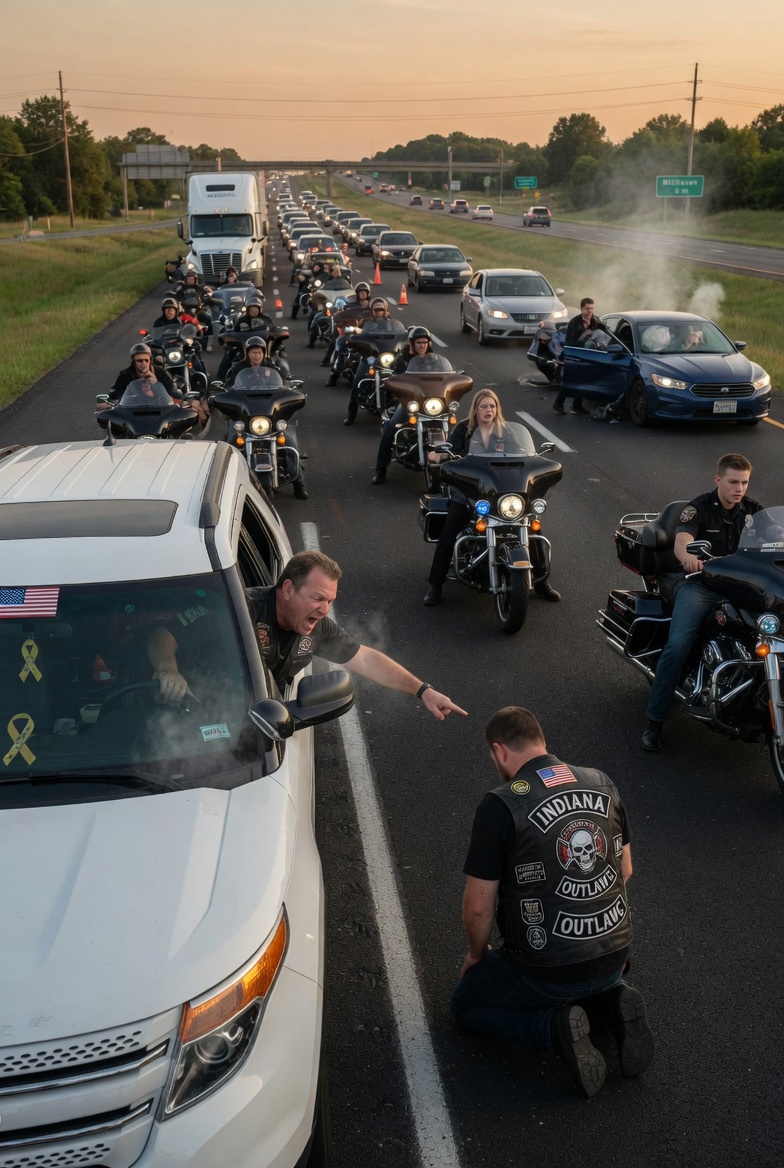
And then his gaze swept the scene, searching for someone to blame. His eyes passed over the wreck, the skid marks, the line of bikes — and landed on me.
Recognition hit him like a second impact.
I saw it happen. The flicker of memory. The narrowing of his eyes. The way his mouth tightened as he placed my face, my cut, the patch on my back. Three years dissolved in an instant. He wasn’t seeing a stranger who’d blocked traffic to save his son. He was seeing the leader of the biker club he’d tried to expel from Millhaven.
His jaw worked. No words came out.
I rose to my feet slowly. The asphalt had left deep impressions in my knees. Behind me, my crew remained kneeling, a silent wall of leather and patience.
The father took a step toward me, away from the trooper. The officer glanced between us, sensing the shift but not understanding it.
— You, — the father said. His voice was hoarse. — It’s you.
I nodded once.
— Me.
He stared. His chest was heaving. I saw the war playing out behind his eyes — gratitude and humiliation wrestling for control. He was a man who’d built his political identity in this town on law and order, on keeping “undesirable elements” out. And here I was, the undesirable element, standing between his son and a closed casket.
— I don’t… — he started. Stopped. Swallowed hard. — How did you know?
— Saw the curve, — I said. — Saw the car. Reacted.
He looked past me at the line of bikes, the kneeling riders, the truck driver still standing by his cab with his hands on his hips, breathing hard.
— You shut down the highway.
— Yes.
— People were screaming at you.
— Yes.
— And you just… stayed.
— We had to.
He opened his mouth to say something else, but a paramedic called out, “We’re ready to move.” The backboard emerged from the wreck, Ethan strapped to it, neck braced, an IV line already running. His face was gray but his chest was moving. Up. Down. Up. Down. The rhythm of a life still being lived.
The father forgot about me instantly. He rushed to the stretcher, walking alongside as they loaded it into the ambulance. He gripped his son’s limp hand, talking to him in a voice too low for me to catch. The ambulance doors slammed shut. Sirens spooled up, and the vehicle pulled away, lights spinning red and white across the orange sky.
I watched until it disappeared around the curve — the same curve that had nearly killed the boy.
The trooper approached me. His nameplate read Haskins. He was young, maybe late twenties, with the kind of face that still believed in order and procedure.
— I need to take a statement, — he said. — What’s your name?
— People call me Preacher.
He wrote it down without commenting on the nickname.
— And your club?
— Iron Covenant.
— You’re the president?
— Road captain. Acting leader for today’s ride.
He nodded, making notes. Then he looked up at the line of bikes.
— You’ve got thirty men down on the pavement. Why?
— Because one man standing up wouldn’t have stopped that semi.
He considered that. Behind him, drivers were being directed slowly around the scene. A few rolled down their windows, their anger now replaced by sheepish silence. The man in the white SUV had retreated to his vehicle without another word. I didn’t hold it against him. He’d seen what we were blocking and understood. That kind of realization is humbling, and humility is hard to swallow in public.
— That truck driver, — Haskins said, — he says he didn’t see the wreck until he was almost on top of it. Said your bikes were the only thing that made him brake before the curve.
— Good.
— You realize you could’ve been killed. All of you. If he’d jackknifed, that trailer could’ve swung right into your formation.
I met his eyes.
— Then we’d have died doing something that mattered. That’s more than a lot of people get.
He didn’t have a response for that. He just wrote something else in his notebook, closed it, and slipped it into his pocket.
— I’ll note in my report that your actions prevented a secondary collision. That’s the best I can do. The highway obstruction… I can’t ignore it. You’ll likely get a citation.
— Mail it to the club, — I said. — We’ll pay it.
He almost smiled. Almost.
— You know the father?
I looked in the direction the ambulance had gone.
— He tried to ban us from town. Three times.
Haskins blinked. Then he shook his head slowly, the kind of shake that said the world was stranger and more complicated than any police manual could account for.
— Hell of a thing, — he muttered. — Hell of a thing.
I didn’t disagree.
I turned back to my crew and raised my hand. Two fingers, a small circle — the signal to stand down. Thirty men rose in unison, boots scraping asphalt. There was no celebration. No high-fives. Just the quiet dignity of men who’d done what was necessary and didn’t need applause.
Doc, my second, walked over. He was a Vietnam-era medic, now in his sixties, with gray-streaked hair pulled back in a ponytail and eyes that had seen too much of everything.
— Boy stable? — he asked.
— Breathing. That’s all I know.
— The father recognized you.
— Yeah.
— Gonna be an interesting conversation when the dust settles.
I grunted. Doc was right, but I wasn’t ready to think about that yet. The adrenaline was fading, leaving behind a deep, bone-level exhaustion. My knees ached. My throat was dry from exhaust fumes and tension. I wanted a cup of coffee and thirty minutes of silence.
But the silence wasn’t coming yet.
The semi driver walked over. He was built like his truck — wide, solid, weathered by miles. His hands were still shaking slightly.
— I almost killed that kid, — he said. His voice was gravel and regret. — If you hadn’t been there…
— But you didn’t, — I said. — That’s what counts.
— I been driving twenty-two years. Never had a close call like that. My brakes held, thank God. But another fifty feet and I’d have turned that sedan into scrap metal with the boy inside.
He pulled off his cap and wiped his forehead.
— I owe you, — he said. — All of you.
— You don’t owe us anything. Just drive safe.
He nodded, replaced his cap, and walked back to his rig. He sat in the cab for a long time before pulling away, his hazard lights still flashing.
The tow truck arrived, and the wrecked sedan was dragged onto a flatbed. Debris was swept from the road. One of the paramedics tossed a bloodied gauze pad into a biohazard bag. The whole scene was being erased, piece by piece, as if it had never happened.
But I knew it would stay with everyone who’d witnessed it.
Especially me.
We mounted up one by one. Engines turned over, a rolling thunder that filled the evening air. I pulled on my helmet and adjusted my gloves, my mind already drifting to the father — to the expression on his face when he realized who I was. Not anger. Not quite gratitude. Something more fragile. The look of a man whose certainties had just cracked.
Doc pulled alongside me at a red light a few miles down the road.
— Clubhouse? — he called over the rumble.
— Yeah. Debrief in an hour.
He nodded and dropped back into formation.
The ride back was quiet. The kind of quiet that settles over a group when words are too small for what just happened. The sky darkened from orange to purple to black. Streetlights flickered on. By the time we pulled into the gravel lot outside the Iron Covenant clubhouse, the stars were out.
The clubhouse was a converted auto body shop on the edge of town. We’d bought it ten years ago, fixed it up with our own hands. It wasn’t pretty — corrugated metal walls, a patch of cracked concrete out front, a hand-painted sign that was starting to fade. But it was ours. And for men who’d spent too much of their lives being turned away from other people’s doors, that mattered.
Inside, the air smelled of motor oil, coffee, and old wood. Photos lined the walls — past rides, fallen brothers, charity events. The bar was a slab of oak salvaged from a barn demolition. The chairs didn’t match, but they were comfortable.
I poured myself a cup of black coffee and sat down heavily. Doc took the stool across from me. A few other members drifted in — Tank, a mountain of a man with a gentle voice; Zeke, who’d been with the club since its founding; and Rabbit, our youngest prospect, barely twenty-three, still wide-eyed at everything.
— So, — Tank rumbled, settling his weight onto a stool that creaked in protest. — Someone gonna explain what the h*ll happened back there? I was at the back of the formation. All I saw was a wall of brake lights and then Preacher’s signal.
— Teenager wrecked his car on the blind curve, — Doc said. — Semi was coming in hot. Preacher called the formation. We knelt. Truck stopped twenty yards short.
Tank looked at me. His expression was unreadable.
— We knelt in the middle of the interstate.
— Yes.
— Blocking rush hour traffic.
— Yes.
— With our engines off.
— Yes.
A long pause. Then Tank’s face split into a slow grin.
— That’s the most insane thing I’ve ever been part of. I love it.
Zeke shook his head, but he was smiling too. Rabbit looked like he was about to burst with questions. I let them process it in their own time. The coffee was hot and bitter. Perfect.
— There’s more, — I said after a moment. — The boy’s father. You all remember David Aldridge.
The names landed. Tank’s grin faded. Zeke’s jaw tightened. Rabbit looked confused — he hadn’t been around three years ago, hadn’t sat through the town hall meetings, hadn’t heard the speeches about “preserving community standards.”
— The councilman? — Tank asked. — The one who tried to block our charity rides?
— Same.
— That was his kid in the car?
— Yes.
Silence fell. It was heavy, layered with history and resentment. I let it breathe before I spoke again.
— I know what he said about us. I know what he did. But none of that mattered on the highway. The only thing that mattered was the curve and the kid.
— He didn’t even thank you, did he? — Zeke asked.
— Not yet. But he recognized me. And the recognition… that was harder for him than any words.
Doc rubbed the back of his neck. He’d patched up club members after bar fights and accidents for two decades, and he had a way of cutting straight to the heart of things.
— Question is, — he said, — do you think this changes anything? A man with that much pride… sometimes they double down instead of admitting they’re wrong.
— I’m not worried about him changing, — I said. — I didn’t kneel on that highway to win an argument. I knelt to save a life.
— And if he still hates us tomorrow?
— Then he hates us. But his son will still be alive. And that’s the only scorecard I care about.
Doc nodded slowly. The others absorbed it. I finished my coffee and stood.
— I’m gonna step outside. Get some air.
The night had cooled considerably. I leaned against the corrugated wall of the clubhouse and stared at the stars. The gravel crunched under my boots. The highway felt like a different world now — the horns, the shouting, the heat of the asphalt. Everything compressed into a few minutes that would replay in my head for a long time.
I thought about Ethan. About his father. About the petition I’d seen with my own eyes, the signatures gathered to block our annual toy run from passing through downtown Millhaven. We’d ended up rerouting, adding forty miles to the ride, but we’d done it quietly. No protests. No lawsuits. Just a different road. Pride wasn’t our currency. Action was.
But I won’t pretend it didn’t sting.
Being called a nuisance. A threat. Being told your presence alone made good people uncomfortable. You learn to carry those words under your skin like shrapnel — not deadly, but always there, itching when the weather changes.
And now the man who’d wielded those words had seen his son’s life balanced on the edge of seconds we’d bought with our bodies.
I didn’t know what would come of it. Probably nothing. Men like Aldridge didn’t reverse their entire worldview because of one incident. They filed the anomaly away, assigned it to luck or circumstance, and returned to their comfortable certainties.
I’d been wrong before, though.
My phone buzzed. Unknown number. I almost let it go to voicemail, but something made me answer.
— Yeah?
A pause. Breathing. Then a voice I recognized.
— Is this… Preacher?
David Aldridge. His voice was stripped of its public polish, raw and unguarded.
— It’s me.
— I got your number from the accident report. I hope that’s all right.
— It’s all right.
Another pause. I heard hospital sounds in the background — a PA system, beeping monitors, the squeak of rubber-soled shoes on linoleum.
— Ethan’s in surgery, — he said. — Internal bleeding. They say they caught it in time, but… they’re not sure yet.
I closed my eyes. The cool night air felt suddenly thin.
— I’m sorry, — I said. — He’s in good hands now.
— I know. I know he is. — His voice caught. — I wanted to call because… I’ve been sitting in this waiting room for two hours, and all I can think about is that moment. On the highway. When I saw you kneeling there, with those horns blaring and people screaming, and you just… didn’t move. How do you do that? How do you stand still when the whole world is yelling at you?
I leaned against the wall and considered the question. It deserved an honest answer.
— Because I wasn’t listening to the yelling, — I said. — I was listening for the truck.
He was quiet for a long moment. When he spoke again, his voice was steadier.
— I was wrong about your club. I’ve been wrong for a long time. And I need to say that to your face. Not over the phone.
— You don’t owe me anything.
— I owe you everything. — The words came out fierce, almost angry. — My son is alive because of what you did. If you’d been even thirty seconds slower… if you’d hesitated… I’d be planning a funeral right now.
I didn’t have a response to that, so I said nothing.
— Will you come to the hospital? — he asked. — Not now. Tomorrow, maybe. When Ethan’s out of surgery. I want him to meet the man who saved his life.
— I didn’t save his life, — I said. — My whole club did that.
— Then bring them. All thirty of them. I’ll rent out the damn cafeteria if I have to.
I almost smiled. Almost.
— Let’s see how the surgery goes first. One step at a time.
— One step at a time, — he repeated. — Okay. I’ll call you when he’s out.
— I’ll be here.
The line went dead. I stood there for a while, phone in hand, the night pressing in around me. Then I went back inside.
Doc looked up when I entered. He must have seen something on my face, because he didn’t ask. He just slid a fresh cup of coffee across the bar. I caught it and sat down.
— That was Aldridge, — I said. — The boy’s in surgery. Internal bleeding.
Tank’s expression darkened. Zeke muttered something under his breath. Rabbit looked stricken — he had a younger brother about Ethan’s age.
— And? — Doc prompted.
— And he asked me to come to the hospital tomorrow. Wants to apologize in person. Wants Ethan to meet us.
No one spoke for a few seconds. Then Tank let out a low whistle.
— Never thought I’d see the day.
— Maybe it’s genuine, — Zeke said cautiously. — People change when their kids are on the line.
— Or maybe he’s just scared and grabbing at anything, — Tank countered. — Once the boy’s healthy, he’ll go right back to his old ways.
— Maybe, — I said. — But that’s tomorrow’s problem.
Doc leaned forward, his elbows on the bar.
— You know what I think? I think we should go. Not for Aldridge. For the boy. If he wakes up and hears what happened, he’s gonna have questions. And I’d rather he get the answers from us than from whatever version the town gossips spin.
That made sense. It made a lot of sense.
— All right, — I said. — Tomorrow, we ride to the hospital. Those who want to come, come. No pressure. No expectations.
Tank nodded. Zeke shrugged his agreement. Rabbit practically vibrated with eagerness. Doc just smiled that tired, knowing smile of his.
— Get some sleep, — he told me. — You look like h*ll.
I laughed, the sound surprising me. After everything that had happened, laughing felt good. Almost defiant.
The clubhouse emptied slowly. Members drifted to their rooms — some lived on-site, others headed home to families. I stayed in my quarters, a small room at the back with a narrow bed and a window that faced the highway. I could hear the traffic from here, the same rush hour flow we’d disrupted hours earlier. Life went on. It always did.
I lay down but didn’t sleep. My mind kept replaying the moment the semi’s brakes screamed, the moment the driver’s face went white, the moment I realized the truck would stop. The relief had been so sharp it hurt. And then the boy’s stillness, the blood, the father’s arrival. All of it colliding into a single, relentless loop.
Somewhere around 3 a.m., my phone buzzed again. Aldridge.
— He’s out of surgery. — His voice was heavy with exhaustion and relief. — They stopped the bleeding. He’s stable. They said another hour and we would’ve lost him.
I closed my eyes and let out a breath I hadn’t realized I was holding.
— That’s good news, — I said. — That’s really good news.
— I just… wanted you to know. First thing. Before anyone else.
— Thank you.
— No, — he said quietly. — Thank you.
The call ended. I stared at the ceiling for a long time, then finally let sleep pull me under.
I woke at seven, showered, pulled on a clean shirt and my cut. The morning light was harsh and honest, the kind that makes everything look exactly like what it is. I walked into the common room to find Doc already up, frying eggs on the griddle. Tank was nursing a cup of coffee at the bar. Rabbit was polishing his boots, a nervous habit.
— We got a plan? — Tank asked.
— Ride to the hospital at ten. Visiting hours start then. Keep it quiet. No revving in the parking lot. We’re not there to make a scene.
— And if the media’s there? — Doc asked. — Small town like this, word travels. Someone probably tipped off the local paper.
— We don’t talk to them. This isn’t a photo op. It’s a visit to a kid who almost died.
They nodded. We ate breakfast in relative silence, the kind that settles over people before something important. At nine thirty, we assembled in the lot. Twenty-three bikes. A few members couldn’t make it — work, family obligations — but most of the club was present. We looked like what we were: a group of men who’d been through things together, who wore their scars visibly and invisibly, who’d learned that family wasn’t always blood.
The ride to Millhaven Regional Hospital took twenty minutes. We parked in the far corner of the lot, out of the way, and walked toward the main entrance as a group. People stared. A security guard tensed until he saw our faces — not looking for trouble, just heading inside. He nodded and stepped aside.
The hospital smelled like antiseptic and anxiety. Aldridge met us in the lobby. He looked like he hadn’t slept in days. His suit was wrinkled, his eyes were red-rimmed, and he’d lost the authoritative posture I remembered from the town hall meetings. In its place was just a tired, scared father.
— You came, — he said, almost disbelieving.
— We said we would.
He looked at the group behind me — Tank, Doc, Zeke, Rabbit, and the others — and something in his face crumpled. He didn’t cry, but he came close.
— Ethan’s awake, — he said. — He’s groggy, but he’s talking. The doctors say he’ll make a full recovery.
Relief rippled through the group. I felt it in my own chest, a loosening of something I’d been carrying since the highway.
— Can we see him? — I asked.
— Yeah. But only a couple at a time. ICU rules.
I turned to the group. — Doc and I will go first. The rest of you, wait here. Be respectful. This is a hospital, not a bar.
Tank nodded. Zeke crossed his arms and leaned against the wall. Rabbit looked around with wide eyes, absorbing everything.
Aldridge led us to the ICU. The hallway was quiet, the lights dim. Ethan was in Room 317. Through the window, I could see him — pale, bandaged, but awake. His eyes tracked us as we entered.
— Ethan, — Aldridge said gently, — these are the men I told you about.
Ethan looked at me, then at Doc. He was young, maybe sixteen, with his father’s sharp jawline but softer eyes.
— You’re the bikers, — he said, his voice raspy. — The ones who blocked the road.
— That’s us, — I said.
— Dad said… he said you saved my life.
— We just slowed things down long enough for help to arrive.
Ethan’s brow furrowed. Even through the pain meds, I could see a sharp mind working.
— They said you knelt on the highway. While people were screaming at you. Why?
I stepped closer to the bed. His father stood at the foot, watching, listening.
— Because sometimes the loudest thing you can do, — I said, — is be still. People were shouting, but none of them could see what we saw. A blind curve. Your car. A semi coming in fast. We didn’t have time to explain. We just had to act.
— But they were so angry, — Ethan said. — Dad said someone got right in your face.
— They didn’t know. And I can’t blame them for not knowing. They saw a gang of bikers breaking the law. It looked wrong. It felt wrong. But the right thing and the wrong-looking thing are sometimes the exact same thing, depending on which side of the curve you’re standing on.
Ethan absorbed that. His eyes drifted to the ceiling, then back to me.
— I want to be like that, — he said quietly. — Brave enough to do the right thing even when everyone thinks it’s wrong.
I felt something shift in my chest. Doc cleared his throat behind me. Aldridge stared at his son with an expression I couldn’t fully read — pride, maybe, mixed with something older and more painful.
— You already are, — I said. — You survived a crash that could’ve killed you. You’re still here. That’s the first step.
— Will you come back? — Ethan asked. — When I’m out of here? I want to hear more. About the club. About the rides.
I looked at Aldridge. He met my eyes and nodded, almost imperceptibly.
— We’ll be around, — I said. — You focus on healing up.
Doc and I stepped out. In the hallway, Aldridge closed the door behind us and faced me. For a long moment, he said nothing. Then he extended his hand.
— I was wrong, — he said. — About your club. About you. I’ve spent years telling people you were a problem. But last night, you were the only solution. And I can’t… I can’t reconcile that without admitting I made a mistake.
I took his hand. His grip was firm, damp with nervous sweat.
— People make mistakes, — I said. — It’s what they do next that matters.
— What I’m going to do next, — he said, — is withdraw every objection I ever filed against your club. And I’m going to recommend, publicly, that the town council issue a proclamation recognizing what you did. I know you didn’t do it for recognition. But the town needs to see it. They need to see who you really are.
Doc raised an eyebrow but didn’t speak. I considered the offer.
— Recognition’s fine, — I said. — But there’s something else you could do.
— Name it.
— Our annual charity ride — the one you tried to ban. It’s coming up in September. We raise money for the children’s hospital. This hospital. If you want to make things right, help us run it. Not block it. Support it.
Aldridge’s expression shifted. For a second, I thought he’d balk. Then something in him settled, the way a man settles when he decides to stop fighting something he can’t defeat and instead embrace it.
— I’ll do more than support it, — he said. — I’ll help organize it. I’ll get the permits. I’ll make sure every official in Millhaven knows this town owes your club a debt.
— Then we’re square, — I said. — No hard feelings.
— Just like that?
— Just like that. We’re not in the business of holding grudges. Takes too much energy.
He stared at me for a beat, then shook his head slowly, a strange, wry smile crossing his tired face.
— You’re not at all what I expected.
— We never are, — Doc said from beside me, and I could hear the smile in his voice.
We left the ICU and rejoined the others in the lobby. Tank raised an eyebrow, and I gave him a short nod — all clear. The tension in the group eased visibly.
Over the next few days, word spread. The Millhaven Gazette ran a front-page story headlined “Biker Club Saves Teen on I-74.” The article quoted Trooper Haskins, the semi driver, and several of the drivers who’d been behind us. One of them — the woman from the minivan, who’d been crying into her phone — told the reporter, “I was so angry. I thought they were criminals. And then I saw the car. I’ll never judge a book by its cover again.”
The story went viral locally. Shares on social media. Comments from people who admitted they’d thought the worst when they first saw the photos. A local TV station wanted an interview, but I declined. Rabbit, on the other hand, talked to a radio host and did us proud — nervous but sincere, telling the story exactly as it happened.
Ethan was released from the hospital after ten days. I got a text from Aldridge with a photo: Ethan standing in front of his house, still bandaged but smiling, holding a handmade sign that read “IRON COVENANT SAVED MY LIFE.” The sign was crooked and the letters were different sizes, but it was the best thing I’d seen in years.
I didn’t post it. Didn’t share it. I just saved it to my phone and looked at it occasionally, when I needed a reminder of why we do what we do.
A month later, on a Saturday in early August, Aldridge called with a proposal.
— I’ve been doing some thinking, — he said. — About the charity ride.
— I’m listening.
— What if we made it bigger? Not just Millhaven. What if we invited clubs from neighboring counties? Turned it into a regional event. I’ve got contacts in the chamber of commerce. We could get sponsors. Raise five times what we did last year.
I leaned back in my chair, considering. It was ambitious. Maybe too ambitious. But the energy in his voice was genuine — not the polished enthusiasm of a politician, but the urgent energy of a man making up for lost time.
— That’s a lot of coordination, — I said.
— I know. I’ll handle the paperwork. You handle the ride. We’ll split the work. Equal partners.
— Partners.
— Yes. If you’ll have me.
I let the silence stretch just long enough for him to feel it. Then I said, — We’ll have you. But there’s one condition.
— Name it.
— You ride with us. Not in a car. On a bike. I’ll find you a spare.
He laughed, the sound startled out of him.
— I haven’t been on a motorcycle in twenty years.
— Then it’s time to remember.
— You’re serious.
— Dead serious. You want to understand this club? You want people to see that things have changed? Then ride with us. Even if it’s just for a mile. Even if you’re terrified the whole time. Show them you’re willing.
He was quiet for a long moment. Then:
— Fine. I’ll ride. But if I fall off, you’re explaining it to Ethan.
— Deal.
The ride was set for the second Saturday in September. Aldridge threw himself into the planning with a ferocity I hadn’t expected. He secured permits, booked a venue for the post-ride gathering, convinced three local businesses to sponsor refreshments. He even convinced the mayor to issue a formal proclamation declaring September 10th “Iron Covenant Day” in Millhaven — a gesture that would have been unthinkable three months earlier.
The day of the ride dawned clear and cool. Riders gathered in the hospital parking lot, the same hospital where Ethan had recovered. More than two hundred bikes from five different clubs. The mayor gave a short speech, her voice carrying over the rumble of idling engines. Aldridge stood beside me, wearing a borrowed helmet and a nervous expression. I’d found him a soft-tail cruiser — easy to handle, forgiving. He clutched the handlebars like he was trying to strangle them.
— Relax, — I said. — It’s just pavement. You’ve been on pavement before.
— Not at sixty miles an hour with nothing between me and it except two wheels.
— You’ll be fine. Stay in the middle of the formation. Follow my lead.
He nodded, swallowed hard, and started the engine.
The ride wound through downtown Millhaven, past the town hall where Aldridge had once stood and called us a menace. This time, the streets were lined with people. They held signs. They cheered. Kids waved from their parents’ shoulders. A group of elderly women in matching church hats clapped as we passed.
I glanced in my mirror at Aldridge. He was riding steady, his body language shifting from terror to something that looked almost like exhilaration. By the time we reached the halfway point — a rest stop on the outskirts of town — he was grinning.
— I forgot what this felt like, — he said, dismounting with shaky legs. — The wind. The openness. It’s… it’s like flying.
— Told you.
He took off his helmet and looked at the long line of bikes stretching down the parking lot. Riders mingled, laughing, trading stories. Tank was showing a group of kids how his exhaust pipes worked. Doc was checking the blood pressure of an elderly rider who’d gotten a little overheated. Rabbit was passing out water bottles.
— I almost stopped this, — Aldridge said quietly. — If I’d had my way three years ago, none of this would exist. No ride. No fundraiser. No community coming together. I almost killed something beautiful because I was afraid of it.
— But you didn’t, — I said. — And now you’re here. That’s what counts.
— How do you do that? Just… let things go. I’ve been wrestling with guilt for weeks, and you just shrug it off.
I leaned against my bike and watched the crowd for a moment before answering.
— I spent a long time being angry, — I said. — At people who judged me. At a system that stacked the deck against guys like us. But anger’s a heavy thing to carry. Eventually, you have to put it down or it crushes you. So I put it down. Not all at once. Little by little. And now, when someone comes around with a grudge or a grievance, I just… don’t pick it up again.
He absorbed that.
— I want to learn how to do that, — he said. — The putting it down part.
— It takes practice. But you’ve got time.
He looked at me then — really looked, the way people do when they’re seeing you for the first time without the lens of their own assumptions.
— Thank you, — he said. — For everything. For Ethan. For this. For giving me a chance I didn’t deserve.
— Everyone deserves a chance, — I said. — That’s the whole point.
The ride raised just over forty-seven thousand dollars for the children’s hospital. Triple the previous year’s total. The Millhaven Gazette ran another front-page story, this time with a photo of Aldridge on his borrowed bike, helmet under one arm, standing next to me and the mayor. The headline read, “From Adversaries to Allies: A Town United.”
A few weeks later, I was sitting in the clubhouse, going through paperwork, when I got a call from an unknown number. I answered, half-expecting another reporter.
— Is this Preacher? — The voice was young, hesitant.
— That’s me.
— This is Ethan. Ethan Aldridge. I hope it’s okay that I called. My dad gave me your number.
— It’s fine. How are you feeling?
— Good. Really good. The doctors cleared me for everything. No lasting damage. — He paused. — I wanted to ask you something.
— Go ahead.
— There’s a career fair at my school next month. They want us to do presentations on people who’ve made a difference in the community. I want to do mine on you. On the Iron Covenant. Is that… would that be okay?
I felt something swell in my chest — pride, maybe, or just the recognition that what we’d done had rippled outward in ways I’d never anticipated.
— That’s more than okay, — I said. — But if you’re going to tell the story, tell it right. Tell them about the kneeling. About the horns. About how doing the right thing sometimes looks wrong from the outside. That’s the part that matters.
— I will, — he said, and I could hear the determination in his voice. — I promise.
— And Ethan?
— Yeah?
— I’m glad you’re still here.
He was quiet for a second. When he spoke again, his voice was thick.
— Me too.
The call ended. I put my phone down and stared at the wall of photos across from me — faces of brothers lost, rides completed, moments captured in fading ink. We’d added a new one recently. A photo from the charity ride, taken by a local photographer. All of us, lined up, with Aldridge in the middle looking terrified and happy and alive.
Doc walked in with two cups of coffee. He handed me one and sat down.
— Everything good?
— Yeah, — I said. — Everything’s good.
— Any regrets?
I thought about the question. About the highway. The screaming drivers. The weight of thirty men kneeling on hot asphalt while the world judged them.
— None, — I said. — Not one.
Doc raised his cup.
— To the curve.
I raised mine.
— And the seconds.
We drank.
Outside, the highway hummed with the sound of cars going somewhere. Going everywhere. Going home. And for once, the noise didn’t feel like chaos.
It felt like a heartbeat.
— Continued —
The months that followed reshaped Millhaven in ways I never would have predicted. David Aldridge kept his word — not just on the charity ride, but on everything. He became a quiet ally, the kind who doesn’t need to make speeches because his actions do the work. At town council meetings, when proposals came up that might affect the club — zoning changes, noise ordinances, parade permits — he was there, offering measured support, sometimes simply asking the kinds of questions that forced others to examine their own assumptions.
He never asked for thanks. I never offered it in public. That wasn’t the nature of our arrangement. But occasionally he’d show up at the clubhouse on a Thursday evening, still in his councilman’s clothes, and ask if he could buy a cup of our terrible coffee. We’d sit on the cracked concrete out front, watching the sunset, and talk about nothing important. His son’s recovery. My bike’s latest mechanical quirk. The weather. The small, ordinary threads that weave people together when they stop trying to be enemies.
One evening in late October, he arrived with a manila envelope. The air had turned crisp, the first real chill of autumn, and he was wearing a jacket I recognized — it had been his son’s idea to buy him a leather one, something sturdy enough for the bike they now rode together on weekends. Ethan had gotten his motorcycle license in September, and Aldridge, after years of driving a sensible sedan, had bought a used cruiser. Father and son, riding side by side on county roads. I’d seen them once, out near the reservoir, and the image had stayed with me.
— I have something for you, — Aldridge said, handing me the envelope.
I opened it. Inside was a letter, typed on official town letterhead, bearing the mayor’s signature. It formally recognized the Iron Covenant Motorcycle Club for “extraordinary bravery and selfless service in the protection of Millhaven citizens.” Below it was a second document — a certificate of appreciation from the county sheriff’s office. Trooper Haskins had apparently pushed for it.
— We wanted to do more, — Aldridge said. — A ceremony. A plaque. But the mayor’s office figured you’d prefer something quieter.
— You figured right.
— Still, I thought you should have those. For the club records. For… I don’t know. For whenever someone needs reminding.
I looked at the documents, then at him.
— You’re different, — I said. — From the man who stood at that town hall three years ago.
— I hope so. — He shoved his hands in his pockets. — I’ve been thinking a lot about that man. He was so certain. So sure he had everything figured out. And the whole time, he was building walls around nothing. Protecting a town from a threat that didn’t exist.
— Certainty does that. It’s comfortable. Until it isn’t.
— I wish someone had told me that sooner.
— Would you have listened?
He considered it honestly.
— Probably not. I had to see it. Feel it. Live through the worst twenty-four hours of my life to understand.
— Then it happened exactly the way it needed to.
He nodded, and for a moment we just stood there, two men who’d started on opposite sides of a line that no longer existed.
— Ethan’s doing a presentation, — he said, changing the subject. — At the high school. Next Tuesday. About the accident, the rescue, the whole thing. He asked me to invite you.
— I know. He called me.
— Are you going?
— Wouldn’t miss it.
Aldridge smiled — a real smile, the kind that reaches the eyes.
— He’s going to be thrilled. He talks about you constantly. You and the club. You’ve become something of a hero to him.
I shook my head.
— I’m not a hero. Neither are my men. We’re just people who happened to be in the right place, and we did what the moment demanded.
— That’s exactly what a hero is, — he said. — Someone who does what the moment demands, even when it’s hard. Even when it costs them something. Even when everyone’s screaming at them to stop.
I didn’t argue. There was no point. He’d made up his mind.
The presentation was held in the high school auditorium. Ethan stood at the podium, notes trembling slightly in his hands, but his voice was steady. He told the story from beginning to end — the curve, the crash, the semi, the kneeling. He described the horns, the shouting, the man in the white SUV. He talked about the moment he woke up in the hospital and saw me standing there.
— I asked him why they did it, — Ethan said to the packed auditorium. — Why they knelt on a highway while everyone hated them. And he told me, “Sometimes the loudest thing you can do is be still.”
The room was silent. Teachers, students, parents — all of them listening, some of them wiping their eyes.
— I used to think bravery was about being the loudest person in the room, — Ethan continued. — About fighting back, about winning arguments. But that’s not it. Bravery is about doing the right thing when it looks like the wrong thing. It’s about trusting yourself even when the whole world is yelling at you. It’s about kneeling.
He looked directly at me, sitting in the back row with Doc, Tank, and a dozen other club members.
— The Iron Covenant taught me that, — he said. — And I’m going to spend the rest of my life trying to live up to it.
The applause was immediate and overwhelming. I didn’t stand. I didn’t wave. I just nodded once, a small, private gesture that Ethan seemed to understand.
Afterward, a teacher approached me — a woman in her fifties with kind eyes and a no-nonsense posture.
— I have to admit, — she said, — I wasn’t sure about Ethan’s topic. A biker club, for a school presentation? But after hearing that… I’m glad I approved it. You’ve done something remarkable.
— I didn’t do it, — I said. — Ethan did. He chose to tell the story.
— He chose to tell it because of what you showed him. Don’t underestimate your impact.
I didn’t respond, but the words lodged somewhere in my chest and stayed there.
Winter arrived, bringing snow and a slower rhythm. The clubhouse became a refuge from the cold, the wood stove glowing, coffee perpetually brewing. We held our annual holiday toy drive, delivering gifts to the children’s hospital — the same one we’d raised money for in September. Aldridge volunteered to dress as Santa. He was terrible at it — his beard kept falling off — but the kids didn’t care. They just saw a man in a red suit handing out presents.
Ethan came along as his elf. He’d fully recovered by then, the only visible reminder of the accident a thin scar above his left eyebrow. He moved through the hospital rooms with a quiet ease, talking to kids who were where he’d been months earlier. I watched him lean down to a little girl in a wheelchair, showing her a magic trick with a coin. Her laugh was thin and tired, but it was a laugh. He’d given her that.
— You’re good with kids, — I said later, as we loaded the empty gift bags into Aldridge’s SUV.
— I just remember what it felt like, — he said. — Being in that bed. Scared. Alone even when people were around. If I can make someone feel less alone, even for five minutes… that’s worth something.
— It’s worth everything.
He looked at me, and I saw the boy who’d been trapped in a crushed sedan, and the young man he was becoming. They were the same person, but also entirely different.
— You know, — he said, — I never asked. Why do they call you Preacher?
I smiled slightly.
— Because I talk too much when I’ve had a drink. And because I believe in things. Redemption. Second chances. The idea that people can change.
— Do you really believe that? Or is it just something you say?
I looked at his father, who was across the parking lot, wrestling the Santa suit into a duffel bag.
— I believe it, — I said. — Because I’ve seen it.
Christmas passed. New Year’s came and went. And then, in late January, something happened that no one expected.
David Aldridge announced he was running for state representative.
The news broke in the Millhaven Gazette, accompanied by a lengthy interview. In it, Aldridge talked about his time on the town council, his regrets, his transformation. And he mentioned the club. Not as a footnote, but as a central part of his story.
“I spent years trying to keep a group of good men out of my town,” the article quoted him. “And when my son’s life hung in the balance, those were the men who saved him. That experience changed me. It taught me that community isn’t about keeping people out. It’s about bringing people in. That’s the philosophy I’ll take to the statehouse, if the voters will have me.”
I read the article at the clubhouse bar, coffee in hand. Doc read over my shoulder.
— He’s using us as a campaign platform, — Doc observed.
— He’s telling the truth, — I said. — That’s not a platform. That’s a testimony.
— You trust him?
— I do.
Doc grunted, noncommittal, but he didn’t argue.
The campaign season was intense. Aldridge’s opponent, a three-term incumbent, painted him as naive, inexperienced, a flip-flopper who couldn’t decide what he believed. Aldridge didn’t flinch. He stood on stages and in town halls and told the same story over and over — the curve, the crash, the bikers who knelt.
He didn’t ask me to campaign for him. He didn’t ask the club to endorse him. He simply told the truth as he’d lived it.
On election night, I sat in the clubhouse with the TV on, sound low. Doc, Tank, and a handful of others were scattered around the room, pretending not to watch.
The results came in around nine. Aldridge had won by a narrow margin — just over two thousand votes. The news anchor called it an upset. A political newcomer unseating a longtime incumbent.
My phone rang within seconds.
— We did it, — Aldridge said. His voice was hoarse, exhilarated, disbelieving.
— You did it, — I corrected. — You ran. You spoke. You earned it.
— I couldn’t have done it without the story. Without what happened. Without you.
— The story’s yours now. What you do with it is up to you.
— I know. — He paused. — I’m not going to waste it. I’m going to fight for the things I used to fight against. Community programs. Second-chance hiring. Funding for rural hospitals. All of it. I owe that much.
— Then do it.
— I will. I promise.
He kept that promise, as far as I could tell. From the statehouse, he championed legislation that expanded emergency response training for rural areas — inspired, he said, by the minutes we’d waited for paramedics on I-74. He pushed for grants that helped small towns like Millhaven afford better equipment. He didn’t mention the club in every speech, but he didn’t hide us either. When a reporter asked about the patch on his jacket — he’d started wearing an Iron Covenant support patch on his leather — he said simply, “These are my friends. They made me who I am.”
Months passed. Then years. The curve on I-74 was eventually re-engineered, the blind spot corrected with better signage and a rumble strip. Every time I drove past it, I remembered. The heat of the asphalt. The scream of brakes. The weight of thirty men kneeling.
Ethan graduated high school, then college. He became a paramedic. When I asked him why, he said, “Because someone was there for me. I want to be there for someone else.”
I couldn’t think of a better reason.
The club continued. We grew older. Some members left, new ones joined. Rabbit stopped being a prospect and earned his full patch. Tank’s knees started bothering him, but he never missed a ride. Doc finally retired from his day job and spent his afternoons tinkering with bikes in the clubhouse garage.
As for me, I stayed road captain. Not because I couldn’t be president — I’d been offered the role more than once — but because I preferred the road. The formation. The silence between engines. The knowledge that wherever we went, whatever we faced, we’d face it together.
One evening, years after the accident, I sat alone on the clubhouse porch, watching the sunset. The sky was the same orange it had been on that June evening, the kind of orange that made everything look calmer than it really was.
My phone buzzed. A text from Ethan, now twenty-three, a freshly certified paramedic working in a city two hundred miles away.
“Saved my first life today. Kid in a car wreck. Reminded me of something. Just wanted to say thanks. Again.”
I typed back: “No thanks needed. Just pay it forward.”
He replied with a heart emoji. I smiled and put the phone away.
The highway hummed in the distance, a river of lights flowing through the darkness. And I thought about all of it — the horns, the anger, the fear. The father who’d hated us. The boy who’d almost died. The thirty men who’d knelt in a line and refused to move.
We hadn’t just stopped a truck that day.
We’d stopped a cycle. A cycle of judgment and resentment and fear. We’d interrupted it with stillness, with silence, with the simple act of kneeling.
And in the space we’d created, something new had grown.
It was still growing. It always would be.
Doc stepped out onto the porch, two cups of coffee in his hands. He handed me one and settled into the chair beside me.
— Thinking deep thoughts? — he asked.
— Just remembering.
— Good things?
— Hard things. That turned into good things.
He nodded and sipped his coffee. We sat in comfortable silence, watching the last light fade from the sky.
— You know, — Doc said after a while, — in all my years, I’ve learned one thing. People will forget what you say. They’ll forget what you do, even. But they never forget how you made them feel.
— And how did we make them feel?
He thought about it.
— Safe, — he said. — Even when they didn’t know it.
That was enough. That had always been enough.
The stars came out, one by one, and the highway sang its endless song. And we sat there, two old bikers on a porch in Indiana, holding coffee cups like they were chalices, bearing witness to the quiet miracle of an ordinary evening.
Because sometimes the loudest thing you can do is be still.
And sometimes, if you’re patient, the world finally stops screaming long enough to hear what the silence is saying.