
## **PART ONE — THE PHOTOGRAPHS**
**By the time my husband came home smelling of hospital antiseptic and another woman’s perfume, I had already learned that the two babies he called his could not possibly be his.**
I was sitting at the dining-room table beneath the chandelier we had chosen during the eighth year of our marriage. Justin had wanted something modern and severe. I had preferred warmth, but as with so many small decisions between us, I had eventually surrendered without admitting that surrender was what I was doing.
Two photographs lay in front of me.
The first showed Justin kissing my best friend, Rachel Cole, beside two newborn bassinets. His hand rested on the back of her neck with an intimacy so natural that it could not have been new.
The second photograph showed him inside a private maternity suite. A hospital wristband circled his arm, and across it, in thick black letters, was the word **FATHER**.
The grandfather clock in the hallway marked each second with a hollow wooden click.
For twelve years, Justin had introduced Rachel as “the sister our marriage gave me.” She had spent Thanksgivings at our table, joined us on vacations, and kept a key to our house. She had known which wine I preferred, which songs made me cry, and which cupboard held the tea I drank when I could not sleep.
She had also held my hand through both of my miscarriages.
After the second loss, I woke in a recovery room with an emptiness inside me that felt larger than my body. Rachel sat beside the bed, brushing damp hair from my forehead.
“Maybe some women are simply meant to become mothers in different ways,” she whispered.
I had believed she was offering comfort.
**Now I understood that she had been imagining herself in my place.**
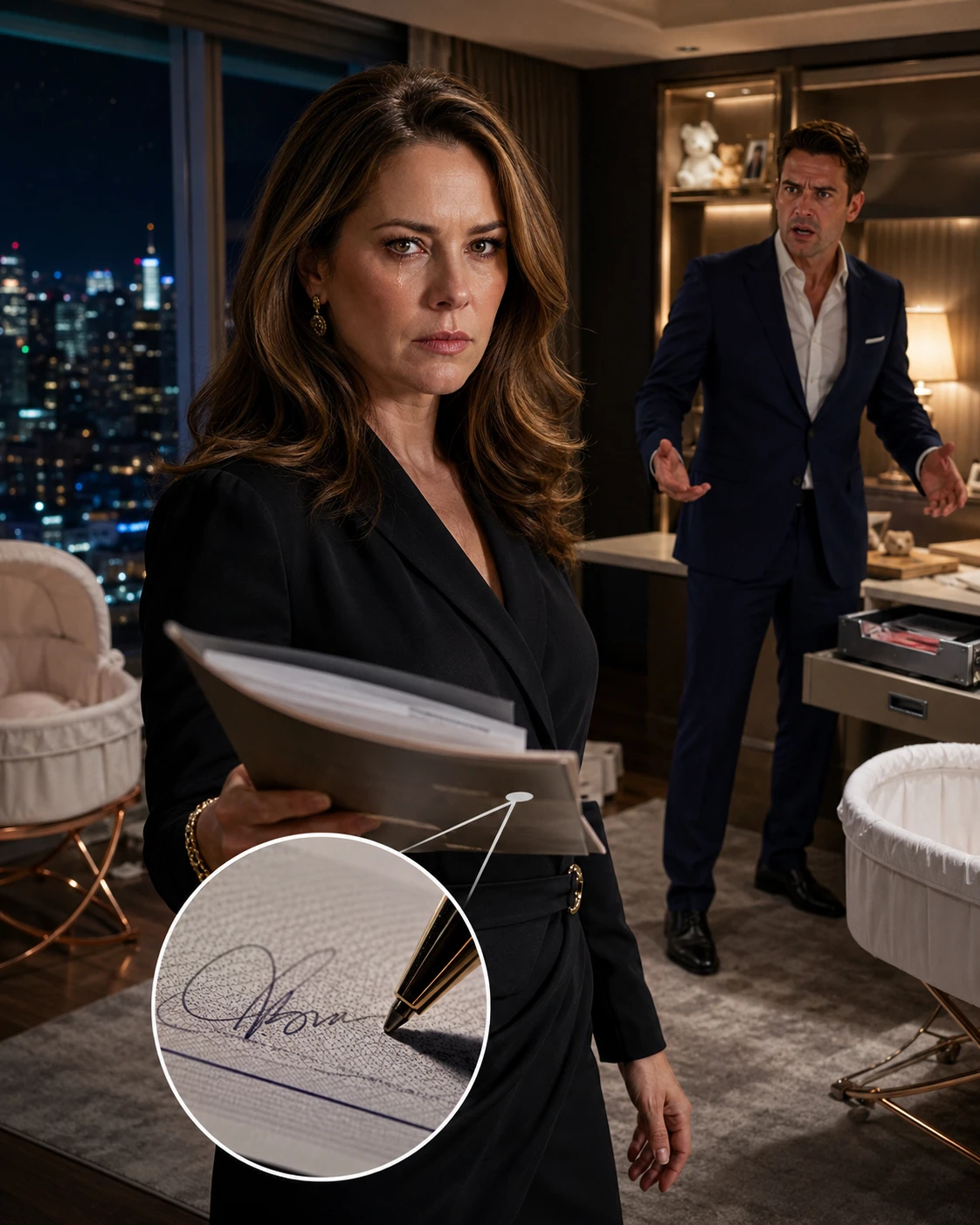
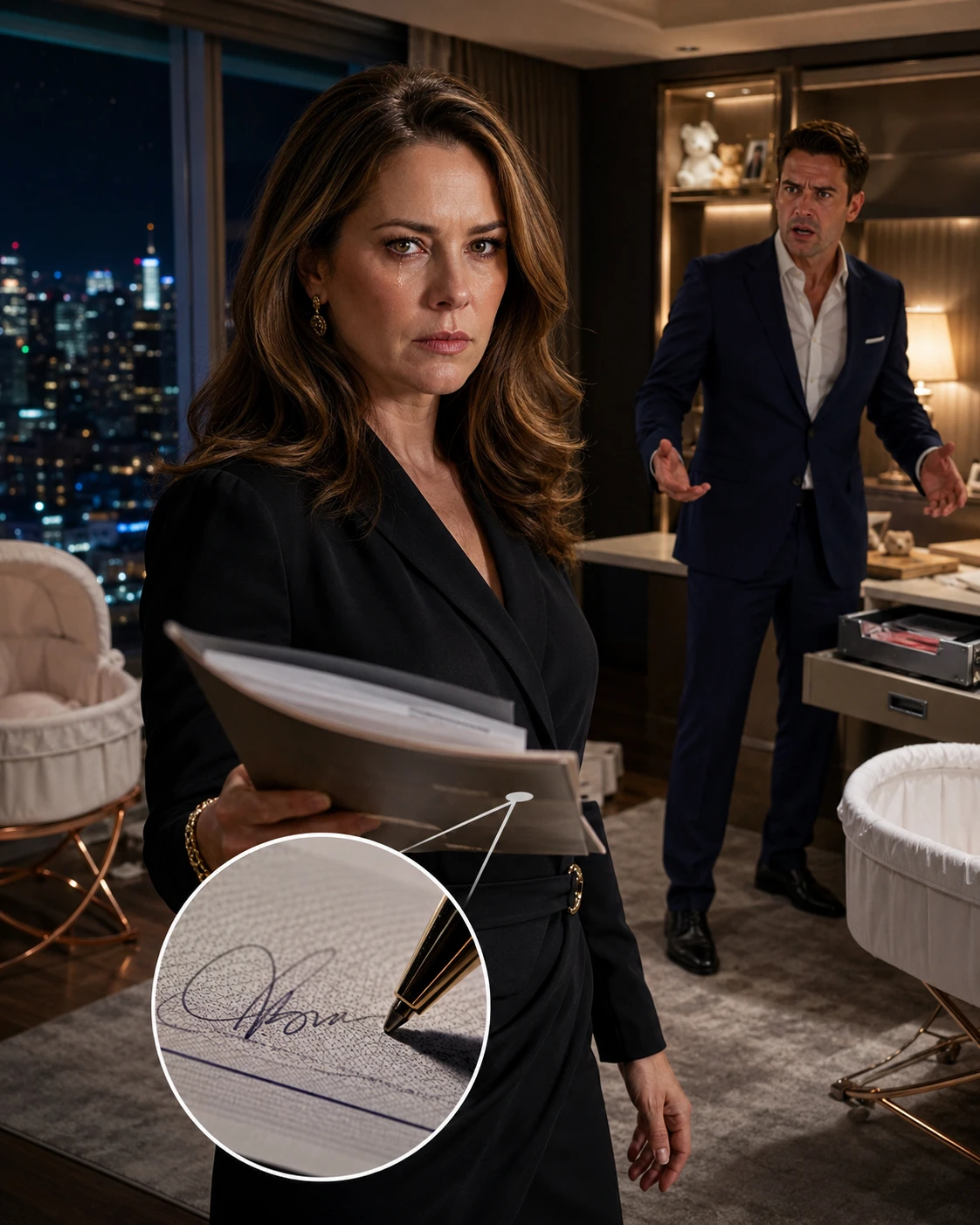
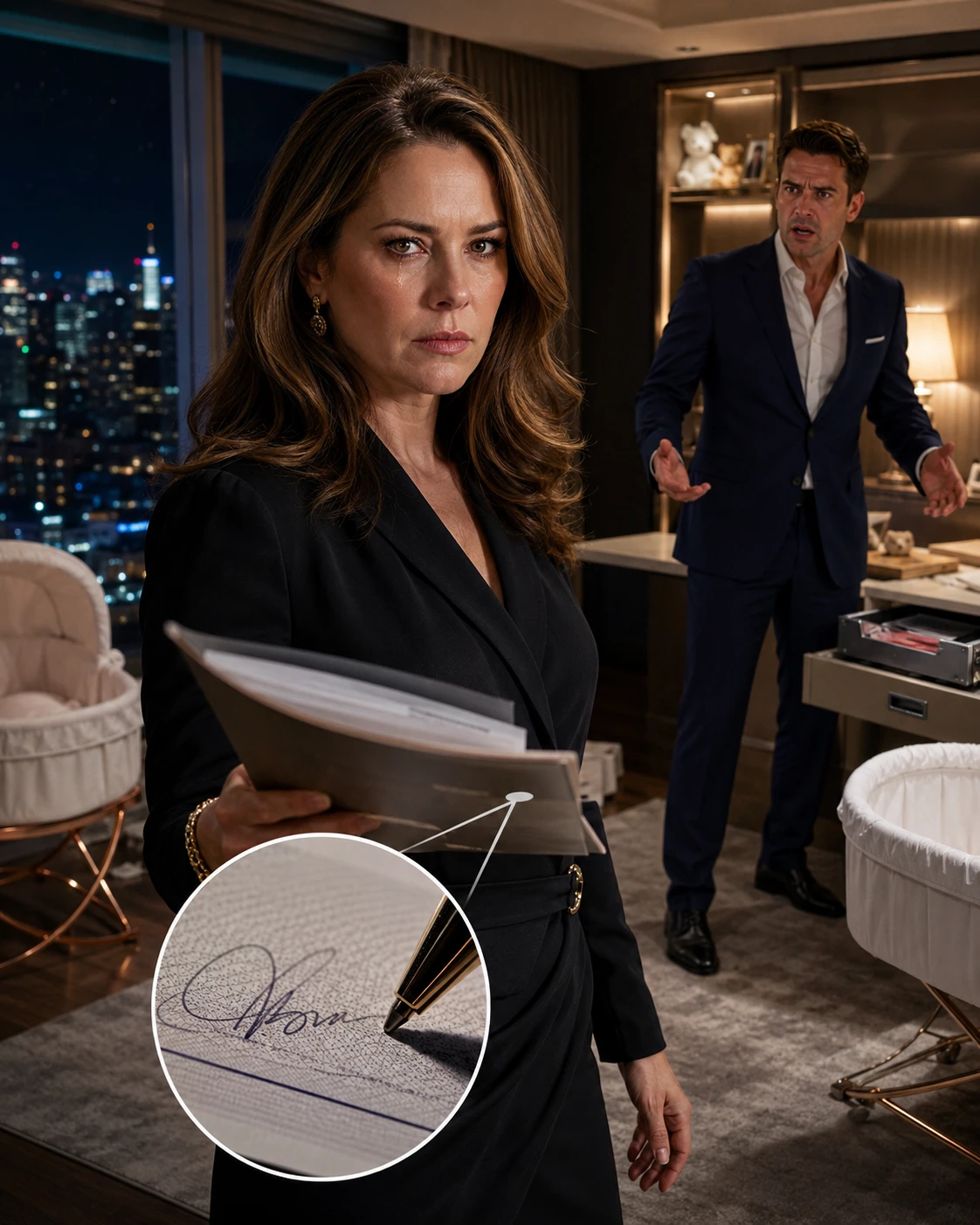
A little after midnight, Justin’s key turned in the front door.
He entered carrying his briefcase and wearing the navy suit I had bought him for our anniversary. His tie was loose. His hair was slightly disordered, and there was a faint trace of lipstick near the collar of his shirt.
He looked tired but pleased.
Then he saw the photographs.
He stopped walking.
For one brief second, the pleasant expression disappeared from his face. Something colder replaced it—not guilt, not shame, but calculation.
He lowered his briefcase to the floor.
“Where did you get those?”
I studied him.
“That is your first question?”
He glanced toward the windows as though checking whether someone might be watching from the darkness outside.
“Claire, where did you get them?”
“They arrived this afternoon.”
“From whom?”
“There was no name.”
He removed his jacket and placed it over the back of a chair. His movements were deliberate, almost ceremonial. Justin had always believed that the person who moved most slowly during a confrontation held the greater power.
I had once mistaken that habit for confidence.
Now I saw it for what it was.
Control.
He looked again at the photographs and exhaled.
“They’re mine,” he said.
My fingers rested against the polished table.
“The photographs?”
“The babies.”
The room seemed to narrow around us.
“The twins are yours?”
“A boy and a girl.”
His tone was disturbingly ordinary, as though he were describing a pair of shoes he had purchased without consulting me.
I forced myself to ask the question.
“How long have you and Rachel been together?”
“Eighteen months.”
The answer came too quickly to be an estimate.
Eighteen months meant Christmas dinners, summer barbecues, business trips, and Sunday afternoons when Rachel had stretched her bare feet across our sofa while Justin poured her a second glass of wine.
It meant the weekend Rachel claimed to be visiting her sister in Boston while Justin attended a leadership conference in Chicago.
It meant every time I had entered a room and found them laughing at something they refused to explain.
“You let me help her prepare for the babies,” I said.
Rachel had told me the father was a man she met while traveling. According to her, he had been charming, briefly attentive, and entirely uninterested in parenthood.
I had accompanied her to an ultrasound.
I had bought blankets.
I had spent an afternoon helping her choose names.
Justin walked to the sideboard and poured himself a glass of water.
“She needed support.”
“And you thought I should provide it?”
He took a slow drink.
“You always wanted children around.”
The cruelty was precise.
He had not spoken carelessly. He had selected the words because he knew exactly where they would land.
I remembered the first miscarriage, when I had sat on the bathroom floor and watched a thin red line spread through the water. Justin had found me there, wrapped a towel around my shoulders, and promised we would try again.
I remembered the second pregnancy, when he had pressed his palm to my stomach and said, “This one feels different.”
It had been different.
The grief afterward had almost ended me.
Now he stood in our dining room and used that grief as a weapon.
“Were you at the delivery?” I asked.
“Yes.”
“Did you cut the cords?”
A faint smile touched his mouth.
“Yes.”
He wanted me to scream.
He wanted accusations, broken glass, and a face distorted by pain. He wanted proof that he still controlled the emotional temperature of every room he entered.
Instead, I reached for the folder beside my elbow and slid it across the table.
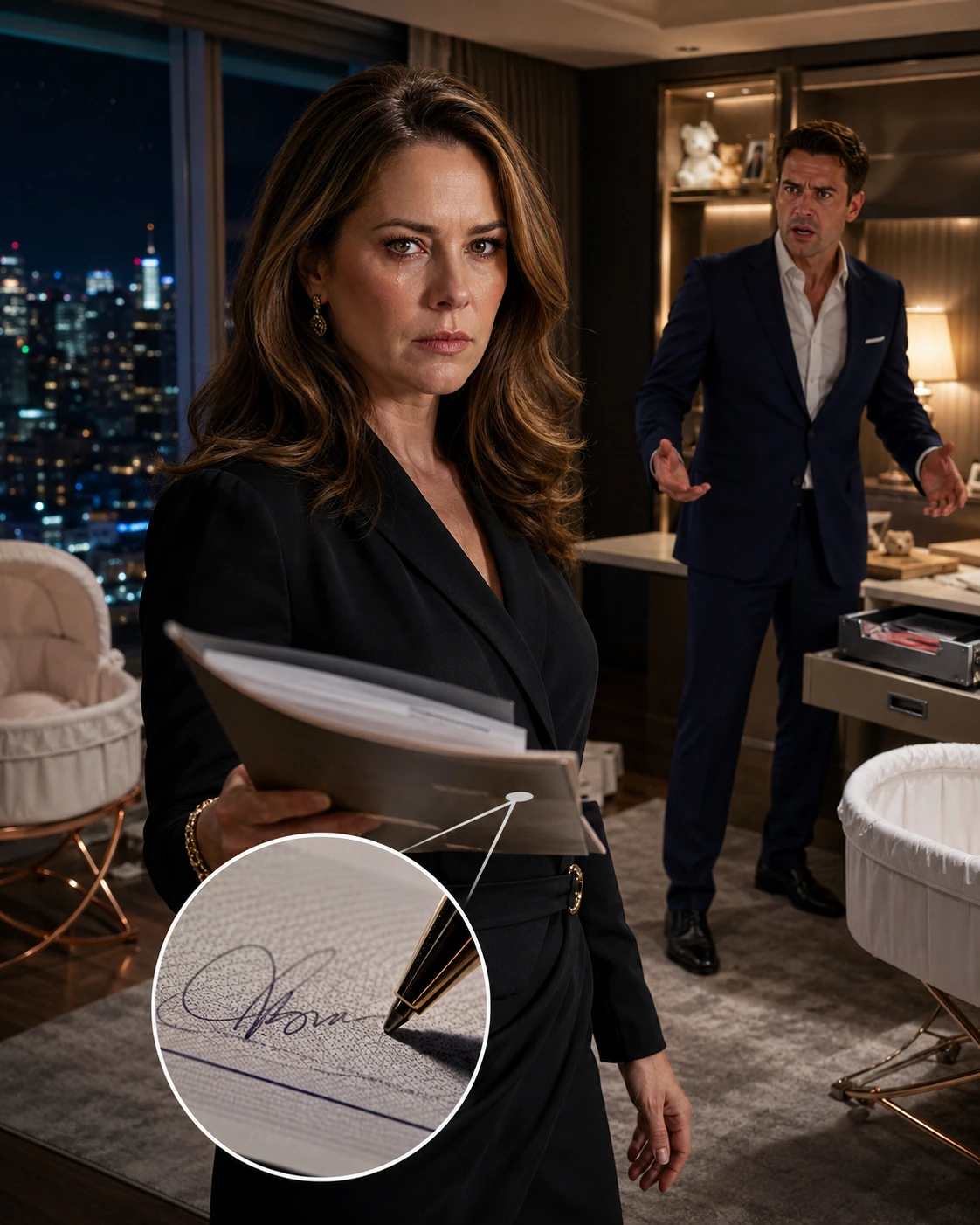
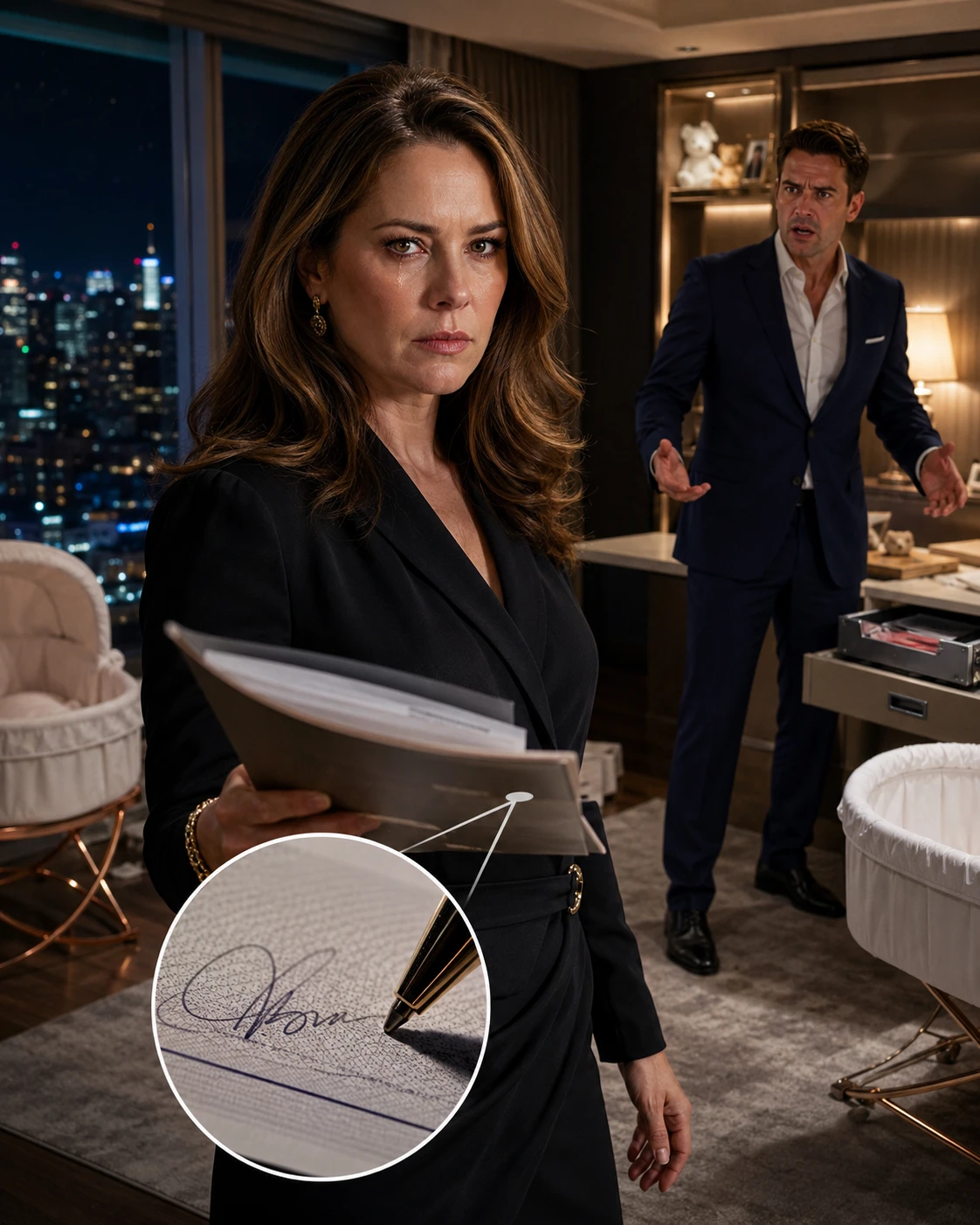
“Divorce papers,” I said. “Sign where the tabs are.”
He looked down at the folder.
Then he laughed.
“That’s all?”
“That’s all.”
“You’ve just learned that your husband has two children with your closest friend, and your response is paperwork?”
“My response is finished.”
He opened the folder and skimmed the first page.
“You cannot possibly have prepared these today.”
“I didn’t.”
His eyes lifted.
“When?”
“Three weeks ago.”
For the first time since entering the room, Justin’s composure shifted.
“What happened three weeks ago?”
“Sign the papers.”
“I asked you a question.”
“And I asked for your signature.”
He leaned back in his chair.
“You’re trying to frighten me.”
“No.”
“You think you can take the house.”
“The house was purchased through a trust established before our marriage.”
His smile remained, but the muscles around his mouth tightened.
“You think you can take the company too?”
“I founded the company six years before I met you.”
“I built it with you.”
“You worked for it.”
“I was chief operating officer.”
“You were an employee with an impressive title.”
His eyes hardened.
Justin had spent years telling friends, clients, and family members that I was the careful woman standing behind his success. He implied that I handled details while he supplied vision.
The truth was less flattering.
I had built Claire Morgan Strategic Consulting from a rented office above a dentist’s practice. I had found the first clients, negotiated the contracts, worked through weekends, and reinvested every dollar until the company employed more than two hundred people.
Justin joined after our marriage.
He was charming with clients and convincing in boardrooms. I had believed those qualities would help us grow together.
Instead, he gradually began speaking as though the business had always been his.
“You have no idea what a divorce will do to you,” he said.
“I have a reasonable idea.”
“You’ll be alone.”
“I already am.”
He stared at me for several seconds.
Then he picked up the pen.
He signed each page quickly, barely reading the language. Arrogance made him careless. He assumed the agreement could be challenged later, after he had moved into Rachel’s penthouse and presented himself publicly as the proud father of twins.
He believed the house belonged partly to him.
He believed the company would be divided.
Most of all, he believed my silence meant defeat.
**He had forgotten one important thing: careful women keep records.**
His phone rang before he finished signing.
Rachel’s name appeared on the screen.
Justin looked at me and pressed the speaker button.
Her voice drifted through the room, warm and triumphant.
“Did she make a scene?”
Justin smiled.
“Not even an interesting one.”
I closed the folder.
“Congratulations to both of you.”
Rachel became silent.
Perhaps the calmness in my voice frightened her more than anger would have.
Justin signed the final page and tossed the pen onto the table.
“You’ll regret making this so easy.”
“Perhaps.”
“I’ll send someone for the rest of my belongings.”
“You will not need to.”
He narrowed his eyes.
“What does that mean?”
“It means everything that legally belongs to you will be inventoried and delivered.”
“You cannot lock me out of my own home.”
“The house is not yours.”
“We’ll see.”
He went upstairs and returned twenty minutes later carrying two suitcases. At the door, he turned and looked at me with the expression of a man leaving an old hotel after finding a more luxurious one.
“Rachel understands me,” he said.
“No. She understands the version of you that benefits her.”
“She gave me a family.”
I held his gaze.
“Did she?”
Something flickered across his face.
Then it vanished.
He left.
I watched his car move through the gates and disappear down the road. Only after the red taillights were gone did I return to my office.
The bottom drawer of my desk opened with a brass key I kept on a chain beneath my blouse.
Inside were six months of bank statements, vendor contracts, security logs, and copies of invoices Justin had approved in his role as chief operating officer.
At first, the irregularities had seemed small.
A marketing consultation no one remembered receiving.
A vendor with no website.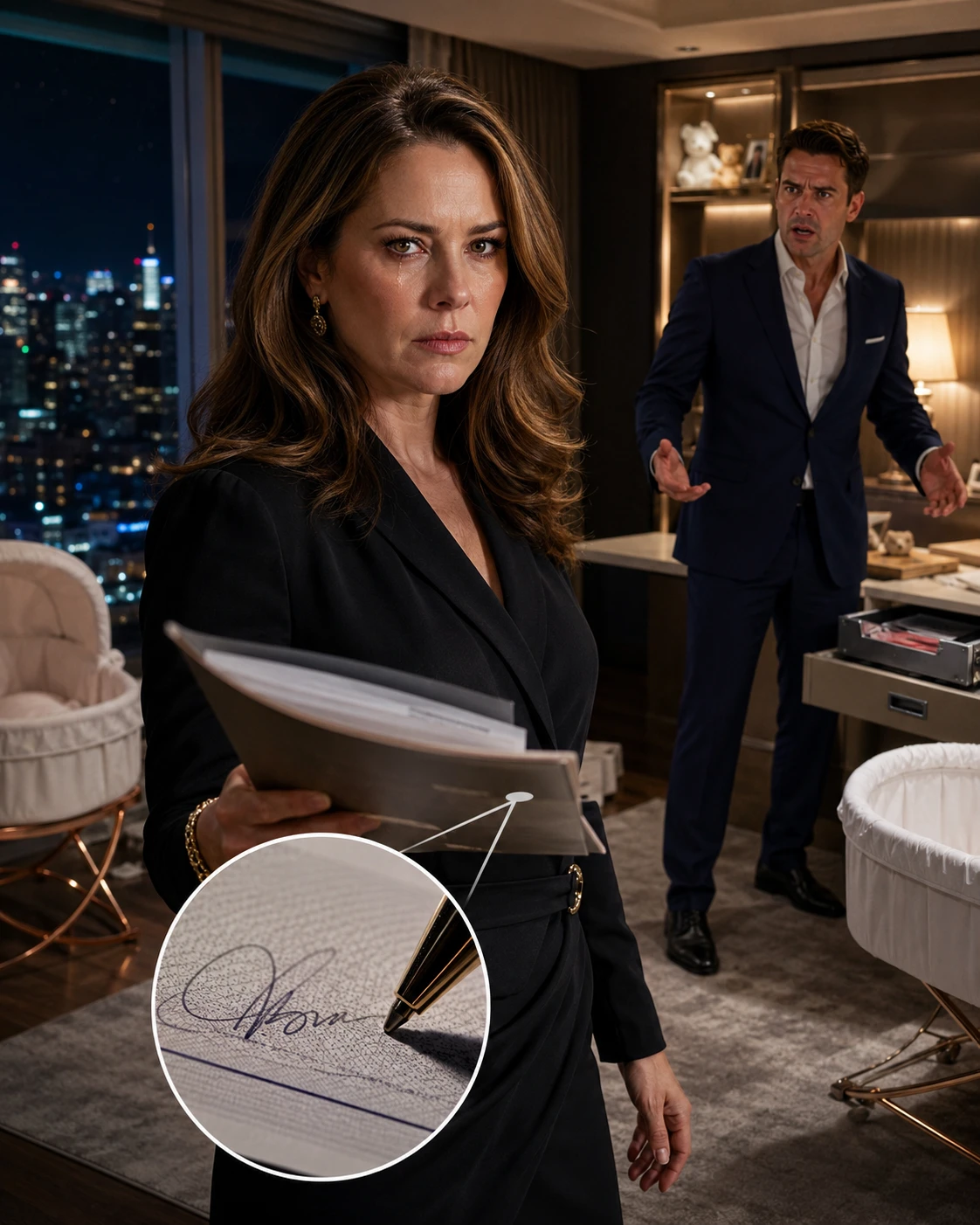
A sequence of payments approved late at night.
Then I discovered that the marketing agency was registered under the name of Rachel’s cousin, a swimming-pool contractor living in Arizona.
**Justin had funneled nearly eight hundred thousand dollars from my company through a business that did not exist.**
The money paid for Rachel’s penthouse, her private maternity clinic, the nursery furniture, and a luxury vehicle registered in her name.
But the paper beneath those records mattered more than all the others.
It was an old surgical report belonging to Justin.
The report had arrived three weeks earlier in an unmarked envelope with one trembling handwritten sentence:
**Before you confront him, you deserve to know the truth.**
The diagnosis was permanent and unambiguous.
**Irreversible non-obstructive azoospermia. No viable sperm cells present.**
Justin had been sterile since he was nineteen.
The twins could not be his.
I returned the report to the drawer and called my attorney, Naomi Bell.
Naomi had represented me for nearly fifteen years. She was sixty-one, sharp-eyed, patient, and almost impossible to intimidate.
She answered on the second ring.
“Claire?”
“File everything.”
There was a brief pause.
“The divorce and the fraud complaint?”
“Yes.”
“And the emergency preservation orders?”
“Before sunrise.”
Her voice softened.
“Are you safe?”
“I am now.”
“Do you know where Justin went?”
“To Rachel’s penthouse, unless he is more cowardly than I thought.”
“Do not contact either of them.”
“I won’t.”
“Claire, once we file, this becomes larger than a marriage.”
“I know.”
“Your employees may be questioned. Accounts will be examined. Reporters may become interested.”
“I know.”
“And if the fertility records are connected to the financial transfers, we may uncover something worse than embezzlement.”
I looked at the medical report.
“That is what I am counting on.”
For the first time that night, my hands stopped shaking.
What I did not know was that Justin never reached Rachel’s penthouse.
He drove instead to his parents’ house, where his mother, Martha, was waiting in the library.
The next morning, one of Martha’s longtime household employees called me privately.
He told me that when Justin entered the room and announced that Rachel had given him a son and daughter, Martha turned pale.
Then she asked a question that silenced him.
**“She… still hasn’t told you about that?”**
—
## **PART TWO — THE CHILDREN WHO SHOULD NOT EXIST**
By eight the following morning, emergency preservation notices had been delivered to three banks, two technology vendors, Rachel’s cousin, and the private fertility clinic that handled the pregnancy.
At nine, Justin’s access to my company systems was terminated.
At nine fifteen, he tried to enter his office and discovered that his key card no longer worked.
He called me immediately.
I let the phone ring.
His first voicemail was indignant.
“You have no authority to lock me out.”
The second was threatening.
“You are exposing the company to liability.”
The third was almost reasonable.
“Claire, we need to discuss this like adults.”
By noon, he had left eleven messages.
The last one was quieter than the others.
“You have no idea what you are doing.”
I forwarded them all to Naomi.
At two o’clock, Martha Morgan appeared at my office.
Justin’s mother had always possessed the kind of elegance that made other people lower their voices around her. At seventy-three, she wore her silver hair in a smooth twist and favored carefully tailored suits in soft shades of gray and blue.
That afternoon, however, she looked as though she had not slept.
Her face was pale. Her lipstick had faded, and she clutched her handbag against her body with both hands.
“May I come in?” she asked.
I closed the door behind her.
Martha sat across from my desk but did not remove her coat.
For a long moment, neither of us spoke.
Finally, I placed the surgical report between us.
“You sent this.”
She looked at the paper.
“Yes.”
“Why anonymously?”
“Because I was ashamed.”
“Of your son?”
Her eyes lifted to mine.
“Of myself.”
I waited.
Martha’s fingers tightened around the leather handles of her handbag.
“When Justin was nineteen, he developed a severe infection. The doctors discovered the condition during his treatment. They told us he would never father a child naturally.”
“He told me he had a low sperm count.”
“He lied.”
“He said the fertility clinic retrieved viable cells through a surgical procedure.”
Another shadow crossed her face.
“That was also a lie.”
Seven years earlier, Justin and I had entered fertility treatment after several unsuccessful years of trying to conceive. He handled most of the consultations concerning his own health, saying the subject humiliated him.
I had respected his privacy.
The clinic created six embryos.
Two were transferred during my first treatment.
The pregnancy ended at nine weeks.
Two more were transferred the following year.
That pregnancy ended at eleven weeks.
After the second miscarriage, I told Justin I could not continue.
The injections, examinations, waiting rooms, and cautious hope had consumed me. Every morning I woke afraid of losing what I had not yet had time to love.
Justin told me the two remaining embryos had become nonviable and were destroyed.
I believed him because he was my husband.
“Whose genetic material was used?” I asked.
Martha looked toward the window.
“I do not know.”
“You expect me to believe that?”
“I knew Justin could not be the biological father. I did not know who the donor was.”
“Did Justin know?”
“Yes.”
The answer struck harder than I expected.
I rose and walked to the window.
Below us, people crossed the street carrying coffee and shopping bags. A delivery truck stopped beside the curb. The world continued with an indifference that felt almost insulting.
Behind me, Martha spoke softly.
“I should have told you before the wedding.”
“Yes.”
“I convinced myself it was his responsibility.”
“He made it mine.”
“I know.”
“No, Martha. I do not think you do.”
She flinched.
I turned to face her.
“What happened last night?”
Her eyes sharpened.
“What do you mean?”
“When Justin arrived at your house, you asked whether Rachel had told him something. What was she supposed to tell him?”
Martha stared at me.
“One of your employees heard you,” I said. “Justin called him this morning and ordered him to remain silent.”
A tired laugh escaped her.
“My son has always believed loyalty can be purchased.”
“What did Rachel know?”
Martha opened her handbag.
“Rachel came to my house before Justin arrived. She was frightened. The hospital’s legal administrator had contacted her regarding irregularities in the twins’ reproductive records.”
“What irregularities?”
“The embryos had been transferred from a storage account belonging to another patient.”
My breath caught.
“Which patient?”
“The clinic would not disclose the name. They said the record had been sealed by an emergency order.”
Naomi’s order.
“Rachel asked whether Justin had ever told me where the embryos came from,” Martha continued. “That was when I told her about his sterility.”
“She did not know?”
“No.”
Rachel had knowingly slept with my husband. She had accepted money stolen from my company. She had allowed me to decorate a nursery while secretly planning to raise children with him.
But apparently, Justin had deceived her too.
“What did she say?”
“She said Justin told her he had frozen biological material before his illness.”
“That is impossible.”
“I told her so.”
“And she left?”
“Yes.”
“Without warning him?”
“I believe she wanted to confront him privately.”
Martha removed a folded sheet of paper from her handbag and placed it on the desk.
It was a copy of a fertility-clinic storage notice dated seven years earlier.
My name appeared at the top.
Below it were six embryo identification numbers.
Two were marked transferred.
Two were marked nonviable.
The final two carried a more recent notation.
**Released to authorized gestational recipient.**
The release date was ten months earlier.
I read the line again.
Then a third time.
“No.”
Martha began to cry.
“I am sorry.”
“Those embryos were mine.”
“Yes.”
“My eggs were used.”
“Yes.”
“Who was the gestational recipient?”
She did not answer.
She did not need to.
Rachel’s twins had been born less than a week earlier.
My knees weakened, and I sat.
The room seemed to tilt.
Those babies might not merely be the result of an affair.
**They might be the children created from my body—the children I had been told no longer existed.**
“Where did you get this?” I asked.
“The clinic mailed a copy to our family address because Justin used it when he opened the private storage account.”
“Why would he use your address?”
“To keep the records away from you.”
“And you never opened the mail?”
“I did not see it until last month.”
I looked at her carefully.
“Last month?”
“Yes.”
“Yet you waited three weeks to send me the report.”
“I needed to be certain.”
“Of what?”
Her answer came slowly.
“That Justin was involved.”
My office telephone rang.
Naomi’s name appeared on the screen.
I answered.
“We received the clinic’s preliminary response,” she said. “Claire, I need you to remain calm.”
“I am calm.”
“No, you are not.”
She was right.
“What did they find?”
“The authorization transferring the embryos carries your electronic signature.”
“I never signed it.”
“I know.”
“How?”
“Because the form was submitted from Justin’s office computer at 2:14 in the morning while you were attending a conference in Denver.”
Martha closed her eyes.
“Is there video?” I asked.
“The clinic retained security footage for only ninety days. However, they have access logs and biometric records.”
“Whose biometric approval?”
“That part has been corrupted.”
“Convenient.”
“Very.”
I looked at the storage notice again.
“Naomi, order genetic testing.”
“We are already preparing the motion.”
“For the twins, Justin, Rachel, and me.”
There was a pause.
“You understand what the testing may show?”
“I understand what it must show.”
Martha reached across the desk and touched my hand.
I pulled away.
“And Naomi?”
“Yes?”
“Find out whose genetic material was used to create the embryos.”
“We will.”
“Do not assume the clinic will cooperate.”
“I never assume cooperation from people who have already forged a signature.”
After the call, Martha sat silently.
I watched her.
“You know more.”
“No.”
“You knew Justin was sterile. You knew the clinic account existed. You received notices at your house. You mailed me the report just before the twins were born.”
“I told you what I know.”
“That is not the same as telling me everything.”
She stood.
“I understand why you do not trust me.”
“Do you?”
“I protected my son when I should have protected you.”
“You are still protecting him.”
Her face tightened.
“No.”
“Then tell me who sent the photographs.”
“I do not know.”
“Tell me why Rachel came to you instead of a lawyer.”
“She was afraid.”
“Of Justin?”
Martha hesitated for half a second.
It was enough.
“Is she afraid of him?”
“Justin does not respond well when he loses control.”
“That is not an answer.”
“It is the only one I can give you.”
She walked toward the door.
“Martha.”
She stopped.
“Did you ever see the twins?”
Her shoulders lowered.
“Yes.”
“When?”
“At the hospital.”
“Before or after you sent me the medical report?”
She did not turn around.
“After.”
“What did you feel when you saw them?”
Her voice became almost inaudible.
“Grief.”
Not joy.
Not surprise.
Grief.
Then she left.
That evening, Rachel called me.
I watched her name appear on the screen and considered ignoring it.
Instead, I answered.
“Claire?”
Her voice was thin and uncertain.
“You have thirty seconds.”
“I did not know the embryos were yours.”
“You knew the husband was mine.”
“I know.”
“You accepted stolen money.”
“Justin said it came from investments.”
“You were listed as a consultant for a company that did not exist.”
“My cousin handled the paperwork.”
“Your cousin repairs swimming pools.”
Silence.
“The babies are innocent,” she whispered.
Something inside me cracked.
“I know.”
“They need stability.”
“I know.”
“I carried them.”
“And I may have created them.”
She began crying.
For years, Rachel’s tears had moved me. I had canceled appointments, crossed cities, and sat beside her after breakups that lasted less time than the comfort she demanded afterward.
Now I listened without speaking.
Finally she said, “Come to the penthouse.”
“Why?”
“Justin left documents here.”
“What documents?”
“I do not know. He keeps them locked in his desk.”
“You expect me to believe that?”
“No,” she said. “But I need you to come anyway.”
“Why?”
Her breath trembled through the phone.
“Because he is on his way back, and I am afraid of what he will do when he discovers I called you.”
—
## **PART THREE — THE PENTHOUSE**
Naomi told me not to go.
Then she sent two investigators with me because she knew I would go anyway.
Rachel’s penthouse occupied the top floor of a new building overlooking the river. Justin had approved the lease through the fake marketing agency, describing it on company invoices as a “regional executive hospitality suite.”
The lobby smelled of polished stone and fresh flowers.
One investigator remained downstairs. The other, a retired police detective named Samuel Ortiz, rode the elevator with me.
“You do not enter any room alone,” he said.
“I understand.”
“You do not touch documents until I photograph them.”
“I understand.”
“And if Mr. Morgan becomes aggressive—”
“I leave.”
Ortiz studied me.
“You do not look like someone planning to leave.”
“I spent twelve years leaving rooms quietly whenever Justin raised his voice. I am done making his comfort my first concern.”
“That is not what I meant.”
“I know.”
The penthouse door opened before I knocked.
Rachel stood in the entrance wearing a pale blue robe. Her auburn hair was tied loosely at her neck, and dark circles shadowed her eyes.
She looked smaller than I remembered.
Perhaps betrayal always makes people appear diminished once admiration is removed.
“Come in,” she said.
I entered.
Everything inside had been purchased with my money.
The cream-colored sofa appeared on an invoice for “executive reception furniture.” The dining chairs had been listed as “client hospitality assets.” Even the abstract painting in the foyer had been billed to my company.
I recognized the nursery lamps because I had chosen them myself.
Two bassinets stood near the windows.
The babies were asleep.
I stopped walking.
The boy had dark hair and one small fist pressed beneath his chin. The girl’s face was turned toward him as though she had been searching for him in her sleep.
An ache moved through me so suddenly that I gripped the back of a chair.
Rachel noticed.
“I named them Noah and Grace.”
“You told me you were considering those names.”
“I was.”
“Noah was my father’s name.”
“I know.”
“Grace was my mother’s middle name.”
Her eyes lowered.
“I know.”
The cruelty of that choice was different from Justin’s. His had been calculated to wound.
Rachel’s seemed born from envy—the desire not merely to take my future but to decorate it with pieces of my past.
“You took my husband, my money, my embryos, and my parents’ names.”
“I did not know about the embryos.”
“But you knew about the names.”
“Yes.”
“Why?”
She sat on the sofa.
“For the same reason I did everything else.”
“Which was?”
“Because every time I looked at you, I saw everything I had failed to become.”
I stared at her.
“You had a career.”
“A job.”
“You had friends.”
“Your friends.”
“You had your own life.”
“No. I had a collection of rooms where other people allowed me to stay.”
“That is not true.”
“It felt true.”
Rachel pressed her hands together.
“You built a company from nothing. You bought your own home. People listened when you spoke. Even after the miscarriages, you walked into rooms and carried yourself as though no one could see the wound.”
“You saw it.”
“Yes.”
“And you still did this.”
Her face crumpled.
“I hated you for surviving better than I survived ordinary life.”
The honesty was almost more painful than a lie.
“Justin told me your marriage had become a business arrangement,” she continued. “He said you did not touch him. He said you cared more about contracts than people.”
“And you believed him?”
“I wanted to.”
“Did he tell you I was attending therapy because I blamed myself for losing the pregnancies?”
“No.”
“Did he tell you he refused counseling?”
“No.”
“Did he tell you that the night before he first slept with you, he kissed me in our kitchen and said we would grow old together?”
She began to cry.
“No.”
“He did.”
The boy stirred in his bassinet.
Rachel immediately rose and lifted him carefully.
Her movements were practiced. She supported his head, held him close, and whispered until he settled.
Whatever else was true, she loved him.
That made the situation more complicated, not less.
“Where are the documents?” Ortiz asked.
Rachel nodded toward the hallway.
“In Justin’s desk.”
“Is the room locked?”
“Yes.”
“Do you have a key?”
“No.”
Ortiz photographed the door and examined the lock.
“Ms. Cole, do you have written permission from the tenant to access the room?”
“I am the tenant.”
“Then you can authorize entry.”
She nodded.
As Ortiz began working on the lock, I remained beside the bassinets.
Grace opened her eyes.
They were dark and unfocused, the eyes of a newborn still learning the difference between light and shadow.
I had imagined motherhood for so long that the reality of a child had become almost mythical. Yet she was not an idea. She was a breathing person with a tiny crease between her brows.
My daughter, perhaps.
Or perhaps not.
I reached toward her but stopped before touching the blanket.
Rachel watched me.
“You can hold her.”
“I am not asking your permission.”
The words came out colder than I intended.
She flinched.
Before either of us could speak again, the front door opened.
Justin entered.
He saw Ortiz kneeling near the office door.
His face transformed.
“What is he doing here?”
Ortiz stood.
“Document preservation.”
“Get out of my home.”
“This residence is leased to Ms. Cole.”
“I pay for it.”
“With money stolen from my company,” I said.
Justin turned toward me.
“What did you tell her?”
“The truth,” Rachel said.
He looked at her as though she were a disobedient employee.
“What truth?”
“That you are sterile.”
The room became silent.
Justin’s jaw tightened.
“Who told you that?”
“Your mother.”
His expression changed again.
Martha’s betrayal affected him more deeply than mine.
“How much else did she tell you?”
Rachel shifted Noah against her shoulder.
“She said the embryos were not yours.”
“They were donated.”
“From Claire’s storage account.”
“That was a clerical error.”
“The identification numbers match.”
“Numbers are copied incorrectly every day.”
“The authorization was submitted from your computer,” I said.
He looked at me.
“You gave me authority to manage the account.”
“I never gave you permission to transfer my embryos.”
“You signed the form.”
“No. You forged it.”
He took one step toward me.
Ortiz moved between us.
Justin stopped.
“You think a blood test will make those children yours?” he asked.
“I do not know what the test will show.”
“I do.”
The certainty in his voice chilled me.
“You know who the biological parents are?”
He smiled.
“The embryos came from an anonymous donor program.”
“They were created from my eggs.”
“You cannot prove that.”
“The clinic retained tissue samples from the original cycle.”
The smile vanished.
Ortiz had not told me that.
He glanced toward me briefly. The statement had been a test.
Justin’s reaction provided the answer.
Rachel saw it too.
“You told me there were no samples,” she said.
He ignored her.
“You told me no one could trace them.”
“Be quiet, Rachel.”
Her face changed.
It was the first time I had seen her look at him without admiration.
“No.”
The word was quiet.
Justin turned slowly.
“What did you say?”
“I said no.”
He stepped toward her.
Noah began to cry.
Justin stopped, not because the baby was frightened, but because Ortiz had placed one hand near his phone.
Rachel held Noah closer.
“You said the biological mother abandoned the embryos,” she said. “You said she signed away all rights.”
“She did.”
“I did not,” I said.
Justin looked at me.
“You stopped treatment. You told the clinic you never wanted to hear about the embryos again.”
“I said I could not continue trying to become pregnant.”
“You walked away.”
“From treatment. Not from my own genetic children.”
He laughed once.
“You always needed language to make your failures sound principled.”
The words struck an old wound.
For a second, I was back in the hospital after the second miscarriage, watching Justin stand near the window while a physician explained that sometimes there was no identifiable reason.
That night, Justin had said, “Maybe your body is trying to tell us something.”
I had carried that sentence for years.
Now I understood why.
He had needed me to believe the losses belonged only to me.
“I did not fail,” I said.
He stared at me.
“I trusted you. That was my mistake.”
Ortiz opened the office door.
Inside, the desk drawers had already been emptied.
Justin’s shoulders relaxed slightly.
But Ortiz crossed to a locked cabinet built into the wall.
“Ms. Cole, do you authorize access?”
“Yes.”
Justin moved.
“Rachel, do not.”
She looked at him.
“Why?”
“Because those are private business records.”
“Whose business?”
He did not answer.
Ortiz photographed the cabinet and used a small tool to open it.
Inside were folders, encrypted storage drives, and a black ledger.
Justin turned toward the front door.
The second investigator appeared in the entrance.
“No one leaves until counsel arrives,” he said.
“You cannot detain me,” Justin replied.
“No. But the officers in the elevator can.”
Justin looked at me with pure hatred.
“This is what you wanted?”
“No.”
“You wanted to humiliate me.”
“I wanted the truth.”
“You have no idea what the truth costs.”
Rachel was still holding Noah.
Grace began crying from the bassinet.
Rachel looked toward her.
Justin looked toward the open cabinet.
That difference told me more than any confession could have.
**Rachel saw two frightened babies. Justin saw evidence.**
Ortiz removed a clinic folder and handed it to me after photographing the cover.
Inside was an embryo-transfer authorization bearing my forged signature.
There was also a copy of the original fertilization report.
My name appeared under genetic mother.
The donor’s identity was represented by a code.
AM-1977.
Below it, a handwritten note read:
**Family-directed donor. Confidential at recipient’s request.**
My hands began trembling.
“Who is AM?” I asked.
Justin said nothing.
Rachel looked at him.
“Who is the father?”
“They do not have a father,” he said. “They have me.”
“No,” I replied. “They have a man who stole them.”
The court ordered emergency genetic testing the next morning.
Justin’s lawyers fought the order, claiming I was using the children to punish him for adultery. They described me as emotionally unstable, obsessed with motherhood, and unable to accept the end of my marriage.
Naomi read the filing aloud in her office.
When she finished, she removed her glasses.
“He is trying to turn your grief into evidence against you.”
“He has done that for years.”
“Tell me.”
I looked toward the window.
“Whenever I disagreed with him, he said the miscarriages made me emotional. Whenever I remembered something differently, he said grief affected my memory. He began handling financial matters because he claimed stress was unhealthy for me.”
Naomi’s expression hardened.
“That is not care.”
“I know that now.”
The genetic results arrived six days later.
Naomi called me to her office but refused to discuss them over the telephone.
Martha was already there when I entered.
The report lay unopened on the conference table.
“You asked her to come?” I said.
“No,” Naomi replied. “She insisted.”
Martha looked at the envelope with an expression I could not read.
I sat.
Naomi opened the report.
The paper made a soft sound as she unfolded it.
Her eyes moved down the page.
Then she looked at me.
“The results are conclusive.”
I could hear my heartbeat.
“Tell me.”
“You are the biological mother of both children.”
The room disappeared for a moment.
I pressed one hand against the table.
Noah and Grace were mine.
My eggs.
My genetic children.
The children I had mourned without knowing they were alive.
I covered my mouth.
Martha began crying.
Naomi continued carefully.
“Justin has no biological relationship to either twin as a father.”
I looked at Martha.
She was staring at the report.
“There is more,” Naomi said.
The paternal DNA matched a sealed genetic profile connected to the Morgan family.
The donor was not anonymous.
The court had authorized the clinic to release the name.
Naomi turned the page.
“His name was Aaron Morgan.”
Justin’s younger brother.
The brother who had died five years earlier.
Martha closed her eyes.
I remembered Aaron as a gentle man with untidy brown hair and a habit of listening more than he spoke. He had taught music at a public high school and avoided the family business whenever possible.
At his funeral, Justin had delivered a polished speech about loyalty between brothers.
Now I understood that Aaron had given us more than loyalty.
**He had unknowingly given Justin the means to steal my children.**
—
## **PART FOUR — A FAMILY BUILT ON LIES**
Martha asked us to meet at her house the following morning.
The Morgan home stood behind old oak trees on twelve acres of land. Justin had grown up there, though he rarely spoke of his childhood except to mention the advantages it had given him.
Martha led Naomi and me into the library.
A portrait of her late husband hung above the fireplace. Aaron’s photograph stood on a side table, showing him at twenty-five with a guitar in his hands and an uncertain smile.
Martha opened a wall safe and removed a cream-colored envelope.
My name was written across the front.
“Aaron gave this to me before he died,” she said.
I looked at her.
“You have had a letter addressed to me for five years?”
“He made me promise not to give it to you unless the embryos were ever used.”
“You knew about the embryos.”
Her face tightened.
“I knew Aaron had donated biological material.”
“Why?”
“Justin approached him privately during your first fertility treatment. He said the two of you wanted a donor from within the family.”
“I never agreed to that.”
“I know.”
“Did Aaron believe I had?”
“Yes.”
The betrayal deepened.
Justin had allowed me to believe that he was the biological father of the embryos transferred into my body. He had watched me speak to them before each procedure. He had held my hand while we waited for pregnancy results.
All the while, he knew they had been created with his brother’s donation.
“Why would Aaron agree?” I asked.
“He cared for you.”
The words startled me.
“As a sister-in-law?”
Martha looked toward his photograph.
“At first.”
Naomi remained silent.
Martha continued.
“Aaron admired you before you married Justin. He never acted on it. He believed Justin loved you and that you loved Justin.”
I remembered conversations with Aaron at family dinners. He had always asked about my work, not merely whether it was successful but whether it still interested me.
Once, after Justin interrupted me repeatedly during dinner, Aaron had quietly said, “I would like to hear Claire finish.”
I had forgotten that moment.
Now it returned with painful clarity.
“He donated because he believed I consented?”
“Yes. Justin told him you wanted a child genetically connected to the family but were too embarrassed to discuss the arrangement directly.”
I opened the envelope.
Inside was a handwritten letter.
Claire,
I hope you never have reason to read this.
Justin told me that you knew about the donation and wanted the children to remain connected to the Morgan family. I believed him because I wanted to believe my brother was asking me for something honest.
Later, I became uncertain.
The embryos were created from your body. Whatever happens, they belong to your choices—not mine, not Justin’s, and not this family’s expectations.
If he ever uses them without your permission, please know that I did not agree to it. I gave the sample because I thought I was helping you become a mother.
I am sorry if I helped him deceive you.
Aaron
I read the final sentence repeatedly.
Martha placed another document beside the letter.
It was Aaron’s donor directive.
The language was explicit.
**No embryo created from this donation may be transferred to any person other than Claire Morgan without her written consent, witnessed by independent legal counsel.**
Justin could not have misunderstood it.
He had violated it deliberately.
“Why did Aaron become suspicious?” Naomi asked.
Martha sat near the fireplace.
“Because he discovered Justin was stealing from the family company.”
The room became very still.
“Aaron found unauthorized payments and forged vendor agreements. He believed Justin had taken more than two million dollars over several years.”
“Did he report it?” I asked.
“No.”
“Why?”
“Because I begged him not to.”
Her voice broke.
“I told him scandal would destroy his father. I told him Justin would repay the money. I said families should resolve their problems privately.”
“And did Justin repay it?”
“No.”
“Did Aaron confront him?”
“Yes.”
“When?”
“Two weeks before the accident.”
Aaron had died when a truck crossed the center line during a winter storm.
The police ruled it an accident.
I looked toward Naomi.
She understood the question before I asked it.
“Was the driver investigated?”
“Yes,” Martha said quickly. “He had been drinking. He went to prison.”
“Did Justin have any connection to him?”
“Not that I know.”
Not that she knew.
It was not an answer that brought comfort.
Martha removed a small digital recorder from the safe.
“Justin came here two nights ago,” she said. “He demanded that I confirm publicly that the twins were his biological children.”
“What did you tell him?”
“I told him I knew they were Aaron’s.”
“What did he say?”
She placed the recorder on the table.
“Listen.”
Naomi pressed the button.
Justin’s voice filled the library.
“Aaron is dead. Claire signed away the embryos. Rachel gave birth. I am the legal father. No one can change that now.”
Martha’s recorded voice answered.
“Claire did not sign anything.”
“She will never prove it.”
“The clinic has records.”
“Then the clinic will lose them.”
Naomi paused the recording.
“That is obstruction.”
“There is more,” Martha said.
The recording resumed.
“If Claire continues,” Justin said, “I will make certain she loses the company before this reaches court. Rachel will testify that Claire knew about the pregnancy and approved the arrangement. The doctors will say Claire became unstable after the miscarriages.”
“And the babies?” Martha asked.
“They are leverage.”
My stomach turned.
Rachel was not his new family.
Noah and Grace were not his miracle.
**They were leverage.**
Naomi stopped the recording.
“What did he expect to gain?” she asked.
Martha looked toward the portrait above the fireplace.
“My husband created a family trust. A portion passes to every biological grandchild born within the Morgan line.”
“How much?” Naomi asked.
“Approximately six million dollars per child.”
Twelve million dollars.
Justin had not risked prison because he wanted to become a father.
He had used Aaron’s biological material because the twins would be genetically connected to the Morgan family. He planned to present himself as their father and obtain access to their trust as legal guardian.
He had selected Rachel because she was emotionally dependent on him.
He had stolen from my company to finance the pregnancy.
He had forged my consent because the embryos already existed.
Everything had been calculated.
Or so it appeared.
The criminal investigation expanded quickly.
Rachel agreed to cooperate after prosecutors showed her the evidence found inside Justin’s cabinet.
She arrived at Naomi’s office without makeup, wearing a plain black coat. For the first time since I had known her, she seemed uninterested in being admired.
“I want to help,” she said.
“You want a reduced sentence,” Naomi replied.
“Yes.”
The honesty surprised me.
Rachel unlocked Justin’s encrypted storage drive.
Inside were spreadsheets forecasting the twins’ trust payments, draft custody documents, offshore bank instructions, and a press release announcing the arrival of “Justin Morgan’s biological heirs.”
There was also a memorandum describing Rachel.
**Cooperative until legal parentage is secured. Replaceable afterward.**
Rachel read that sentence in silence.
Then she stood and walked to the window.
“He said we would marry.”
Naomi did not soften.
“He also described you as a temporary risk.”
Rachel pressed one hand against the glass.
“I destroyed my life for him.”
“No,” I said. “You damaged your life because you wanted mine.”
She turned.
“You are right.”
It was the first time she had said those words without explanation.
“There is something else,” she said.
She opened a folder she had brought with her.
During the fifth month of pregnancy, Rachel had received an automated clinic message mentioning my patient identification number.
She confronted Justin.
He admitted that the embryos had originally belonged to me but claimed I had legally donated them.
“You knew before the babies were born,” I said.
Her eyes filled.
“Yes.”
“You knew when I helped decorate the nursery.”
“Yes.”
“You knew when I felt Grace move.”
Rachel covered her mouth.
“Yes.”
The memory returned with unbearable sharpness.
I had been sitting beside her on the sofa, one hand resting lightly against her stomach. Grace kicked beneath my palm.
Rachel had laughed and said, “She likes you.”
All the while, she had known.
“Why didn’t you tell me?”
“I was afraid you would stop the pregnancy.”
“I would have protected my children.”
“I thought you would take them.”
“They were not yours to take first.”
“I carried them.”
“And I created them.”
“I loved them.”
“So did I, before I ever saw them.”
Rachel began crying.
Naomi allowed the silence to continue.
Eventually Rachel whispered, “Justin said if I told you, he would leave me with nothing.”
“And that frightened you more than betraying me?”
“Yes.”
The answer was ugly but clean.
She had chosen herself.
The investigation uncovered another horror.
Six months before the twin pregnancy, Justin had submitted a transfer request involving the same embryos to a different gestational carrier. The procedure had been canceled after the woman failed a medical screening.
He had been trying to use the embryos longer than anyone realized.
Then investigators found a private email from Justin to a clinic administrator dated shortly after my second miscarriage.
The subject line read:
**Close the patient emotionally.**
The message said:
Claire must believe there is no viable material remaining. She will continue asking questions otherwise.
I read the sentence until the words blurred.
Justin had not merely lied years later.
He had decided, while I was grieving, that I should be prevented from knowing my embryos still existed.
Another record showed that I had requested a meeting with the clinic’s laboratory director three weeks after the miscarriage.
The appointment was canceled from Justin’s email account.
He told the clinic I was psychologically fragile and that all communication should pass through him.
At home, he told me the laboratory director had nothing more to explain.
**While I mourned the children I believed I would never have, Justin was preserving them for his own future use.**
He was arrested on a Thursday afternoon outside his attorney’s office.
News cameras recorded him stepping into a federal vehicle. He did not look ashamed.
He looked offended.
The charges included wire fraud, embezzlement, forgery, identity theft, conspiracy, obstruction, and unlawful reproductive-material transfer.
Rachel was charged as a co-conspirator.
The clinic administrator was arrested the next day.
Dr. Samuel Cole—Rachel’s father and a former financial partner in the clinic—was taken into custody shortly afterward.
The revelation stunned Rachel.
She had always claimed her father retired before my treatment began.
In truth, he had remained a silent investor and retained access to administrative systems.
He had approved the forged transfer.
Faced with prison, Dr. Cole confessed.
Justin paid him to conceal Aaron’s identity during the original fertility cycle. Years later, he paid him again to reactivate the storage account and transfer the embryos to Rachel.
But Dr. Cole’s confession introduced an inconsistency.
He insisted Justin had not developed the plan to use Rachel.
“That came from someone else,” he said.
“Who?” the prosecutor asked.
Dr. Cole refused to answer.
For several weeks, everyone assumed he was protecting his daughter.
Then Naomi received a copy of the first fraudulent invoice connected to the fake marketing agency.
The invoice had not been approved by Justin.
It predated his involvement by eleven days.
The authorization code belonged to someone with access to the Morgan family trust.
Only three people possessed that access.
Justin.
Martha.
And Aaron, who had been dead for five years.
Naomi placed the invoice in front of me.
“Justin did not begin this alone,” she said.
I thought of Martha’s anonymous envelope.
Her perfect knowledge of the medical report.
Her presence at the hospital.
The storage notice she claimed to have discovered only recently.
Her grief when I asked what she felt upon seeing the twins.
Not surprise.
Grief.
The pieces shifted.
For months, I had believed Martha was a frightened mother finally choosing truth over loyalty.
Now another possibility emerged.
**Perhaps Martha had not exposed the plan because she discovered it. Perhaps she exposed it because the plan had stopped benefiting her.**
—
## **PART FIVE — THE WOMAN BEHIND THE DOOR**
Naomi advised me to say nothing.
Investigators quietly examined the Morgan trust, Martha’s private accounts, and the fertility clinic’s archived communications.
The more they found, the less innocent she appeared.
A payment from one of Martha’s charitable foundations had reached Dr. Cole four months before Rachel’s embryo transfer.
A trust-owned apartment had been made available to Rachel during the earliest stage of her pregnancy.
Martha’s personal assistant had arranged prenatal appointments under a false name.
And three days before the embryos were released, Martha entered the clinic through a private employee entrance.
Security footage had been deleted.
But the parking garage retained license-plate records.
I remembered Martha sitting in my office with tears in her eyes.
“I protected my son when I should have protected you,” she had said.
I had assumed she meant Justin.
Perhaps she meant Aaron.
Naomi arranged a meeting at the Morgan family home.
I wore a small recording device beneath my blouse.
Two federal investigators waited in an unmarked vehicle beyond the property.
Martha received me in the library.
She had prepared tea.
The room looked exactly as it had when she gave me Aaron’s letter. His photograph still stood beside the fireplace.
“You sounded troubled on the telephone,” she said.
“I found the first invoice.”
Her hand paused over the teapot.
“What invoice?”
“The one that funded Rachel’s apartment before Justin began moving money.”
Martha set down the pot.
“I do not know what you mean.”
“The authorization came from the trust.”
“That does not make sense.”
“You entered the clinic three days before the embryos were transferred.”
Her eyes changed.
Only slightly.
But enough.
“How do you know that?”
“The parking records survived.”
She sat opposite me.
For several seconds, the only sound was the ticking clock on the mantel.
Then she sighed.
“You should not have come alone.”
“I didn’t.”
Her gaze moved toward the windows.
“You are recording me.”
“Yes.”
She leaned back.
Surprisingly, she smiled.
It was not Justin’s smile. His arrogance was loud even when he whispered.
Martha’s confidence was older and quieter.
“You always were careful,” she said.
“That is what Justin forgot.”
“No. It is what I counted on.”
The words chilled me.
“Why did you send me the medical report?”
“Because Justin had become reckless.”
“You wanted me to expose him.”
“I needed someone who could.”
“You used me.”
“I gave you the truth.”
“After helping steal my children.”
Martha’s expression hardened.
“I preserved your children.”
“They were already preserved.”
“Not forever.”
“They were mine to decide.”
“You had stopped treatment.”
“That did not make them yours.”
Her voice rose for the first time.
“They were Aaron’s last chance to continue in this world.”
I looked toward his photograph.
“You arranged the transfer.”
“I arranged an opportunity.”
“For whom?”
“For all of us.”
“No. For yourself.”
Martha stood and walked toward the fireplace.
“When Aaron died, something ended in this family. He was the good one. The gentle one. Justin inherited his father’s ambition and none of his conscience.”
“Yet you protected Justin.”
“Because he was still my son.”
“You begged Aaron not to report the theft.”
“Yes.”
“And after Aaron died, you helped Justin steal again.”
“I redirected him.”
The word was astonishing.
“Redirected?”
“Justin already intended to access the trust. He had been searching for a way to produce a biological connection that would survive scrutiny.”
“He was sterile.”
“He knew family DNA could satisfy an initial lineage review. He believed he could control Rachel and avoid direct paternity testing.”
“And you told him about the embryos.”
Martha looked at Aaron’s photograph.
“I reminded him they existed.”
“You knew Aaron’s donation had been used.”
“Yes.”
“You knew his directive allowed transfer only to me.”
“Yes.”
“Then why Rachel?”
“Because you would never have agreed.”
The simplicity of the answer took my breath away.
“So you stole my consent.”
“I made a decision you were too wounded to make.”
Anger rose through me, clear and hot.
“You do not get to rename violation as courage.”
“You wanted children.”
“I wanted choice.”
“You have the children now.”
“After losing years I can never recover.”
Martha turned toward me.
“You would rather they had remained frozen?”
“I would rather no one had treated them as property.”
“They are not property. They are Aaron’s legacy.”
“They are Noah and Grace.”
“They carry his blood.”
“They carry mine too.”
“Yes,” she said. “That made you useful.”
The word landed with brutal force.
Useful.
Not loved.
Not protected.
Useful.
Martha returned to her chair.
“I knew Justin would eventually betray Rachel,” she continued. “I knew Rachel would eventually panic. I knew you would follow the financial records once you learned about the affair.”
“The photographs.”
“Yes.”
“You sent them.”
“I arranged for them to reach you.”
“Why?”
“Because Justin planned to leave the country with Rachel and the babies. He had created accounts in the Cayman Islands. Once he accessed the trust, I would never see Aaron’s children again.”
“So you turned me against him.”
“I gave you the weapon.”
“You expected me to destroy him.”
“I expected you to do what I could not.”
“And afterward?”
Martha’s silence answered before she did.
I leaned forward.
“You expected me to collapse.”
Her face remained still.
“You had endured two miscarriages, the destruction of your marriage, public scandal, and financial betrayal. It was reasonable to believe full-time motherhood would overwhelm you.”
“You thought I would give you the twins.”
“I thought you would recognize that this house, this family, and Aaron’s trust could provide what they needed.”
“You planned to become their guardian.”
“I planned to protect them.”
“From the crime you created.”
Martha’s voice sharpened.
“I did not create Justin’s greed.”
“No. You fed it.”
“I gave him enough rope.”
“You gave him my children.”
“I gave them life.”
The library door opened.
Naomi entered, followed by two investigators.
Martha looked at them without surprise.
“I wondered how long you would allow the conversation to continue,” she said.
One investigator approached.
“Martha Morgan, you are under arrest for conspiracy, fraud, identity theft, unlawful transfer of reproductive material, and obstruction of justice.”
She did not resist.
As they placed her in handcuffs, she looked at me.
“You think this makes you different from me?”
“Yes.”
“You will use the trust.”
“For the children.”
“So would I.”
“You used the children for the trust.”
For the first time, her composure broke.
“I loved Aaron.”
“So did I, in the way he deserved to be loved—with respect for his choices.”
“You barely knew him.”
“I knew enough to understand that he would have hated what you did.”
Martha’s face twisted.
“I preserved him.”
“No,” I said. “You turned his final act of kindness into another family weapon.”
They led her from the room.
I remained beside Aaron’s photograph.
All along, Justin had believed himself the mastermind.
Rachel had believed herself the chosen woman.
Martha had believed herself the guardian of a family legacy.
Every one of them had looked at Noah and Grace and seen what the children could provide.
Money.
Status.
Redemption.
Immortality.
**I was the only one who had never been given the chance simply to see them as children.**
The legal proceedings lasted fourteen months.
Justin went to trial first.
He testified against Martha in exchange for the possibility of a reduced sentence, then damaged his own case by lying about financial records the prosecution already possessed.
Rachel pleaded guilty and cooperated fully.
Dr. Cole lost his medical licenses, surrendered his assets, and received a prison sentence.
Martha’s trial drew national attention.
Her attorneys portrayed her as a grieving mother manipulated by a criminal son. The recordings destroyed that defense.
The jury heard her say that I had been “useful.”
They heard her admit that she expected me to collapse.
They heard her describe the transfer of my embryos as an opportunity.
She was convicted on every major count.
Justin received twenty-eight years.
Martha received twenty-two.
Rachel received six, with credit for cooperation and a recommendation for a family-contact program after review by the children’s guardian.
The court declared me Noah and Grace’s genetic and intended mother.
Rachel remained their gestational mother, but her parental rights were limited because of her knowing participation in the forged transfer after the fifth month of pregnancy.
It would have been easy to demand that she disappear forever.
For months, I wanted exactly that.
Then I watched Noah turn his head when he heard her voice during a supervised visit.
I watched Grace settle against her chest.
Children do not understand legal categories. They understand scent, rhythm, warmth, and absence.
I refused to repeat the family’s oldest mistake—the belief that love must be controlled to remain valuable.
Rachel would not raise them.
But neither would I erase the truth.
Under supervision, she was allowed to write letters and record messages for their future. Whether they chose to know her more deeply as adults would belong to them.
Choice mattered.
It mattered because it had been stolen from all of us.
The Morgan trust became the subject of a separate proceeding.
Justin had expected twelve million dollars to pass under his control as the twins’ supposed father.
Martha expected to control the same funds as trustee for Aaron’s biological children.
Both were wrong.
Aaron’s original estate documents contained a provision neither of them had considered.
If his genetic material resulted in children through a legally disputed transfer, all assets intended for those children would be placed under an independent fiduciary selected by the court and the children’s lawful intended parent.
The principal could not be touched by any member of the Morgan family.
Not Justin.
Not Martha.
Not even me.
The money would remain protected until Noah and Grace reached adulthood.
That was exactly as it should have been.
My company recovered most of the stolen funds through insurance, seized assets, and restitution. Rachel’s penthouse was sold. Justin’s vehicles were auctioned. Several senior employees who had ignored obvious warning signs resigned.
I returned to work slowly.
For the first time in years, the company felt like mine again.
I promoted the people who had protected the business rather than flattered its executives. I established independent financial oversight and removed the Morgan name from every public document.
Then I restored my maiden name.
Claire Bennett.
The first time I saw it printed on my office door, I stood in the hallway and cried.
Not because I was returning to the woman I had been before Justin.
That woman had trusted too easily and apologized too often.
I cried because I finally understood that survival did not require returning to an earlier self.
Sometimes survival meant becoming someone entirely new.
Noah and Grace came home to me in early spring.
Their room overlooked the garden.
I painted the walls a soft shade of cream and placed Aaron’s piano recording on a shelf between their photographs.
Martha had once given me the recording as proof of his kindness. I kept it because her crimes did not belong to him.
On difficult nights, when both babies refused sleep, I played the melody.
It was unfinished—gentle, hesitant, full of spaces where another instrument might have entered.
Noah usually quieted first.
Grace listened with her eyes open.
By their second birthday, they had developed entirely different personalities.
Noah studied everything before touching it. Grace entered every room as though she had been invited to reorganize it.
They loved picture books, scrambled eggs, and the old dog I adopted from a shelter after the trial.
They knew nothing of trusts, courtrooms, or forged signatures.
They knew that breakfast came after sunrise.
They knew that rain tapped differently on the nursery windows than on the kitchen roof.
They knew I came when they called.
That was enough.
On the anniversary of Justin’s arrest, I received a letter from him.
I nearly threw it away.
Instead, I opened it in Naomi’s office.
Claire,
You have convinced everyone that I am a monster, but one day the children will ask who made their lives possible.
Without me, they would not exist.
You can remove my name from their records, take my money, and poison them against me, but you cannot erase the truth.
I gave you what you always wanted.
Justin
Naomi watched me read.
“Do you want to respond?”
“No.”
I folded the letter.
Then I changed my mind.
I wrote one sentence beneath his signature.
**You did not give me children. You stole their beginning and mistook the crime for creation.**
I did not mail it.
Justin had received enough of my life.
Years passed.
Rachel continued sending letters from prison. Some were apologetic. Others were self-pitying. Over time, the self-pity lessened.
In one letter, she wrote:
I used to believe being chosen meant I was loved. Now I understand that Justin chose people according to how easily they could be used. I am sorry I made the same calculation about you.
I placed the letter in a locked box for Noah and Grace to read when they were older.
I did not forgive Rachel.
Forgiveness is often described as a door one opens for oneself. Perhaps that is true for some people.
For me, peace came from boundaries.
I no longer needed to hate her.
I also no longer needed to rescue her.
On the twins’ fifth birthday, Naomi joined us for dinner.
After cake, Grace climbed onto my lap and pointed toward Aaron’s photograph.
“Is that our father?”
The question stopped every adult at the table.
I had prepared for it.
Still, preparation did not make the moment easy.
I held her closer.
“He helped create you,” I said. “His name was Aaron.”
“Where is he?”
“He died before you were born.”
Noah looked at the photograph.
“Did he know us?”
“No. But he hoped you might exist one day.”
“Did he love us?”
I considered Aaron’s letter.
The donor directive.
The unfinished melody.
“I think he loved the possibility of you,” I said. “And he wanted your life to begin with honesty.”
Grace frowned.
“Did it?”
Children can ask the most difficult questions with the simplest words.
“No,” I said. “But we are making it honest now.”
She accepted that answer and reached for another piece of cake.
Later, after they were asleep, I stood alone in the nursery.
For years, I believed my body had failed me.
I believed my marriage had failed because grief changed me.
I believed Rachel possessed some warmth or softness that I lacked.
I believed Justin’s confidence meant he understood the world better than I did.
Every belief had been placed inside me by someone who benefited from it.
The truth was different.
My body had not betrayed me.
My grief had not made me weak.
Rachel had not been chosen because she was better.
Justin had not been powerful.
He had merely been protected by silence.
And Martha had not been a sorrowful mother trying to save what remained of her family.
She had been the architect standing behind the architect, convinced that age, elegance, and grief would make her invisible.
**The final betrayal had not come from the man who called the twins his. It came from the woman who believed every person in the family—including me—could be arranged like pieces on a board.**
But she had made one mistake.
She believed my quietness meant obedience.
Justin had made the same mistake.
So had Rachel.
They all mistook restraint for surrender.
They mistook grief for helplessness.
They mistook love for a weakness that could be turned against me.
In the end, the children inherited Aaron’s protected trust, my name, and the full truth of how they entered the world.
They inherited none of Justin’s lies.
They inherited none of Martha’s control.
They inherited no obligation to redeem the adults who had used them.
They would decide for themselves what family meant.
That was the inheritance I valued most.
One Sunday morning, Noah and Grace ran through the garden while Aaron’s melody played through an open window.
Grace turned back and shouted, “Mom, watch me!”
I watched.
Not because I was afraid she would fall.
Not because I needed to control where she went.
I watched because she wanted to be seen.
The morning sun caught in her hair. Noah raced beside her, laughing so hard that he could barely stay on his feet.
For one brief moment, the years of grief loosened their hold on me.
Justin had once told me that life had finally given him what I never could.
He was wrong in every possible way.
Life had not given him children.
It had revealed his fraud.
It had not given Martha a legacy.
It had exposed her hunger for control.
It had not given Rachel my life.
It had forced her to confront what she had destroyed in pursuit of it.
And life had not simply returned Noah and Grace to me.
It had returned something I had lost long before the embryos were stolen.
My judgment.
My voice.
My name.
Myself.
I stepped into the garden as the children ran toward me.
Noah reached me first.
Grace arrived half a second later and wrapped both arms around my waist.
Behind them, the house stood bright beneath the morning sky.
It no longer felt like the place where my marriage ended.
It felt like the place where deception finally did.
Justin had wanted to be remembered as the father of heirs.
Martha had wanted to be remembered as the woman who preserved a dynasty.
Rachel had wanted to be remembered as the woman he chose.
History would remember none of them that way.
**Justin was never the twins’ father.**
**Martha was never their savior.**
**Rachel was never their rightful mother simply because she helped steal their beginning.**
And I was no longer the silent wife standing behind someone else’s success.
I was Claire Bennett.
I was their mother.
I was the woman who followed every false invoice, every forged signature, every frightened silence, and every carefully buried lie until there was nowhere left for the truth to hide.
Most importantly, I was the woman they had all underestimated.
**They believed they were creating a family without me.**
**Instead, they created the evidence that destroyed them—and led my children home.**