PART 3
His first description of my departure was abandonment.
I turned toward him.
“Owen, if your father and I had told you that you had seventy-two hours to leave your home, would you have called us abandoning you when we moved out?”
He frowned.
“That isn’t the same.”
“Why?”
“Because you’re my mother.”
I nodded slowly.
“Exactly.”
He looked confused.
“I thought being your mother meant you could speak to me honestly,” I continued. “I thought it meant you could tell me you needed the basement back, and I could tell you I needed time to find another home. I thought it meant we could disagree without treating one another like strangers.”
He looked away.
“But your wife left a note on my door, and you sat upstairs watching football while I tried to understand why my own son had agreed to it.”
“Mom—”
“I am not asking you to choose between Tessa and me. I am asking you to understand that being your mother does not mean I have no boundaries.”
He stood there for another moment.
Then his phone buzzed.
He glanced at the screen.
“Tessa wants to know if you can watch the kids tomorrow. She has a hair appointment.”
I stared at him.
Even then, even after everything, the request arrived as naturally as a question about the weather.
“No,” I said.
His head lifted.
“No?”
“No. I have packing to do.”
“But she booked it weeks ago.”
“Then she’ll need to make another arrangement.”
He looked genuinely stunned.
“It’s only three hours.”
“Owen, I have spent four years making myself available whenever you needed me. Tomorrow, I need those three hours for myself.”
He slipped his phone into his pocket.
“Fine.”
He walked upstairs without another word.
I listened to his footsteps disappear.
Then I sat on the edge of my bed and allowed myself to cry.
Not because I regretted leaving.
Because I finally understood how much of my life I had spent making myself indispensable to people who had stopped noticing the difference between my love and my availability.
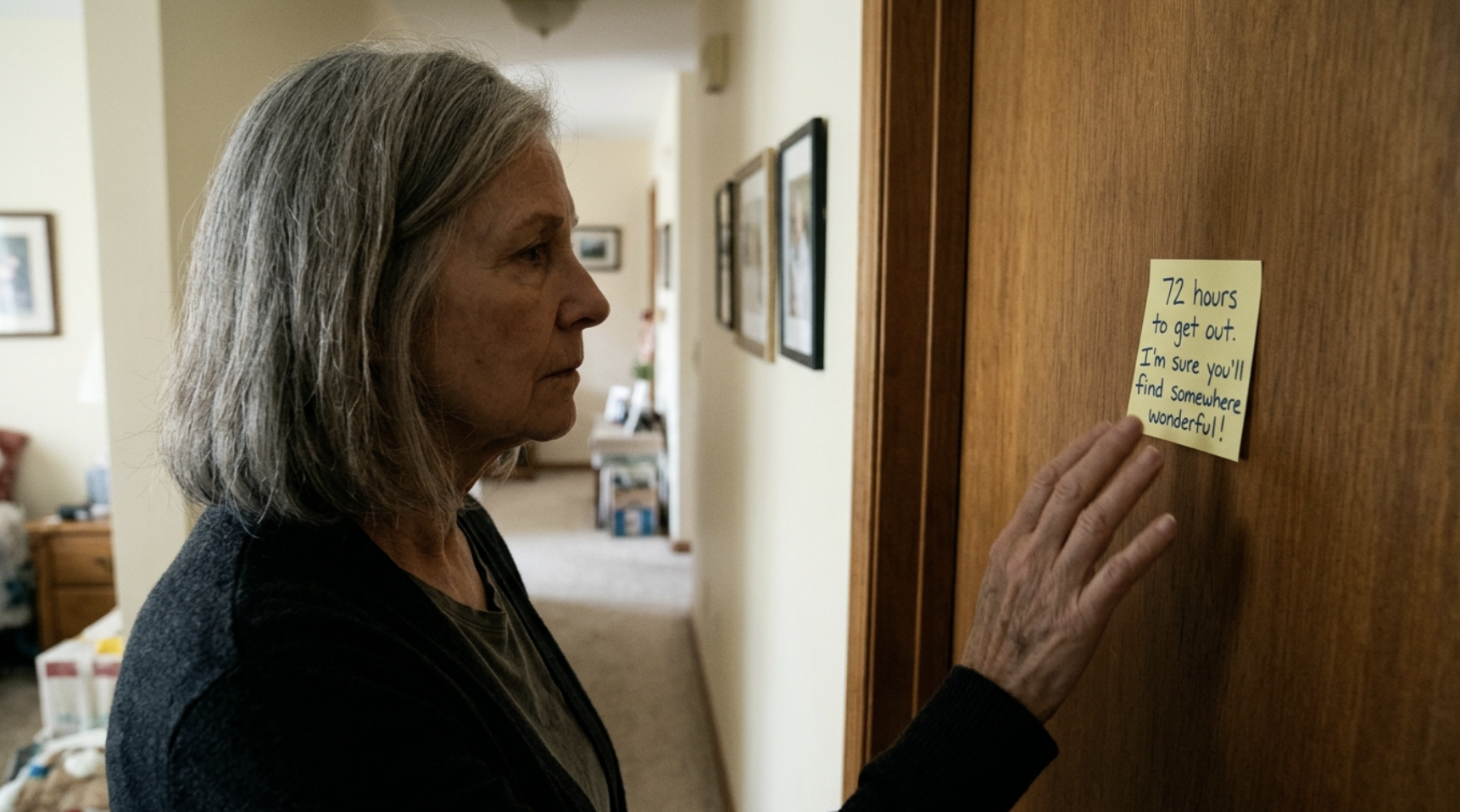
And once I understood that, I knew I could not go back to being the woman I had been before that yellow sticky note.
Not even if they asked me to.
Friday: The Listing Goes Live
At 8:17 Friday morning, my phone rang.
The caller was a woman named Denise from a local property-management company.
“Mrs. Cole? I’m calling regarding the basement suite at your son’s address. I understand you currently occupy the unit.”
“Yes, I do.”
“I’m sorry to hear you’re moving. I wanted to confirm that the suite will be available for our scheduled photographs this afternoon.”
I leaned against the kitchen counter.
“Who told you I would be available for photographs?”
There was a pause.
“Mr. and Mrs. Cole confirmed that the suite would be vacant by Monday morning.”
“Did they tell you I was moving out voluntarily?”
Another pause.
“I’m not sure I understand.”
“I’m not asking you to take sides, Denise. I simply want to make sure you have accurate information. I am still living in the suite. My belongings are being packed, and the owners have asked me to leave within seventy-two hours.”
“Oh.”
Her voice changed.
“I see.”
“I also noticed that the listing describes the suite as having a private entrance and exclusive use of the laundry area. Is that correct?”
“Yes, those are the details provided to us.”
“The laundry area is shared with the main household, and the entrance is through the main house. The basement has a separate exterior exit for emergencies, but it isn’t a private entrance.”
I heard typing.
“Thank you for clarifying that,” she said. “I’ll make a note of it.”
“There’s one other thing. The listing says the suite is available Monday. I cannot promise that every one of my belongings will be removed by then. I have hired professional movers, and they have given me a confirmed schedule.”
“Understood. I’ll discuss the timing with the owners.”
“Thank you.”
I ended the call and stared at my phone.
I hadn’t planned to interfere with the rental.
I had no desire to prevent Owen and Tessa from earning additional income. Their financial decisions were theirs to make.
But I would not pretend I had already left simply because they wanted to advertise the space.
At 10:30, I received a text from Tessa.
Did you tell the property manager that the basement isn’t ready?
I read it twice.
Then I replied.
I told her the truth about the current arrangements. The movers are scheduled, and I’ll provide access to my belongings according to the schedule we discussed.
Her response came almost immediately.
You could have waited until after the photos.
I typed a reply, deleted it, and tried again.
You gave me seventy-two hours to move out. I am doing exactly that.
She didn’t answer.
At lunchtime, I went upstairs to make myself a sandwich.
Tessa was standing beside the kitchen island, staring at her phone.
“Denise says she can’t guarantee the Monday listing anymore,” she said.
“I imagine she’ll need to confirm the move-out schedule.”
“She said you told her about the shared laundry.”
“I did.”
“It’s a minor detail.”
“Then it shouldn’t be difficult to correct.”
She set down her phone.
“Marian, why are you doing this?”
I looked at her.
“Doing what?”
“Making everything difficult.”
For a moment, I considered explaining the past four years.
The mornings I had sat beside a sick child while she and Owen went to work.
The afternoons I had spent driving to school, buying groceries, and helping with homework.
The $62,000 I had invested in the basement.
The monthly transfers.
The times I had rearranged my own plans because one of the children needed something.
But she knew those things.
Explaining them again would not change the conversation.
So I asked her a question instead.
“Tessa, when you left that note on my door, did you believe you were treating me fairly?”
She crossed her arms.
“We needed the space.”
“That wasn’t my question.”
She looked toward the window.
“I thought it was the easiest way.”
“For whom?”
She didn’t answer.
I picked up my sandwich.
“I hope the rental works out for you.”
As I walked toward the stairs, she called after me.
“You’re acting as if we never did anything for you.”
I stopped.
That was the first time she had said something that truly angered me.
I turned around.
“You gave me a room in your home. I have never denied that, and I have never said I was entitled to live here forever. But I paid to turn a concrete basement into a livable apartment. I helped with the household expenses. I cared for your children because I loved them.”
My voice remained steady.
“None of those things bought me a permanent right to stay. But they deserved a conversation, not a sticky note.”
Her face reddened.
“I didn’t know you would take it so personally.”
I almost laughed.
Then I realized she meant it.
In Tessa’s mind, the problem was not the decision.
It was my reaction to it.
I went downstairs and closed my door.
For the rest of the afternoon, I packed.
Friday Evening: The Children Ask Questions
My granddaughter, Lily, was the first to notice the empty shelves.
She was ten, old enough to understand that moving meant leaving, but young enough to believe adults could fix anything if they simply talked long enough.
She appeared in my doorway holding a stuffed rabbit.
“Grandma, why are your books in boxes?”
I sat on the floor beside her.
“I’m moving to Oregon.”
“When?”
“Very soon.”
“Why?”
I took a breath.
“Your mom and dad need the basement for something else, sweetheart. So Grandma is going to stay with her friend Faye for a while.”
Lily looked around the room.
“But this is your home.”
“It has been my home for four years.”
“Then why do you have to leave?”
I searched for words that would not make her feel responsible.
“Sometimes grown-ups make arrangements that stop working for everyone. When that happens, we have to find a new arrangement.”
She frowned.
“Did you do something bad?”
My heart broke a little.
“No, darling. I didn’t do anything bad.”
“Then why can’t you stay?”
I drew her into my arms.
“Because your mom and dad have decided they need the space, and I have decided it’s time for me to have a place of my own again.”
She was quiet for a long time.
Then she whispered, “Will you still come to my school play?”
“Of course.”
“And my birthday?”
“If your parents arrange the visit and we can make it work, absolutely.”
She held my cardigan tightly.
“Promise?”
“I promise I’ll always love you. And I promise I’ll do my best to be there for the important things.”
She seemed satisfied with that.
Her younger brother, Ben, appeared behind her.
“Are you taking the cookies?”
I laughed through the sudden tightness in my throat.
“Which cookies?”
“The chocolate ones.”
“Those are coming with me.”
He gasped as though I had announced a national emergency.
“Grandma! Those are my favorite!”
“Then you’d better come visit me in Oregon.”
He considered that.
“Does Oregon have cookies?”
“The entire state is full of them.”
That was not technically true, but he accepted it without question.
For a few minutes, we sat together on the floor, talking about airplanes, mountains, and whether Faye’s dog would allow two children to sleep in his bed.
Then Tessa called them upstairs.
Lily hugged me one more time before leaving.
When the door closed, I remained seated on the floor.
I had known leaving would hurt.
I had not fully understood that I would also be leaving behind the ordinary moments that made a house feel like a home.
The sound of little feet on the stairs.
The smell of toast in the morning.
The occasional drawing slipped beneath my door.
I would miss those things.
But missing them did not mean I had made the wrong decision.
That night, I called Faye.
“Everything all right?” she asked.
“Yes.”
“You sound like a woman who is trying very hard to convince herself.”
I smiled faintly.
“I’ll miss the children.”
“Of course you will.”
“I don’t want them to think I left because I stopped loving them.”
“Then keep loving them, Marian. You don’t have to live in the same house to do that.”
I leaned back against my pillow.
“Do you think Owen will ever understand?”
“Perhaps. But you cannot spend the rest of your life waiting for someone else to understand why you deserved kindness.”
I closed my eyes.
Faye had always been good at saying the thing I needed to hear, even when I wished she wouldn’t.
“Get some sleep,” she added. “Tomorrow is a long day.”
I hung up.
Then I opened the folder containing the renovation invoices.
The first invoice was dated four years earlier.
It listed insulation, framing, electrical work, and plumbing.
The final invoice showed the total cost of the conversion.
$62,000.
I remembered sitting at the kitchen table with Owen when I wrote the checks.
He had put his hand over mine.
“Mom, this is going to be wonderful,” he had said. “You’ll have your own place, and the kids will always have you close.”
I had believed him.
Perhaps he had believed it too.
But promises made in happy times can become inconvenient when circumstances change.
And I had finally learned that my security could not depend on someone else’s changing feelings.
I placed the invoices in the folder.
Then I put the folder into my handbag.
There was one more thing I needed to do before I left.
Something I had not told Owen or Tessa.
Something that had nothing to do with punishing them.
And everything to do with making sure I would never again confuse generosity with security.
Saturday Morning: The Appointment
At nine o’clock Saturday morning, I drove to the office of a local attorney named Helen Brooks.
She had handled the closing when I sold my townhouse four years earlier.
I had called her the previous afternoon and explained that I needed advice about a substantial contribution I had made toward improvements to a family home.
Helen listened carefully.
Now she sat across from me in a small office overlooking the parking lot.
“Let’s start with the documents,” she said.
I gave her the renovation invoices, copies of the checks, and the bank statements showing the payments.
She examined them without rushing.
“Were you ever added to the deed?”
“No.”
“Was there a written agreement stating that the money was a loan?”
“No.”
“Were you promised an ownership interest in exchange for the contribution?”
“No. We discussed it as an investment in the family, but nothing was written down.”
She nodded.
“Then I want to be careful not to give you false hope. The invoices establish what you paid for the renovations, but they don’t automatically establish a right to reimbursement or ownership. We would need to examine the full circumstances and the applicable law.”
“I understand.”
“Do you want to pursue repayment?”
I looked out the window.
For a long time, I had imagined that asking for money back would somehow make the last four years feel more balanced.
But the truth was more complicated.
I had chosen to help my son.
I had wanted the children to have a comfortable home.
I had wanted to be close to my family.
I did not want to turn every act of love into a financial transaction after the relationship had broken down.
“No,” I said finally. “Not right now.”
Helen folded her hands.
“Then what do you want?”
“I want to know what I should protect going forward. I want to make sure my savings are secure, my estate documents are current, and nobody can assume that my future is available for negotiation simply because I am their mother.”
Helen smiled.
“Those are sensible goals.”
We spent the next hour reviewing my finances, my will, my medical directives, and the arrangements I would need to establish once I settled in Oregon.
She explained the importance of keeping my money separate, documenting any future financial assistance, and avoiding large transfers without a clear written agreement.
She also recommended that I speak with an attorney in Oregon once I established residency, particularly if I purchased property there.
When the meeting ended, I felt lighter.
Not because I had discovered a secret legal weapon.
I hadn’t.
I had discovered something more useful.
I could protect myself without turning my family into enemies.
Before leaving, I asked Helen one final question.
“Have you ever seen a situation like mine before?”
She thought for a moment.
“Many times. Usually, the financial contribution isn’t the only issue. The real problem is that people make informal arrangements based on trust, and then circumstances change. Everyone remembers the arrangement differently.”
I nodded.
“What would you tell someone in my position?”
“Don’t make your next decision to prove a point. Make it because it creates the life you want to live.”
I thanked her.
Outside, the morning was bright and cool.
I sat in my car for several minutes before starting the engine.
For the first time since finding the sticky note, I was not thinking about Owen’s reaction.
I was thinking about my own future.
And that felt like progress.
Saturday Afternoon: The Last Dinner
I had intended to spend Saturday packing, but Lily had asked whether we could have one last dinner together.
So I cooked.
Roast chicken.
Mashed potatoes.
Green beans.
The apple cake Owen had loved since childhood.
I did not cook because I was trying to earn my place back.
I cooked because I wanted to remember my final evening in that house as something more than a conflict.
The children helped set the table.
Owen arrived home early and paused when he saw the food.
“You didn’t have to do all this,” he said.
“I know.”
Tessa came downstairs a few minutes later.
She looked uncomfortable.
Nobody mentioned the note.
For a while, we talked about ordinary things.
Ben’s school project.
Lily’s upcoming play.
A neighbor’s new dog.
Then Owen cleared his throat.
“Mom, I want to talk about Monday.”
I set down my fork.
“All right.”
“The movers are coming tomorrow, right?”
“Yes.”
“And you’ll be gone by Sunday evening?”
“That is the plan.”
He nodded.
“Tessa and I were wondering whether you’d consider leaving some of the furniture.”
I looked at him.
“Which furniture?”
“The couch. The table. Maybe the bed.”
I glanced around my apartment.
Most of the furniture had come from my old townhouse. I had paid for it long before moving in.
“Why?”
“The basement will look better for the rental.”
I felt a strange calm settle over me.
“Then you’ll need to furnish it.”
He shifted in his chair.
“Mom, we thought you might not need everything in Oregon.”
“I may not. But that doesn’t mean I’m giving it away.”
“We’re not asking you to give it away. We could buy it from you.”
“That would be fine. If we agree on a price.”
Tessa looked surprised.
“How much?”
“I haven’t decided. I’ll make a list of the pieces I’m willing to sell and their condition. You can decide whether you want them.”
Owen nodded slowly.
For once, the conversation had become simple.
A request.
A decision.
An arrangement.
No assumptions.
No guilt.
No yellow paper.
After dinner, Lily helped me wash the dishes.
“Grandma,” she whispered, “are you mad at Mom and Dad?”
I dried a plate.
“I was hurt by something that happened.”
“Are you still mad?”
“I’m still working through how I feel.”
She considered that.
“Does that mean you don’t love them?”
I placed the plate in the cabinet.
“No, sweetheart. Loving someone and being hurt by them can happen at the same time.”
She looked down at the dish towel.
“I think Mom is sad too.”
I paused.
“Maybe she is.”
“Will you forgive her?”
I thought about it.
“Forgiveness doesn’t mean pretending something didn’t happen. It means deciding what to do with the hurt so it doesn’t control the rest of your life.”
Lily nodded as though she understood every word.
Then she hugged me.
“I love you, Grandma.”
“I love you too.”
Later, after the children went upstairs, Tessa appeared at my door.
She stood in the doorway with her hands clasped.
“I owe you an apology,” she said.
I waited.
“The note was unkind. I shouldn’t have done it that way.”
It was not a complete apology.
She had not mentioned the four years, the money, or the fact that Owen had participated in the decision.
But it was the first time she had acknowledged that the way she handled things had caused harm.
“Thank you for saying that,” I replied.
She glanced at the boxes.
“I thought you’d argue with us. I thought you’d insist on staying.”
“Why?”
She hesitated.
“Because you love the children. Because you don’t have a husband anymore. Because this has been your home.”
I nodded.
“All of those things are true.”
“Then I thought you’d need us.”
I looked at her for a long moment.
“I may need help sometimes, Tessa. Everyone does. But needing help is not the same as having no choices.”
She lowered her eyes.
“I didn’t think about it that way.”
“I know.”
She looked toward the stairs.
“Owen is upset.”
“I imagine he is.”
“He thinks you’re leaving because of him.”
I felt sadness rather than anger.
“I am leaving because the arrangement has ended. I am also leaving because I want to live somewhere I can make my own decisions without worrying that my place in the household depends on how useful I am.”
She said nothing.
Then, very quietly, she asked, “Will you come back to visit?”
I looked at her.
“Yes. I want to visit my grandchildren. I want to see Owen. And I hope that, eventually, you and I can build a better relationship.”
Her shoulders relaxed slightly.
“But things will be different,” I added.
She nodded.
“I understand.”
I hoped she did.
I also knew that understanding was not the same as changing.
That would take time.
After she left, I stood in the center of my little apartment and looked around.
Tomorrow, the furniture would begin disappearing.
By Sunday evening, I would be gone.
And by Monday morning, the basement would belong to Owen and Tessa again.
But the next chapter of my life would belong to me.
Sunday Morning: The Surprise
At 7:12 Sunday morning, I heard the front door open upstairs.
Then came the sound of hurried footsteps.
A door slammed.
Someone called my name.
“Mom!”
Owen’s voice.
Loud.
Alarmed.
I was sitting at my kitchenette table, drinking coffee and watching the sunrise through the window.
My bags were packed.
My documents were secure.
The movers were scheduled to arrive at eight.
I took another sip of coffee.
Then I heard him coming down the stairs.
He appeared in my doorway holding his phone.
His face was pale.
“Mom, what did you do?”
I put down my cup.
“Good morning, Owen.”
“Did you cancel the internet?”
“The account ends at the close of the billing cycle. I told you that.”
“The lawn service?”
“Yes.”
“The cleaning service?”
“Yes.”
He stared at me.
CONTINUE READ NEXT ….
My Daughter-in-Law Gave Me 72 Hours to Leave After I Spent $62,000 on Their Basement—By Sunday Morning, They Regretted Everything
Part 1 of 2