
Part 1 – My Daughter Stood Up Before I Could Defend Myself
The morning I walked into family court, my hands were so cold I could barely hold the stack of documents my attorney had prepared. Before the hearing even began, I had the overwhelming feeling that everyone in the room had already decided who I was—a fragile woman, an unstable wife, and a mother too emotional to raise her own child. That was exactly the image my husband, Mark Mitchell, wanted the judge to see.
Mark looked every bit like the devoted father he had practiced becoming. He wore a perfectly tailored blue suit, polished shoes, and carried himself with the calm confidence of someone convinced he would win. Sitting beside him was his lawyer, while just behind them sat Brooke, the woman Mark had started a new life with before our marriage had even officially ended. She wore a cream-colored blouse and repeatedly rested one hand on her barely noticeable pregnancy, almost as if she wanted to remind me that she already imagined herself replacing me.
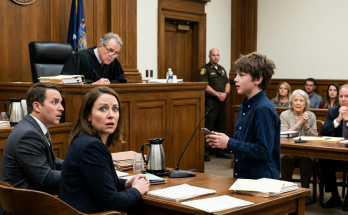
My nine-year-old daughter, April, sat beside me wearing her school uniform because I hadn’t even had enough time to take her home and change her clothes before court. Her two loose braids framed a frightened little face, and she clutched her old kitten backpack tightly against her chest. No child should ever have to listen to one parent accuse the other of being dangerous, but Mark had specifically requested that the judge speak with her during the custody hearing.
His attorney stood and addressed the court.
“Your Honor, it’s important for the child to understand which parent can provide a stable environment.”
That single word—stable—felt almost unbearable.
Over the previous months, Mark had quietly emptied our savings account, changed the locks on my house twice, hidden my keys, and secretly recorded me crying after deliberately provoking arguments. One night, he even rearranged the furniture while I slept, only to ask me the following morning, in front of April, whether I had forgotten where I put everything. Little by little, I began questioning my own memory, and that was perhaps the cruelest part of everything. He hadn’t simply tried to hurt me—he had tried to convince me I was losing my mind.
The judge reviewed several documents before looking directly at me.
“Mrs. Mitchell, your husband is requesting temporary custody based on allegations of emotional instability.”
Before I could answer, Mark’s attorney rose again.
“My client has spent months trying to protect his daughter. Mrs. Mitchell cries frequently, becomes emotionally overwhelmed over minor issues, mismanages finances, and depends on sleeping medication.”
“I wasn’t sleeping,” I replied quietly.
My voice sounded weaker than I wanted.
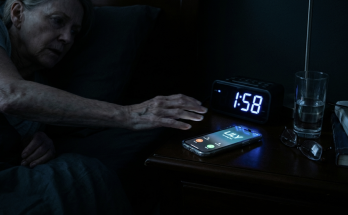
Mark lowered his eyes with carefully rehearsed sadness, pretending it hurt him to hear me speak that way. Only I knew the truth. He had spent months calling me from blocked numbers in the middle of the night before hanging up the moment I answered. He slipped empty envelopes beneath my front door, frightened me with unexplained noises, and even warned April not to wake me because “Mommy wasn’t acting like herself lately.”
Then his lawyer produced another folder.
“We also have recordings of Mrs. Mitchell screaming inside the home.”
The first photograph showed me sitting on the kitchen floor, disheveled and crying beside shattered glass. What it didn’t show was Mark smashing the glass himself moments earlier before whispering, “Let’s see how you explain this.”
Behind him, Brooke sighed dramatically.
“Poor little April.”
My daughter immediately tensed.
I squeezed her hand.
“Don’t listen.”
But children always hear more than adults realize.
The judge adjusted her glasses and turned back toward me.
“Mrs. Mitchell, would you like to respond?”
I opened my mouth, determined to tell the court everything—that my father had left the house to me years before, that Mark wanted control of the property far more than he wanted custody of our daughter, and that Brooke had already measured the bedrooms because they expected to move in as soon as I was declared unfit. But every word became trapped in my throat because I knew how desperate I would sound.
Once a woman has been labeled unstable, every tear becomes evidence.
Every raised voice becomes proof.
Every attempt to defend herself is treated like another symptom.
Before I could force out another sentence, I felt April let go of my hand.
“Your Honor?”
The courtroom turned toward her.
The judge’s expression softened.
“Yes, April?”
Mark shifted uncomfortably in his chair.
“April,” he interrupted quickly, “sit down. This isn’t something children need to be involved in.”
She didn’t even look at him.
Instead, she slowly unzipped her kitten backpack and removed an old tablet with a cracked screen and faded purple case covered in cartoon stickers.
“Can I show something?”
“My mom doesn’t know about it.”
A heavy silence settled across the courtroom.
I stared at her in confusion.
“April… what are you talking about?”
She looked at me with tear-filled eyes.
“I’m sorry, Mom.”
“I didn’t tell you because Dad said if I did… they’d send you away to a hospital.”
The color drained from Mark’s face.
“That’s not true,” he blurted out.
The judge immediately raised one hand.
“Mr. Mitchell.”
“Be quiet.”
April held the tablet with both trembling hands.
“I recorded Dad telling Brooke they had to make Mom look sick before court.”
For the first time that morning, Mark completely lost his composure.
His attorney leaned toward him, whispering urgently, while Brooke stopped absentmindedly rubbing her stomach altogether. I felt my heart pounding so hard it almost hurt as the courtroom clerk carefully accepted the tablet and connected it to the courtroom monitor.
Drawings.
Homework.
School photos.
Videos of April singing.
Then a hidden folder protected by a password.
April quietly gave the clerk four numbers.
“It’s Brooke’s birthday.”
The folder opened.
Several audio recordings appeared.
Then one video.
Its filename stole every bit of air from my lungs.
How to Make Eleanor Lose April Before Our Baby Is Born.
Mark slammed both hands onto the table.
“Turn that off!”
The judge stood immediately.
“One more interruption, Mr. Mitchell, and I’ll have you removed from this courtroom.”
The clerk clicked the file anyway.
The video began.
It showed my kitchen late at night.
Mark stood beside the counter holding my favorite blue coffee mug.
Then Brooke’s voice came through the speakers.
“Put a little more in.”
“She needs to wake up confused tomorrow.”
Part 2 – My Daughter Recorded the Truth They Tried to Hide
Brooke’s voice echoed through the courtroom with terrifying clarity.
“Put a little more in.”
“She needs to wake up confused tomorrow.”
The shaky video showed Mark standing at our kitchen counter with my favorite blue coffee mug in his hand. He slowly stirred something into the drink with a teaspoon, moving carefully, almost gently, as though he were preparing a thoughtful cup of coffee instead of laying another trap. The recording was unsteady because the tablet had obviously been hidden somewhere low, probably inside April’s backpack beneath the kitchen table, but every word was unmistakable.
I couldn’t breathe.
For months, I had blamed myself for waking up dizzy, exhausted, and unable to think clearly. I had wondered why I kept forgetting simple things or struggling to concentrate after drinking the coffee Mark insisted on making for me every evening. Standing in that courtroom, I finally realized those frightening mornings hadn’t been accidents.
Mark shot to his feet.
“The video’s fake!”
“She doesn’t understand what she recorded!”
April looked directly at him.
“I understood.”
“You told Brooke that if Mom looked confused, the judge would let me live with you.”
The entire courtroom fell silent.
The judge immediately instructed security officers to remain outside the courtroom doors and ordered that no one leave until the hearing was finished. Mark tried speaking again, but this time even his own attorney grabbed his sleeve and quietly told him to stop talking before he made everything even worse.
The clerk opened another recording.
There was no video this time.
Only voices.
Mark’s footsteps echoed across our living room before his voice filled the speakers.
“If Eleanor screams… record it.”
“If she cries… even better.”
“We need everyone to believe she’s losing control in front of April.”
Brooke answered quietly.
“What if April tells someone?”
Mark laughed.
It wasn’t a nervous laugh.
It was confident.
“She believes me.”
“I told her that if Mommy has to stay in a hospital for a while, it’ll be because she’s sick.”
I slowly turned toward my daughter.
She was staring down at the floor, twisting the sleeve of her school uniform between trembling fingers as though she believed she had done something wrong. Every terrible moment suddenly made sense. Every time April hesitated before speaking, every frightened glance she had given me, every awkward silence after spending time with her father—it had all been fear.
I wanted nothing more than to run across the courtroom and hold her.
The judge gently raised one hand.
“We’ll take care of her.”
“But we need the whole truth.”
The next recording carried a simple filename.
Keys.
The audio began with the unmistakable sound of a lock turning.
Then Brooke spoke.
“What if Eleanor calls the police?”
Mark answered without hesitation.
“She’ll tell them I’m locking her out.”
“But that’s exactly what I want.”
“The house belongs to her.”
“If I get temporary custody of April, my lawyer can petition to manage our daughter’s property.”
“With April living with me… I’ll control the house.”
The judge stopped writing.
She slowly looked up at me.
“Mrs. Mitchell.”
“Is the house legally yours?”
My throat tightened.
“My father left it to me before he passed away.”
“Mark always claimed he didn’t care about it.”
Brooke suddenly laughed nervously.
“This is ridiculous.”
“No one would destroy a family over a house.”
Before I could answer, April quietly spoke again.
“You measured my bedroom.”
Everyone turned toward her.
She pointed directly at Brooke.
“You said that’s where the baby’s crib was going.”
Brooke’s face lost all color.
April continued in a trembling voice.
“You told me if I behaved… I could keep my bed.”
“But Mommy couldn’t.”
“Because grown-ups were going to take care of her.”
The judge immediately suspended the custody hearing and converted it into an emergency protective proceeding involving both me and my daughter. Mark’s attorney argued that the tablet hadn’t yet undergone forensic examination and shouldn’t be treated as verified evidence, but the judge calmly explained that the recordings already justified immediate protective action while investigators completed a full analysis.
Then she looked directly at Mark.
“You are prohibited from contacting your daughter until further order of this court.”
Mark stared at her in disbelief.
“She’s my child.”
The judge’s voice became noticeably firmer.
“And your first responsibility was protecting her.”
“Not using her to destroy her mother.”
For the first time all morning, Brooke began crying.
Not dramatically.
Not convincingly.
She looked like someone realizing the future she had imagined was disappearing in front of her.
“Mark told me Eleanor was mentally unstable,” she whispered.
“He said she forgot things.”
“He said April wasn’t safe.”
I looked at her.
“And that’s why you told him to put more into my coffee?”
She immediately covered her mouth.
The judge instructed the court reporter to record Brooke’s statement exactly as spoken.
Mark finally stopped pretending.
Every trace of kindness disappeared from his face.
“You ruined everything,” he hissed at me.
“You took my future.”
I met his eyes without looking away.
“The house belonged to me before we were married.”
“And you’re losing your daughter because of your own choices.”
Before anyone else could speak, April slowly raised her hand once more.
The judge leaned toward her gently.
“Yes, sweetheart?”
“I think there’s one more thing.”
The clerk reopened the hidden folder.
Near the bottom sat a blurry photograph.
After zooming in, everyone could clearly see several legal documents spread across our dining room table beside a pen, a photocopy of my driver’s license, and paperwork carrying the letterhead of a local notary office.
The judge narrowed her eyes.
Then she quietly read two words aloud.
Voluntary Transfer.
My entire body went cold.
Near the bottom of the page…
Was an empty signature line.
April pointed toward the screen.
“I took that picture because…”
“…Dad kept practicing Mom’s signature.”

Part 3 – The Truth Saved My Daughter Before It Was Too Late
Mark was removed from the courtroom before the hearing officially ended. He wasn’t placed under arrest that afternoon, but two security officers escorted him into the hallway while his perfectly pressed blue suit suddenly looked as exhausted as the expression on his face. I expected to feel triumphant watching him disappear through those courtroom doors, yet all I felt was overwhelming exhaustion, as though I had spent months holding together a house that everyone else insisted was perfectly safe until it finally collapsed in front of them.
Brooke followed several steps behind him, crying quietly with one hand covering her stomach and the other gripping her phone so tightly her knuckles had turned white. The confident woman who had sat beside Mark rubbing her belly throughout the hearing had completely disappeared. For the first time, she looked less like someone preparing to move into my home and more like someone realizing she had built her future on someone else’s lies.
The judge immediately issued an emergency protective order.
April would remain with me.
Mark was prohibited from approaching our home, visiting her school, or contacting either of us without court approval. The judge also ordered a full forensic examination of the tablet, a medical evaluation for me, and counseling for April before any future custody discussions could even be considered.
As I signed the paperwork, my hands still trembled.
This time, though, I read every single line before writing my name.
When everything was finished, the clerk returned April’s kitten backpack, although the tablet itself remained in police custody as evidence. My daughter stared at the empty pocket where it usually rested before quietly looking up at me with tears filling her eyes.
“I’m sorry, Mom.”
“I hid it from you.”
I immediately pulled her into my arms in the middle of the courthouse hallway.
Lawyers walked past.
Court employees watched silently.
None of it mattered.
“You saved me,” I whispered.
“But sweetheart…”
“That was never supposed to be your job.”
She buried her face against my shoulder.
“I was scared nobody would believe me.”
I kissed the top of her head.
“I was scared of that too.”
The weeks that followed weren’t filled with celebration.
They were filled with healing.
Every ordinary object inside my house reminded me of something Mark had turned into a weapon. The smell of coffee made my stomach tighten. Every misplaced set of keys made my heart race. Even the sound of footsteps outside after dark sometimes pulled me back into months of fear and uncertainty.
April struggled too.
She refused to sleep alone for several nights and kept reaching for the tablet that wasn’t there anymore, almost as if she believed she still needed proof to protect us.
Her child psychologist gently explained that she wasn’t simply recovering from a difficult divorce.
She was recovering from prolonged manipulation.
“She needs permission to be a child again,” the therapist told me.
“So don’t rush her.”
The next weekend, April asked if we could buy a new coffee mug.
“Not blue,” she said immediately.
“Yellow.”
We found one covered with tiny sunflowers.
When we returned home, she carefully placed it on the kitchen shelf.
“Nobody touches this one except you.”
I smiled for what felt like the first genuine time in months.
The forensic examination confirmed exactly what April had already shown the court. None of the files had been altered, and investigators recovered dozens of deleted recordings Mark believed had disappeared forever. They found videos of him hiding my keys beneath the driver’s seat of his car, Brooke photographing every room inside my house, Mark deliberately breaking dishes before recording my emotional reactions, and one conversation that removed any remaining doubt about his true intentions.
“If I get April,” his voice said calmly, “Eleanor will sign anything.”
“She’ll do whatever I ask just to see her daughter.”
That recording became one of the strongest pieces of evidence in both the criminal investigation and the family court proceedings. It proved this had never been about protecting April. It had been about using my daughter to gain control of the house my father had left me before he died.
Brooke eventually agreed to cooperate with investigators.
She admitted that Mark had convinced her I suffered from serious mental health problems and claimed he was trying to rescue April from an unsafe environment. She also confessed that she knew about the property transfer documents, watched Mark practice my signature, and heard him repeatedly say that once I lost custody, I’d become desperate enough to sign away everything.
Her testimony didn’t erase what she had done.
But it exposed the entire plan.
One carefully manufactured lie after another.
Mark ultimately lost every request he had made for temporary custody. His visitation rights were suspended while both criminal and family court cases continued, and the attempted property transfer was permanently blocked before anyone could use my forged signature. Watching the legal process unfold taught me something painful but important. Justice rarely moves as quickly as fear does, yet every official ruling became another reminder that the truth had finally found its voice.
Two weeks later, April returned to school.
That first morning, she clung tightly to my hand outside the entrance before quietly asking the question I had dreaded hearing.
“What if Dad comes?”
I knelt until we were face to face.
“You find your principal.”
“You call me.”
“And you never keep grown-up secrets again.”
She nodded slowly.
Then she asked something that broke my heart all over again.
“Can I still love him?”
“Even after everything?”
I wrapped my arms around her.
“Yes.”
“You can love someone…”
“And still know they aren’t safe.”
Those words became something I repeated almost as often to myself as I did to her.
Gradually, our house began changing.
Not because we bought new furniture or repainted every room.
Because fear slowly stopped living there.
There were no more mysterious phone calls in the middle of the night.
No more missing keys.
No more whispered accusations designed to make me question my own memory.
April and I painted her bedroom together, moving her bed away from the corner Brooke had measured for a crib months earlier. On the wall above her desk, she taped a drawing of the two of us standing beneath our little house.
Across the top she carefully wrote:
“We tell the truth here.”
I never took it down.
Months later, after speaking with her therapist, April agreed to one supervised visit with Mark.
I waited outside the room, my heart pounding until she finally walked back toward me.
She looked thoughtful.
Not frightened.
“Dad cried,” she said quietly.
“What did you tell him?”
She smiled just a little.
“I said I was sorry too…”
“But I’m never letting him borrow my tablet again.”
I laughed through tears.
In that moment, I realized my daughter hadn’t lost her childhood completely.
She had simply learned something many adults spend a lifetime trying to understand.
Love doesn’t require giving someone another chance to hurt you.
The day Mark walked into court, he expected a frightened woman who could barely defend herself.
Instead…
A nine-year-old girl carrying a cracked tablet, two loose braids, and a kitten backpack quietly told the truth.
And the truth accomplished what fear never could.
It gave both of us our lives back.