His mistress tried to sign my son up for her pregnancy announcement video.
Not metaphorically. Not in some vague, emotional way that wives say when they are trying to explain the humiliation of being replaced.
Literally.
At 8:12 on a Tuesday morning, while rain stitched silver lines down the windows of our Upper East Side apartment, an email landed in my inbox from a videographer I had never hired.
Subject: FINAL CALL SHEET — ALDEN BABY REVEAL — SAG HARBOR.
I was drinking coffee from a porcelain cup Julian had bought me in Paris after our first anniversary, the kind of gift he used to give when he still remembered I liked delicate things. My son, Oliver, was on the floor beside the kitchen island, building a crooked skyline out of wooden blocks. He was six years old, still missing his two front teeth, still small enough to believe his father’s promises arrived intact.
I opened the email because my last name was Alden and because I had learned, in marriage, that accidents were often only truths that had slipped their leash.
There it was.
10:00 A.M. — Talent arrival.
10:30 A.M. — Wardrobe.
11:15 A.M. — Family garden scene.
11:45 A.M. — “Big Brother” reveal with Oliver Alden.
Wardrobe notes: cream cashmere sweater, tan trousers, loafers. Hair natural. Smile encouraged.
Prop: “I’m getting promoted to big brother!” sign.

At the bottom, beneath the neat columns and bright, obscene cheerfulness, was the line that made my hand go cold around the cup.
Parental consent confirmed by Julian Alden.
My husband.
My estranged husband.
The man who had moved out three months earlier “to think,” which apparently meant into a glass penthouse in Tribeca with a twenty-seven-year-old lifestyle influencer named Blaire Covington, who filmed her green smoothies, her “quiet luxury mornings,” and my family’s collapse in the same soft beige light.
I read the email twice.
Oliver stacked another block on top of his tower.
“Mommy,” he said, “do you think Daddy will come to my soccer game Saturday?”
The cup trembled once. Just once.
Then I set it down.
I kissed the top of my son’s warm head, walked into the butler’s pantry where he couldn’t see my face, and forwarded the email to my attorney.
No explanation.
No tears.
No screaming.
Just one sentence.
Nina, I believe Exhibit A has arrived.
The pregnancy announcement never filmed.
But the custody motion wrote itself.
CHAPTER 1 — THE MISTAKE THAT WORE IVORY
There are humiliations that arrive dressed like accidents.
A wrong email. A misplaced invitation. A photograph posted too early by someone too smug to check the reflection in the champagne bucket.
Mine arrived in ivory linen, wrapped in a call sheet.
I stood in the butler’s pantry of a home that no longer felt like mine, listening to the rain and my son’s blocks clicking against marble. The apartment overlooked Park Avenue from the eighteenth floor, all pale oak, museum-grade art, and quiet wealth. It had been photographed once for Architectural Digest under the title “A Young Family’s Timeless Manhattan Haven.”
The article said Julian and I had designed it together.
That was a beautiful lie.
Julian chose the view. I chose the home.
He wanted the kind of apartment people recognized from across a dinner table. I wanted a place where Oliver could run barefoot, where books were not props, where the kitchen smelled like cinnamon on Sundays. For seven years, I had softened Julian Alden’s sharp edges. I had turned his appetite into taste, his ambition into philanthropy, his name into a brand people could trust.
Then Blaire Covington arrived with a ring light and a mouth full of gratitude.
She had first appeared at one of our foundation events, hired by Alden House Media to “modernize charity engagement.” That was the phrase Julian used. Modernize charity engagement. As if compassion needed better lighting.
She was small and golden and camera-ready, with hair that fell in expensive waves and eyes trained to water without ruining her makeup. Her Instagram bio said: Soft life. Strong heart. Faith. Fashion. Family soon.
At the time, I thought “family soon” meant she wanted one of her own.
I did not understand she meant mine.
The first public humiliation came at the Whitmore Children’s Hospital gala in February, held beneath the chandeliers of The Plaza. I wore black silk. Julian wore a tuxedo. Blaire wore a silver dress that clung to her like a confession.
She was not supposed to be seated at our table.
She was not supposed to know Julian’s private jokes.
She was definitely not supposed to touch his wrist while the photographer leaned in and say, “Jules, look this way.”
Jules.
Nobody called him Jules except his mother, and she had died before Oliver was born.
I remember the exact second the room understood before I did.
It happened in the silence after laughter. That sudden velvet dip in conversation, when rich people smell blood but are too well-trained to point.
A senator’s wife looked at me with pity so polished it could cut glass. A fashion editor glanced from Blaire’s hand to my face and then away. Julian smiled for the camera, not at me, but through me, as if I had become part of the backdrop. A column. A floral arrangement. A wife.
Later, in the limousine, I asked him once.
“Are you sleeping with her?”
He looked out the window at Fifth Avenue’s wet shine and sighed, not with guilt, but inconvenience.
“Evelyn, don’t do this tonight.”
That was the first time I realized heartbreak did not always sound like breaking.
Sometimes it sounded like a man annoyed that your pain had interrupted his evening.
“Answer me,” I said.
He turned then. His profile was flawless in the passing light: the clean jaw, the dark blond hair, the winter-blue eyes that had once made me feel chosen. Julian Alden was the sort of man America forgave before he apologized. Men like him inherited rooms. Women like me learned how to own them quietly.
“You’re embarrassing yourself,” he said.
Something inside me went very still.
Not dead. Not broken.
Still.
There is a difference.
I did not throw wine. I did not call Blaire. I did not make a scene in front of the driver, who had worked for my family since I was fourteen and had already lowered his eyes in the mirror.
I went upstairs when we got home. I removed my diamonds one by one. I placed them in the velvet tray Julian had given me and left my wedding ring beside them.
Then I opened my laptop.
The first thing I did was not cry.
The first thing I did was change every password.
By morning, Julian was gone.
He left a note on his side of the bed written on stationery embossed with both our initials.
Need space. Please don’t make this ugly. Think of Oliver.
Men always remember the children when they need women to behave.
For three months, I behaved beautifully.
I smiled at school drop-off. I attended board meetings. I told Oliver that Daddy loved him and grown-up problems were never a child’s fault. I let Julian tell his friends we were “separating with mutual respect.” I watched Blaire post a photo of two coffee cups on a Tribeca balcony with the caption: Peace looks different when you stop forcing what was never meant for you.
The cups were from my wedding china.
I did not comment.
Silence, when done correctly, is not weakness.
It is storage.
I stored everything.
Screenshots. Receipts. Calendar entries. Venmo transfers Blaire forgot to make private. Photographs of Julian’s town car outside her building on nights he had told Oliver he was working late. Emails from his assistant accidentally copying me on “personal logistics.” A jeweler’s invoice for a yellow diamond bracelet purchased the same afternoon Julian’s lawyer claimed he needed to reduce child support because “liquidity was temporarily constrained.”
Nina Kapoor, my attorney, called my approach “disciplined.”
My therapist called it “delayed processing.”
My grandmother would have called it breeding.
Margaret Whitmore, who had raised me after my parents died in a Cape Cod sailing accident, believed in three things: handwritten thank-you notes, ruthless financial independence, and never letting a man know the precise moment you stop loving him.
“Men like Julian,” she told me the week before my wedding, while fastening pearls at my throat, “do not fear tears. They expect tears. What they fear is a woman who has read the documents.”
At twenty-seven, I had laughed.
At thirty-six, I understood.
The call sheet glowed on my phone.
I read it again.
Blaire had planned everything like a campaign.
The location was the Sag Harbor house, the one Julian and I bought the summer Oliver turned two. The garden scene would be filmed under the pergola where Oliver had taken his first steps. The reveal would happen beside the hydrangeas I planted myself after three miscarriages because I needed something blue to live.
My child, holding a sign for the woman who had helped dismantle his home.
My son, used as proof that everyone had moved on.
My son, edited into a thirty-second video designed to make strangers type congratulations under the ruins.
I opened the attached production notes.
Blaire’s name was listed as “Mother.”
Julian’s name was listed as “Father.”
Oliver’s name was listed as “Big Brother.”
Mine was not listed at all.
I felt, for one bright second, the old animal urge. The simple one. To call Julian and let my voice become a knife. To tell Blaire that motherhood was not a filter, not a cardigan, not a prop sign placed in the hands of another woman’s child.
But rage is a luxury careless women spend too quickly.
I had been raised by Margaret Whitmore.
I forwarded the email to Nina.
Then I made Oliver pancakes.
He wanted blueberries in the shape of a smiley face. I gave him extra syrup. He told me about a dinosaur book his teacher had read. I nodded in all the right places while my phone remained face down on the counter, silent as a loaded gun.
At 8:39, Nina called.
Her voice was calm, which meant she was furious.
“Evelyn,” she said, “please tell me you have not contacted your husband.”
“I have not.”
“Good. Do not.”
“I assumed you’d say that.”
“I’m going to ask a few questions. Answer precisely. Has Julian ever received written permission from you to film Oliver for Blaire Covington’s social media?”
“No.”
“Has Oliver appeared on any monetized accounts?”
“Not with my consent. We agreed no public-facing content. It’s in the temporary parenting stipulation.”
“It is. Section Four, Paragraph C.”
I could hear paper moving. Nina always printed important things. She said screens made people sloppy.
“Has there been any discussion of Blaire being pregnant?”
“No.”
A pause.
“You didn’t know?”
I looked through the doorway at Oliver, who was now making his pancake dinosaur “eat” a blueberry.
“No,” I said.
Nina exhaled through her nose. “All right. I’m filing an emergency order to show cause. We’ll seek temporary sole legal decision-making for media, medical, education, and extracurricular matters pending hearing. Also a restraining provision against filming, posting, or involving Oliver in promotional content. The call sheet is perfect.”
Perfect.
What a strange word for something that made me feel as if the floor had opened beneath my dining room.
“Will it stop the shoot?”
“Yes.”
“Today?”
“Yes.”
I closed my eyes.
“And Julian?”
“He’ll be angry.”
“He’s always angry when reality fails to admire him.”
Nina made a small sound that might have been a laugh. “Evelyn, listen to me. He gave us a clean violation. Don’t muddy it with emotion.”
“I won’t.”
“I mean it. No texts. No calls. No posts. No private messages to the mistress, no matter how tempting.”
“I don’t fight women in comment sections, Nina.”
“No,” she said. “You fight like you were educated by widows with trust funds.”
That time, I laughed.
A real laugh. Brief, sharp, surprising.
After we hung up, I walked back into the kitchen. Oliver looked up at me with syrup on his chin.
“Mommy, why are you smiling?”
I took a napkin and wiped his face gently.
“Because,” I said, “grown-ups are finally going to use their words.”
He accepted this, because children accept what they are given until adults teach them suspicion.
At nine, I dressed him for school in his navy sweater and rain boots. He asked if he could bring his wooden stegosaurus for show-and-tell. I said yes. In the lobby, our doorman, Mr. Alvarez, handed me a package and said, with careful neutrality, “Mr. Alden’s driver came by earlier. Asked if Master Oliver would be ready for pickup at nine-thirty.”
I held the package against my chest.
“Did he.”
“Yes, ma’am. I told him we had no such pickup scheduled.”
“Thank you.”
The driver was not Julian’s usual one.
Of course not.
Julian would never risk the loyalty of a man who had watched me grow up.
Outside, the city smelled like rain, exhaust, and money. I buckled Oliver into the backseat of my car myself. Julian had offered to keep the driver “for continuity,” as though staff were furniture and not witnesses. I declined.
At school, Oliver kissed my cheek and ran inside.
I stood under my umbrella until the blue doors closed behind him.
Only then did I allow myself to look at my phone.
There were seven missed calls from Julian.
Three from his assistant.
One text.
Evelyn. Call me immediately. This is ridiculous.
I stared at it for a long moment.
Then I turned my phone face down again.
The beautiful thing about evidence is that it does not need you to explain itself.
CHAPTER 2 — THE WIFE WHO DIDN’T CRY
By noon, everyone in Julian’s orbit knew something had gone wrong.
That was the thing about powerful men. Their emergencies traveled ahead of them.
My first warning was a text from Lila Ashford, my closest friend since boarding school and the only woman I knew who could make gossip sound like market analysis.
Lila: Why is Blaire Covington crying on Stories about “spiritual warfare” in a beige nursery?
I was in my office at the Whitmore Foundation, seated beneath a portrait of my grandmother in a cream suit and pearls, reviewing pediatric grant proposals as if my husband’s mistress had not attempted to borrow my child for a sponsored family fantasy.
Me: No idea.
Lila: Evelyn.
Me: I truly don’t know why she’s crying. I can guess, but guessing is for amateurs.
Lila: You scare me when you punctuate.
I put my phone away.
The Whitmore Foundation occupied the top three floors of a limestone building on Madison Avenue. My grandmother had purchased it in 1982 after a man on a bank board told her women were “too sentimental” to manage institutional money. By 1990, she owned his bank’s debt.
The building was quiet, elegant, and very difficult to enter without authorization.
I liked that in a workplace.
At 12:15, Nina sent me a copy of the filed emergency motion.
The language was clean, lethal, and almost painfully unemotional.
Plaintiff seeks immediate intervention to prevent the unauthorized filming and commercial exploitation of the parties’ minor child, Oliver Alden, by Defendant and third party Blaire Covington, for purposes of social media dissemination and monetized brand promotion.
There it was. The sentence that stripped all the beige cashmere off the violation.
Not family.
Content.
Not love.
Promotion.
Not a sweet reveal.
Exploitation.
Nina had attached the call sheet, the parenting stipulation, Blaire’s media kit, screenshots of sponsored posts, and a draft declaration from the videographer, who apparently panicked when Nina’s office called and admitted Blaire’s manager had repeatedly emphasized that “including the existing child would humanize the storyline.”
The existing child.
That phrase stayed with me longer than pregnant mistress did.
There is a particular violence in reducing a child to continuity.
At 1:03, Julian arrived at the foundation without an appointment.
My assistant, Marisol, appeared in my doorway with the expression of a woman who had just seen a designer handbag catch fire.
“Mr. Alden is here.”
“Tell him I’m unavailable.”
“I did.”
“And?”
“He said he’ll wait.”
“Then he will enjoy the lobby.”
Marisol’s mouth twitched. “He said it’s urgent.”
“It usually is, once consequences begin.”
I returned to the grant proposal in front of me. It concerned neonatal care access in rural Montana. It deserved more attention than Julian.
He made it eight minutes.
Then my office door opened hard enough to strike the wall.
Julian stood there in a navy suit, rain in his hair, fury under his skin. Behind him, Marisol looked ready to commit a felony with a letter opener.
“It’s all right,” I told her. “Leave the door open.”
Julian’s eyes flicked toward the hallway.
“Close it,” he said.
“No.”
His jaw tightened. “We need to talk.”
“We are talking.”
“In private.”
“Privacy is for people who respect boundaries.”
He stepped inside anyway. I noticed the details automatically. The Hermès tie I had given him. The watch my grandmother gave him when Oliver was born. The slight crease beside his mouth that appeared only when he was losing control and trying to look bored.
He had always been handsome.
It is embarrassing, how often women are expected to forgive beauty for being cruel.
“You called a lawyer over a video?” he said.
“I forwarded evidence of a custody violation to my attorney.”
“Don’t dress this up.”
“I didn’t. The court did.”
His laugh was low and ugly. “Do you hear yourself? Custody violation? Blaire wanted to include Oliver in a family moment.”
“A family moment,” I repeated.
“Yes.”
“Whose family?”
He looked away first.
That pleased me more than it should have.
“She’s pregnant,” he said, as if announcing weather. “Oliver is going to have a sibling. We wanted to make it positive.”
“You wanted to make it public.”
“Those aren’t the same thing.”
“For Blaire, they appear to be.”
His face flushed. “Do not attack her.”
There it was.
Not I’m sorry.
Not You found out in a horrible way.
Not I should have told you before involving our son.
Do not attack her.
Something ancient and quiet moved in me. A door closing in a house no one lived in anymore.
“I haven’t attacked anyone,” I said. “I filed a motion.”
“This is exactly what I meant when I said you’d make things ugly.”
I leaned back in my chair.
Julian hated that. He liked women leaning toward him. It made him feel like gravity.
“You brought your mistress to my hospital gala,” I said. “You moved into her apartment while telling our child you were busy with work. You signed my name, functionally if not literally, to a production schedule involving my minor son. And your concern is that I made it ugly?”
“It was a pregnancy announcement.”
“It was evidence.”
He stared at me.
For the first time in months, Julian Alden seemed unsure of the room he was in.
He tried softer then. Men like him always do when force fails. His voice lowered into the tone he once used after fights, when he would come into our bedroom smelling like cedar and whiskey and say, Come here, Evie. Don’t be stubborn.
“Evelyn,” he said, “I know this hurts.”
“No, Julian. You don’t.”
His mouth closed.
“If you knew what hurt me, you wouldn’t have chosen the garden.”
For a second, the color left his face.
Good. He remembered.
Sag Harbor. The hydrangeas. The miscarriages. Me in linen pants on my knees in the dirt, planting flowers because I could not plant a heartbeat.
I had loved Julian most dangerously then. When grief made us tender. When he slept on the bathroom floor because I could not stop bleeding and did not want to be alone. When he cried into my hair and promised me that if we ever had a child, he would protect that child from every sharp thing in the world.
Promises are easy when they are made to pain.
Harder when made to power.
“I didn’t think,” he said.
“No. You didn’t think I’d stop you.”
His eyes hardened again. “You cannot keep Oliver from me.”
“I’m not trying to.”
“You’re asking for sole decision-making.”
“For media, education, medical, and extracurricular decisions pending hearing, because you demonstrated that your judgment is compromised.”
“My judgment is fine.”
“You tried to send a six-year-old to a pregnancy reveal for your girlfriend.”
“My partner.”
I smiled.
It was not kind.
“Of course.”
He stepped closer to my desk. “You’re angry because I moved on.”
I looked up at him, really looked.
This was the man I had married beneath white roses in Newport. The man whose hands shook when Oliver was born. The man who used to trace circles on my wrist during boring dinners. The man who had learned my softness so well he mistook it for supply.
“No,” I said. “I’m angry because you tried to turn our son into proof that your betrayal was wholesome.”
The sentence landed between us.
Julian had no answer.
Then his phone rang.
He glanced at the screen. Blaire, probably. Or his attorney. Or God, calling too late.
He silenced it.
“You’re going to regret this,” he said.
I opened the grant proposal again.
“I already regret many things, Julian. This is not one of them.”
He stood there for another moment, waiting for the old Evelyn to appear.
The peacemaker.
The translator.
The wife who could turn his cruelty into stress, his absence into workload, his affair into a rough patch that required grace.
I let him wait.
Then he left.
Marisol appeared in the doorway thirty seconds later.
“Do you need anything?”
“Yes,” I said. “Tea.”
“Chamomile?”
“Black.”
“Excellent.”
When she was gone, I allowed myself exactly one minute.
I pressed my palms flat against the desk.
I breathed in.
I breathed out.
I did not cry.
Not because I was not sad.
Because tears, in that moment, would have been too small for what I felt.
By evening, the story had begun leaking through the circles where reputation goes to be undressed.
Not publicly. Not yet.
New York society does not shout first. It whispers until the shouting becomes profitable.
Lila called at seven.
“I just heard Julian’s shoot got shut down by a court order,” she said without saying hello. “Please tell me it’s true.”
“I can’t discuss pending litigation.”
“Oh my God. It’s true.”
“Lila.”
“I’m sorry. I’m being supportive in my native language.”
I was in Oliver’s room, folding tiny soccer jerseys while he brushed his teeth down the hall. His room was painted slate blue, with shelves full of dinosaurs, picture books, and rocks he insisted were rare crystals. Through the window, Manhattan glittered with all its indifferent beauty.
“Is he okay?” Lila asked, softer now.
“Oliver? Yes. He doesn’t know.”
“And you?”
I folded a jersey once, then again.
“I found out she was pregnant from a production schedule.”
Silence.
Then Lila said, “I’m coming over.”
“No.”
“Evelyn.”
“No. I need tonight to be normal.”
“You don’t have to be made of marble.”
“I’m not.”
“Then what are you made of?”
I looked at Oliver’s little sneakers lined by the door. One lace was frayed. Julian had promised to take him for new ones two weekends ago and canceled because of “board prep.” Blaire had posted from Aspen that same afternoon.
“Memory,” I said.
After Oliver fell asleep, I poured a glass of wine and went to the room Julian had always called “your war room” because he found women’s paperwork amusing when it did not threaten him.
It had once been a library. Now it held binders.
Financial disclosures. Property deeds. Prenuptial agreement. Trust documents. Foundation records. Alden House Media investor reports. Copies of every temporary custody stipulation. Receipts from Julian’s life with Blaire, filed chronologically.
And one navy leather folder my grandmother had given me the year before she died.
On the front, embossed in silver, were my initials.
E.W.A.
Inside were documents Julian had never asked about because he assumed old family money was decorative.
He knew about my grandmother’s pearls.
He did not know about her holding companies.
He knew about the Newport house.
He did not know about the voting shares.
He knew I had inherited wealth.
He did not know I had inherited strategy.
Three years before her death, Margaret Whitmore had quietly restructured several family assets into private vehicles with names no gossip columnist would recognize. One of those vehicles, Harborlight Partners, had invested early in Alden House Media when Julian’s company needed capital after a failed expansion.
Julian knew an institutional investor had saved him.
He did not know that investor was controlled by me.
I had not hidden it out of malice. At the time, I had done it because Julian was proud, and because I loved him, and because my grandmother had insisted that women should help men only in ways that left paperwork behind.
“You can adore him,” she had said, signing the documents with a fountain pen. “But never become unsecured debt.”
For years, I had never touched the shares.
Then Julian brought Blaire to The Plaza.
Then his lawyers claimed his company valuation was “volatile” and his personal liquidity “limited.”
Then a yellow diamond bracelet appeared on Blaire’s wrist in a morning routine video.
So I called the trustee.
Quietly.
And the forensic accountant.
Quietly.
And a private investigator who had once worked corporate fraud cases for the Southern District.
Very quietly.
By the time the call sheet arrived, I already knew Julian had been moving marital funds through “brand development expenses” connected to Blaire’s influencer company. I knew he had used a corporate card for her condo staging, her stylist, her “wellness retreat,” and a nursery designer who described the aesthetic as heirloom minimalism, which sounded like theft with cream walls.
What I did not have was the one thing family court judges understand instantly.
A child placed at risk for adult vanity.
Julian gave me that himself.
I opened the navy folder and read the Harborlight voting provisions again.
My phone buzzed.
Unknown number.
I let it ring out.
A text followed.
This is Blaire. I know you’re hurting but punishing a baby won’t heal you. Oliver deserves to feel included. Please don’t make me the villain.
I stared at the message.
Then I took a screenshot and sent it to Nina.
Nina replied within seconds.
Do not respond.
I didn’t.
But I did pour the wine down the sink.
Revenge, I was learning, required a clear head.
CHAPTER 3 — NO CAMERAS IN FAMILY COURT
The courthouse did not care about Julian Alden’s tailoring.
That was its first act of mercy.
Two days later, we appeared before Judge Melinda Crowe in Manhattan Supreme Court. Julian arrived with two attorneys, a crisis publicist, and the expression of a man who had been told too often that charm was a legal strategy. Blaire came with him, though she was not required to attend. She wore a cream maternity dress despite not yet showing, one hand resting delicately on her stomach whenever anyone looked her way.
She had learned quickly that pregnancy could be a shield.
She had not yet learned that shields become evidence when used in the wrong room.
I wore charcoal gray.
No jewelry except my wedding ring, which I had placed back on my finger that morning for the first time in three months.
Not sentiment.
Optics.
Nina noticed and gave one approving nod.
“Devastating,” she murmured.
“Too much?”
“Just enough.”
Julian saw the ring when we entered the courtroom. His eyes caught on it. For a fraction of a second, something like confusion crossed his face. Perhaps nostalgia. Perhaps ownership. Perhaps the irritation of a man discovering the lock still existed after he had thrown away the key.
I sat at counsel table and did not look at Blaire.
That seemed to upset her more than hatred would have.
Judge Crowe was in her late fifties, with silver hair cut blunt at her chin and the calm, unsentimental face of a woman who had spent decades listening to people call selfishness love. She read the papers before taking the bench. I knew because she came in already annoyed.
“Mr. Alden,” she said after the case was called, “help me understand why I am looking at a production schedule listing a six-year-old child as a participant in a social media pregnancy announcement.”
Julian’s lead attorney, Martin Voss, stood.
“Your Honor, we believe Plaintiff has dramatically mischaracterized a private family video.”
Judge Crowe peered over her glasses.
“Was the video intended for public dissemination?”
Voss hesitated. “Eventually, perhaps, but—”
“Was Ms. Covington’s account monetized?”
Another hesitation.
Nina stood. “Yes, Your Honor. We attached her media kit as Exhibit D. Her combined platforms exceed two million followers. She has active brand partnerships in maternity fashion, home goods, and family lifestyle categories.”
Blaire shifted in her seat.
Judge Crowe turned a page.
“I see that.”
Voss tried again. “The child was to be included in a loving, age-appropriate manner to help him understand the coming change in his family structure.”
Nina’s voice stayed mild. “Your Honor, Oliver Alden was not told about the pregnancy by either parent. He was scheduled to learn of it on camera.”
The courtroom became very still.
Judge Crowe looked at Julian.
“Is that accurate?”
Julian leaned toward his attorney, whispered, then sat back.
Voss said, “There had been discussions—”
“With the child?” the judge asked.
“No, Your Honor, but with regard to how best—”
“So yes.”
Voss stopped.
Judge Crowe removed her glasses.
For one wild second, I wanted my grandmother there beside me. Not because I needed comfort, but because she would have enjoyed this with frightening elegance.
The judge continued.
“The temporary parenting stipulation, signed by both parties six weeks ago, states neither parent shall publish, authorize, facilitate, or permit the filming or posting of the minor child on public or monetized social media accounts without prior written consent of the other parent. It is not ambiguous.”
Voss said, “Mr. Alden believed, as the child’s father—”
“Mr. Alden believed incorrectly.”
Julian’s face darkened.
Nina rose again. “Your Honor, we have additional evidence that the planned use of Oliver was not incidental. May I approach?”
Voss objected before he knew what it was.
Judge Crowe allowed it.
Nina handed up a printed text exchange obtained from the videographer after subpoena notice had been served to the production company. The messages were between Blaire’s manager and Julian.
Nina read only the necessary portion aloud.
“Ms. Covington’s manager writes, ‘The brand wants the son involved because blended-family content tests better and makes the reveal feel less messy.’ Mr. Alden replies, ‘Fine. Oliver will be there. Evelyn won’t make trouble if she doesn’t know until after.’”
There are sentences that end marriages retroactively.
That was one.
I felt Julian looking at me.
I kept my eyes on the judge.
Blaire whispered something, and Julian snapped under his breath, “Not now.”
Not now.
A whole affair summarized in two words.
Judge Crowe’s expression did not change, but the temperature in the courtroom did.
“Mr. Alden,” she said, “did you write that?”
Julian’s attorney stood again. “Your Honor, we have not had an opportunity to authenticate—”
“That is not what I asked.”
Julian swallowed.
“Yes,” he said. “But it’s taken out of context.”
Of course.
Men like Julian believed context was a private island where facts could be buried.
Judge Crowe leaned back.
“Then please provide the context in which ‘Evelyn won’t make trouble if she doesn’t know until after’ reflects sound co-parenting judgment.”
No one spoke.
I almost felt sorry for him.
Almost.
Blaire began to cry.
It was delicate crying. Camera crying. Her shoulders trembled, but her makeup stayed intact. She whispered, “I never meant to hurt anyone.”
Judge Crowe looked at her.
“Ms. Covington, you are not a party to this custody matter. But since you are present, I will say this once: the minor child in this case is not a supporting cast member in your personal narrative.”
Blaire stopped crying as if someone had cut the power.
The order came down before lunch.
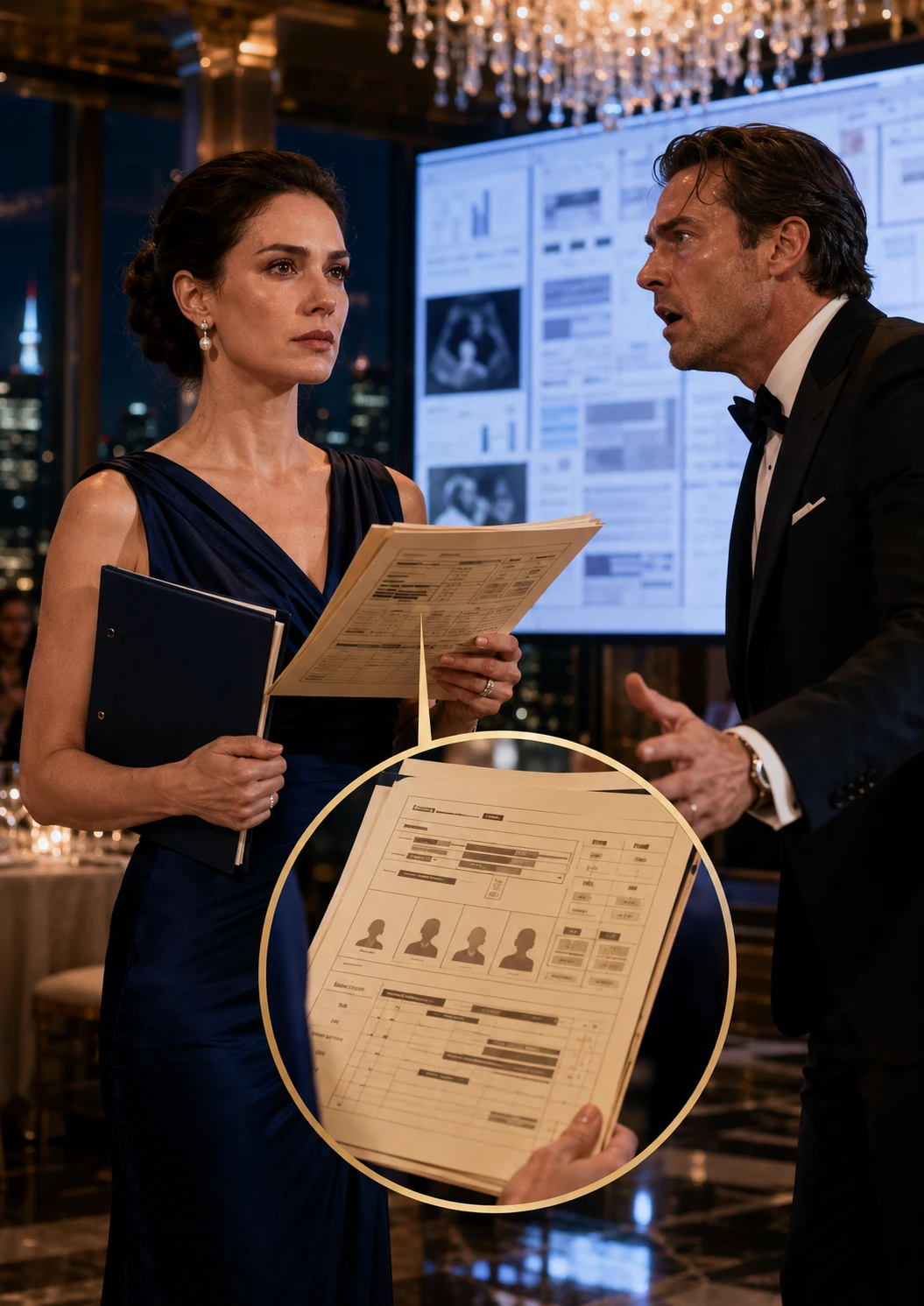
Temporary sole decision-making authority to me regarding Oliver’s media exposure, education, medical care, and therapeutic support until further order. Julian’s parenting time remained, but with conditions. No third-party filming. No public posts. No introducing Oliver to Blaire’s pregnancy without therapist guidance and mutual parental planning. No involving him in promotional, sponsored, or monetized content. No bringing him to Blaire’s residence until the court received recommendations from a child specialist.
And my favorite line, which Nina underlined in her copy:
The Court finds Defendant’s conduct reflects a troubling willingness to subordinate the minor child’s emotional privacy to adult reputational concerns.
Adult reputational concerns.
It sounded so civilized.
So clean.
So much nicer than what it meant.
Outside the courtroom, Julian caught up to me near the elevators.
Nina stepped slightly in front of me.
He ignored her.
“Are you proud of yourself?” he asked.
I looked at him then.
Really looked.
He seemed older under the fluorescent light. Not less handsome, exactly, but less convincing. The beautiful suit could not hide the sweat at his temple or the little pulse of panic in his jaw. For years, I had mistaken Julian’s confidence for strength. Now I saw it for what it was: a performance that required applause.
“I’m relieved,” I said.
“You humiliated Blaire in court.”
“She volunteered to attend.”
“She’s pregnant.”
“I heard.”
His mouth twisted. “You’re cold.”
“No. I’m precise.”
“Oliver is my son too.”
“Then stop treating him like a brand asset.”
His eyes flickered, and I knew I had hit the bruise beneath the ego.
Nina touched my elbow.
“We’re done here.”
But Julian stepped closer.
“You think this makes you safe?” he said quietly. “You think a judge’s order changes anything? People know you, Evelyn. They know how controlling you are. How perfect you need everything to look. Blaire is young, she’s kind, she’s carrying my child. What do you think the public will see?”
There it was.
The threat beneath the velvet.
He thought this would become a story about a bitter wife punishing a pregnant woman. He thought Blaire’s followers would do what followers do: consume the easiest emotion available. He thought the world would see her tears before it read the order.
Maybe he was right.
But he had forgotten one thing.
I had spent my entire adult life making powerful people donate money after dessert. I understood narrative. I understood lighting. I understood where sympathy lived and how quickly it moved when fed the right image.
Most importantly, I understood restraint.
“Julian,” I said, “the public is not my judge.”
He smiled then, and it was almost sad.
“No,” he said. “But it can be your jury.”
He walked away with Blaire tucked under his arm like a campaign promise.
Nina waited until the elevator doors closed.
“He’s going to leak something.”
“Yes.”
“Good. Let him.”
I turned to her.
She smiled. It was the first truly dangerous expression I had seen on her face all week.
“Evelyn, men like your husband always think the first person to talk controls the story. They forget the last document usually does.”
That night, Blaire posted a video.
Not the announcement. She could not risk that now.
Instead, she sat in a nursery chair beneath a cream boucle throw and spoke softly about “choosing peace during spiritual attacks.” She never named me. She did not have to. She held her stomach. She dabbed at her eyes. She said some people believe love is ownership. She said children deserve to be welcomed, not weaponized. She said motherhood had already taught her that protection sometimes looked like prayer.
The video had 1.8 million views by morning.
The comments were exactly what Julian had predicted.
His ex sounds bitter.
Imagine attacking a pregnant woman.
Some women can’t handle being replaced.
The kid deserves to know his sibling.
Team Blaire.
Lila sent me screenshots until I asked her to stop.
Nina called.
“Do you want to pursue a gag provision?”
“No.”
“Evelyn.”
“She didn’t name me.”
“She heavily implied.”
“I know.”
“This could get ugly.”
“It already is. Let it get useful.”
A pause.
“You have something.”
“I have many things.”
After I hung up, I took Oliver to school.
A photographer was outside.
Not paparazzi, exactly. New York has tiers of vultures. This one was freelance, wearing a baseball cap and pretending to photograph a delivery truck.
Oliver squeezed my hand.
“Mommy, why is that man looking at us?”
I knelt in front of him, blocking the camera with my body.
“Sometimes adults are curious in rude ways,” I said. “But you are safe.”
“Did I do something?”
My heart cracked cleanly.
“No, sweetheart. Never.”
He nodded, trusting me because he was six and I was his weather.
After drop-off, I walked straight to the photographer.
He lowered his camera too late.
“Delete the photos,” I said.
“Public sidewalk.”
I smiled.
“My attorney will be in touch with your agency in fifteen minutes. The child you photographed is subject to an active family court privacy order. The school also has a no-media perimeter policy. You can sell the pictures and buy yourself a lawsuit, or you can delete them and enjoy your coffee.”
He stared at me.
Then he deleted them.
Sometimes grace is overrated.
By the time I reached the office, I had made a decision.
Julian wanted the public.
Fine.
But he would not get my tears.
He would get the architecture.
CHAPTER 4 — THE HOUSE ALWAYS KNOWS
The Alden House Media annual investor dinner was scheduled for the following Thursday at the Rainbow Room.
Julian should have canceled.
But arrogance is optimism with better tailoring.
The dinner was meant to celebrate the company’s expansion into “family-centered lifestyle programming,” a phrase that had become poisonous in my mouth. Investors, advertisers, media executives, and cultural parasites would gather beneath the famous windows while Manhattan glittered below like a jewelry box. Julian would stand at a podium and talk about trust, legacy, emotional storytelling, and the future of American family content.
Blaire was supposed to attend as his partner.
So was I.
Not as his wife.
As a representative of Harborlight Partners, the quiet institutional investor whose voting stake Julian still had not bothered to trace back to me.
The invitation arrived by courier on thick white cardstock.
Mr. Julian Alden and Alden House Media request the pleasure of your company…
I laughed so hard Marisol came into my office to check on me.
“Good laugh or bad laugh?” she asked.
“Expensive laugh.”
“Those are my favorite.”
The week between court and the dinner unfolded like a chessboard assembling itself.
Julian’s team pushed stories through friendly society columns. Sources close to the Aldens described me as “struggling with the separation” and “deeply uncomfortable with Julian’s new happiness.” Another item claimed I had “blindsided” him with legal action during a “sensitive family transition.”
Blaire posted less but better. A hand on her stomach beside a window. A Bible verse. A tray of saltines. A shot of tiny ivory booties with the caption: Loved already, even when the world is unkind.
The world, apparently, was me.
I said nothing.
Instead, I met with accountants.
Numbers are wonderfully indifferent to captions.
In a conference room at Whitmore Foundation, beneath a painting of a storm off Nantucket, my forensic accountant, Daniel Cho, laid out Julian’s financial misconduct with the neat sorrow of a doctor explaining a preventable disease.
“Corporate funds paid for Ms. Covington’s condo staging,” he said. “Also wardrobe, travel, personal security, cosmetic treatments categorized as ‘on-camera wellness preparation,’ and a nursery design invoice coded under set development.”
Nina sat beside me, highlighting.
“How much?” she asked.
“Directly traceable? Just over $612,000. Likely more.”
I looked at the spreadsheet.
Half a million dollars to make adultery look aspirational.
Daniel continued. “There are also transfers to a Delaware LLC, Bellwether Creative. It appears to be controlled by Ms. Covington’s manager. The payments are labeled consulting.”
“Deliverables?” I asked.
“None we can find.”
Nina’s pen stopped.
“Say that again.”
“No deliverables.”
“How much?”
“Two point four million over eighteen months.”
Even Lila, who had insisted on attending as my “emotional support menace,” went silent.
Nina looked at me.
“Evelyn.”
“I know.”
This was no longer only a divorce.
It was corporate exposure.
Shareholder exposure.
Possibly fraud.
Julian had not simply betrayed me.
He had used company money, investor trust, and philanthropic goodwill to subsidize the woman who planned to put my child in front of a camera.
There are moments when revenge stops being personal and becomes custodial.
You are no longer punishing a man for hurting you.
You are removing him from machinery he has proven willing to corrupt.
Harborlight’s counsel issued a formal demand for records the next morning.
By afternoon, Julian called seventeen times.
I answered none.
At five, his attorney emailed Nina accusing us of “weaponizing corporate governance to gain leverage in matrimonial proceedings.”
Nina forwarded it to me with a note.
Translation: they are very frightened.
Good, I wrote back.
On Wednesday, the day before the investor dinner, I drove to Sag Harbor.
I had not been back since Julian left.
The house sat behind hedges on a quiet lane near the water, gray shingles, white trim, hydrangeas still bare from winter. It was the sort of place magazines called understated because the truly rich prefer their excess to whisper. I parked in the shell driveway and sat for a moment with both hands on the steering wheel.
The garden looked smaller than I remembered.
Pain often enlarges places.
Inside, the house smelled faintly of lemon oil and cold stone. The housekeeper, Mrs. Donnelly, hugged me at the door and pretended not to wipe her eyes.
“I changed the linens in the primary,” she said. “I didn’t know if you’d stay.”
“Thank you.”
“And I boxed what she left.”
My gaze sharpened.
“She?”
Mrs. Donnelly’s mouth tightened.
“Ms. Covington came with Mr. Alden last month. For a weekend.”
Of course she had.
I walked through the house slowly.
Blaire had touched it everywhere.
A silk scarf in the mudroom. A bottle of perfume in the downstairs powder room. A prenatal vitamin sample pack in the kitchen drawer where I kept birthday candles. In the primary bathroom, she had left a gold hair clip beside the sink, delicate and deliberate.
Women leave things for other women.
Not by accident.
A hair tie. A lipstick. A receipt. A small flag planted in enemy soil.
I picked up the hair clip with a tissue and dropped it into the trash.
Not because I was threatened by it.
Because it was ugly.
In the garden, beneath the pergola, chalk marks remained on the stone patio where the production team had planned camera positions. Someone had taped a tiny label to the back of a chair.
OLIVER.
I stood there for a long time.
The hydrangeas were beginning to bud. Small green fists.
I thought of the day I planted them after the second miscarriage, how Julian had brought me lemonade and sat beside me in the dirt wearing trousers too expensive for mud. I had loved him then for not caring. I had not understood that the same quality could become carelessness.
Mrs. Donnelly found me there.
“I almost called you,” she said.
“You should have.”
“I was afraid of overstepping.”
“The overstepping occurred before you.”
She nodded toward the chalk marks.
“They had balloons,” she said. “Ivory and blue. A little sign. Very tasteful, I suppose.”
Tasteful.
The word struck me as obscene.
“Did Oliver know?”
“No. He wasn’t here yet. Mr. Alden said a driver would bring him.”
I closed my eyes.
A driver.
Not even Julian.
He was going to have my child delivered to his own exploitation like wardrobe.
When I opened my eyes, I saw something half-hidden beneath the outdoor console.
A small white envelope.
Inside was a folded sheet of production stationery, overlooked during the failed cleanup.
A revised shot list.
Scene 7: Oliver runs to Blaire. She kneels. He touches belly. Julian joins. Family embrace.
Director note: encourage natural first reaction. If child hesitates, reset and prompt with “baby sibling.”
At the bottom, in handwriting I recognized, Julian had written:
Make sure Ev never sees this version.
The garden disappeared for a second.
Not from tears.
From clarity.
That night, I slept in the Sag Harbor house alone.
No wine. No music. No dramatic staring at the sea.
I slept because war requires rest, and because the bed was mine.
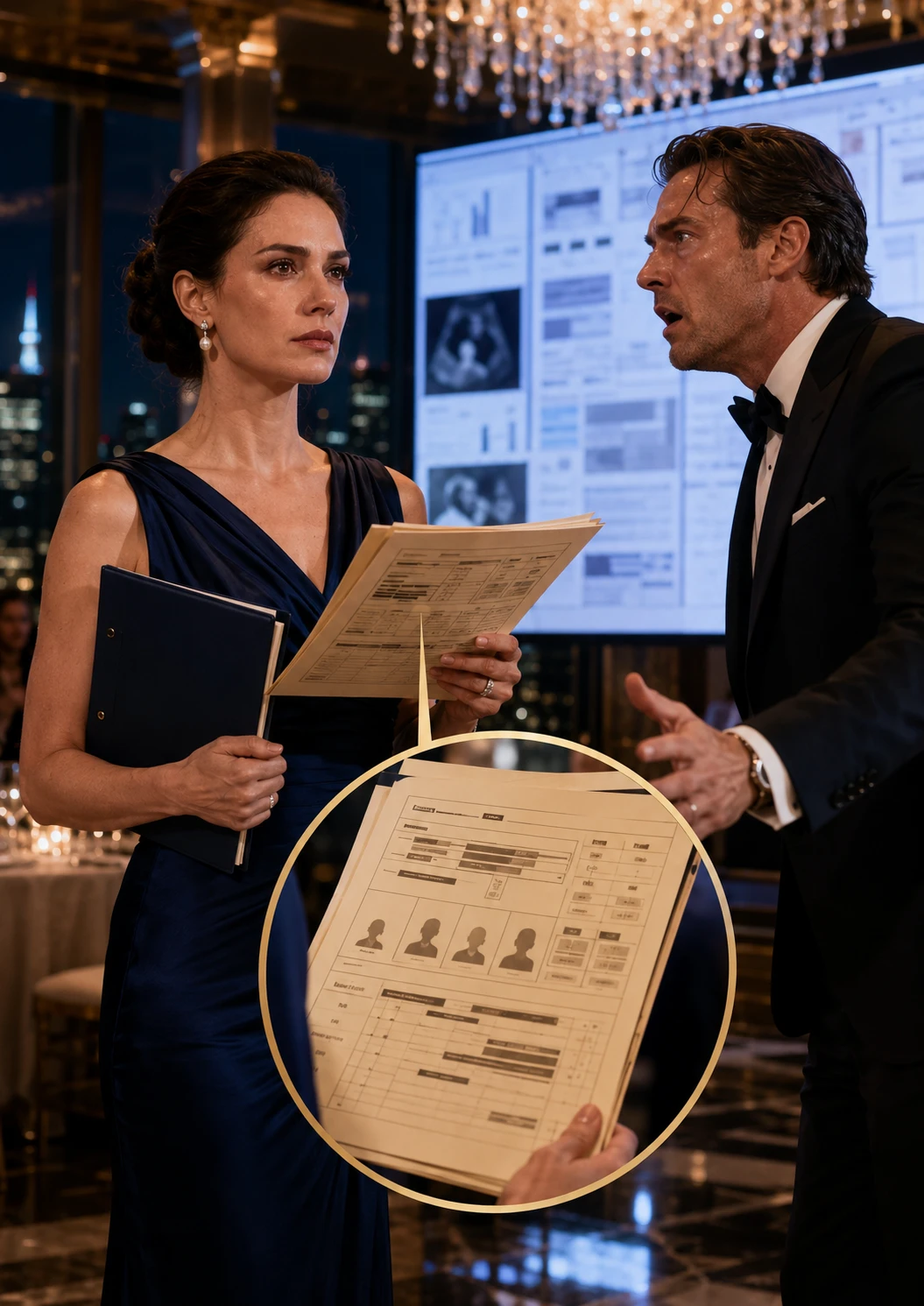
The next morning, I dressed for the Rainbow Room in a gown the color of midnight.
Not black. Not mourning.
Midnight.
A deep blue silk column with long sleeves, a high neck, and a slit that appeared only when I moved. My hair was swept back. My makeup was minimal. My grandmother’s pearls were at my ears. My wedding ring was on my finger.
In the mirror, I looked like a woman a man might underestimate only once.
Lila arrived to ride with me.
She looked me up and down.
“Oh,” she said. “You’re not attending. You’re haunting.”
“Good.”
In the car, my phone buzzed.
Julian: Don’t come tonight if you plan to embarrass yourself.
I showed Lila.
She smiled out the window.
“Men truly have no survival instinct.”
The Rainbow Room was all gold light and glass, the city spread below in a glittering black bowl. Waiters moved with silver trays. Women in satin laughed too brightly. Men checked stock prices between compliments. A jazz trio played something smooth enough to hide a murder.
Conversation dipped when I entered.
I let it.
Blaire stood near the windows in pale pink, one hand curved over her still-flat stomach. Julian was beside her, surrounded by investors. He saw me and froze for half a second before recovering with that politician’s smile I used to mistake for composure.
“Evelyn,” he said as I approached. “I wasn’t sure you’d come.”
“Why not?”
His smile tightened. “Given everything.”
“Everything is exactly why I came.”
Blaire looked at my wedding ring.
I looked at her face.
She was very pretty in person. Softer than her pictures, younger, less certain without comments rolling in beneath her. For one human second, I saw not a villain, but a girl who believed being chosen by a married man meant she had won something rare.
Then she smiled.
“Evelyn,” she said, voice honeyed for the nearby listeners, “I hope someday we can all heal. For the children.”
The children.
Plural.
I tilted my head.
“That will depend on the adults.”
Her smile faltered.
Julian touched her back.
Possessive. Protective. Public.
Once, that gesture would have hollowed me out.
Now I simply noticed that his hand shook.
Dinner began at eight.
Julian took the podium at nine.
He was excellent. I will give him that. Men like Julian do not rise without talent. He spoke of storytelling, of American families, of digital trust. He talked about audiences craving authenticity in a fractured culture. He said Alden House Media was uniquely positioned to become the leading luxury family-content platform in the country.
The room warmed to him.
Of course it did.
A good speech is a beautiful suit for an ugly body.
Then he said, “And tonight, I want to honor the people who make family possible. New beginnings are not always easy. But they are worth celebrating.”
Blaire lowered her eyes, glowing on cue.
A murmur moved through the room.
I felt Lila stiffen beside me.
“He wouldn’t,” she whispered.
But he would.
Julian smiled toward Blaire.
“As many of you know, my life has changed profoundly this year. And I am grateful for grace, for love, and for the courage to build something honest.”
Honest.
My hand closed around the stem of my water glass.
He was going to do it. Not the full reveal, perhaps, but enough. Announce the pregnancy in a room of investors before court had cooled. Turn the narrative into applause. Force the world to clap before it understood what it was clapping for.
Julian looked directly at me.
“To family,” he said.
The room raised glasses.
I did not.
Then the screens behind him changed.
Not to baby photos.
Not to Alden House branding.
To a single blue slide.
HARBORLIGHT PARTNERS — SPECIAL GOVERNANCE NOTICE.
Julian turned.
For the first time all evening, his face emptied.
A woman at the side of the stage stepped forward. Camille Price, Harborlight’s general counsel. Impeccable, silver-haired, and allergic to nonsense.
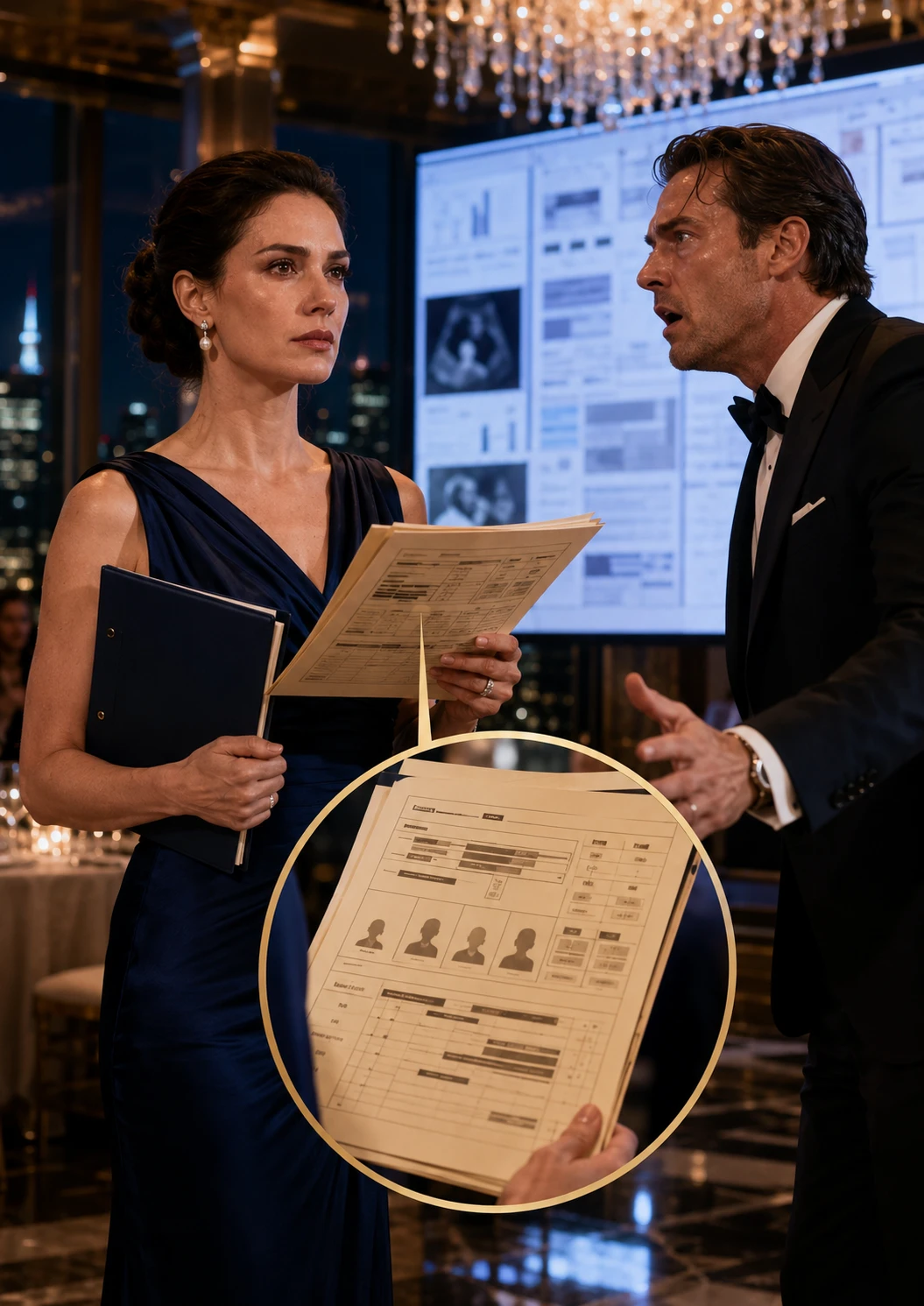
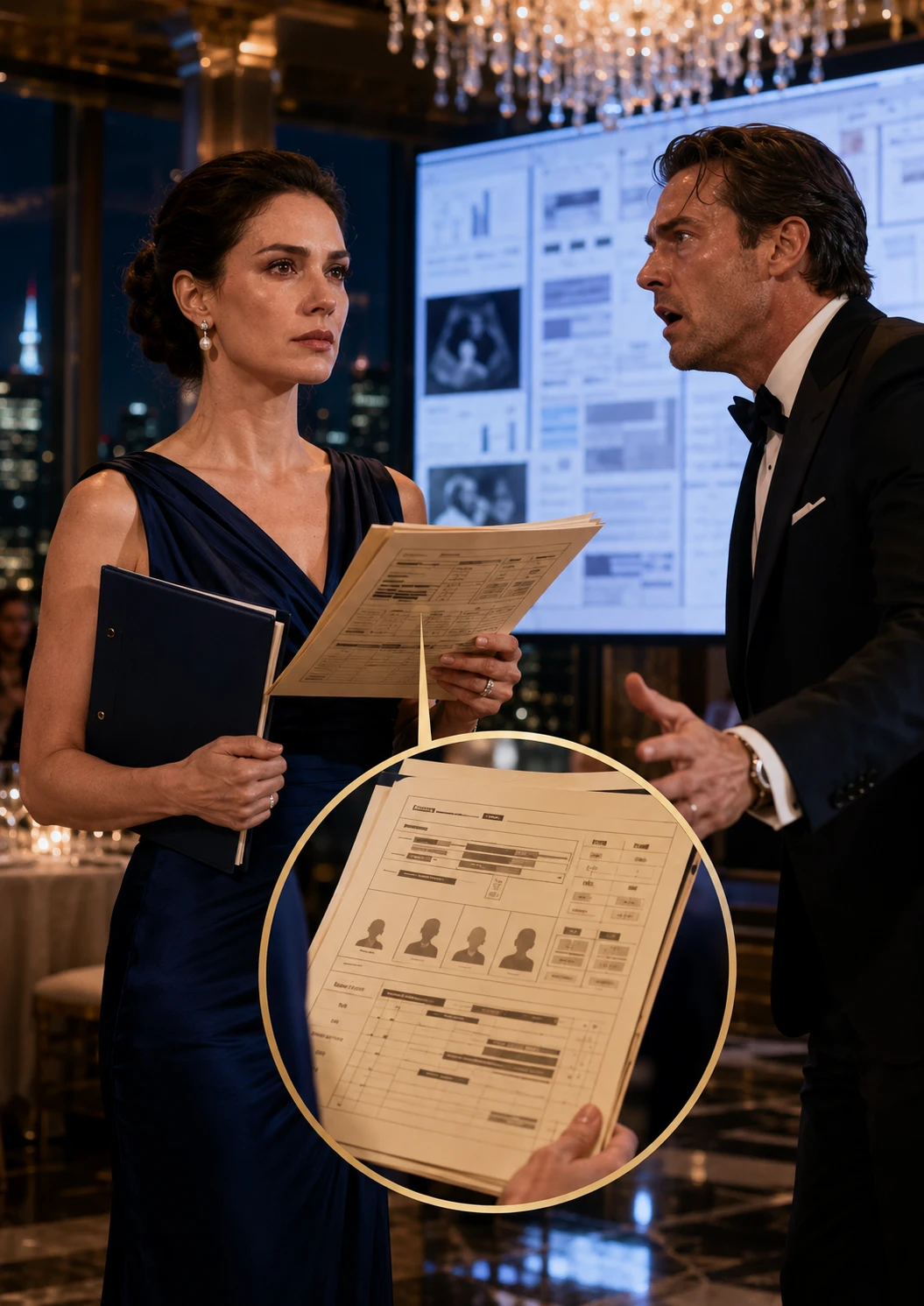
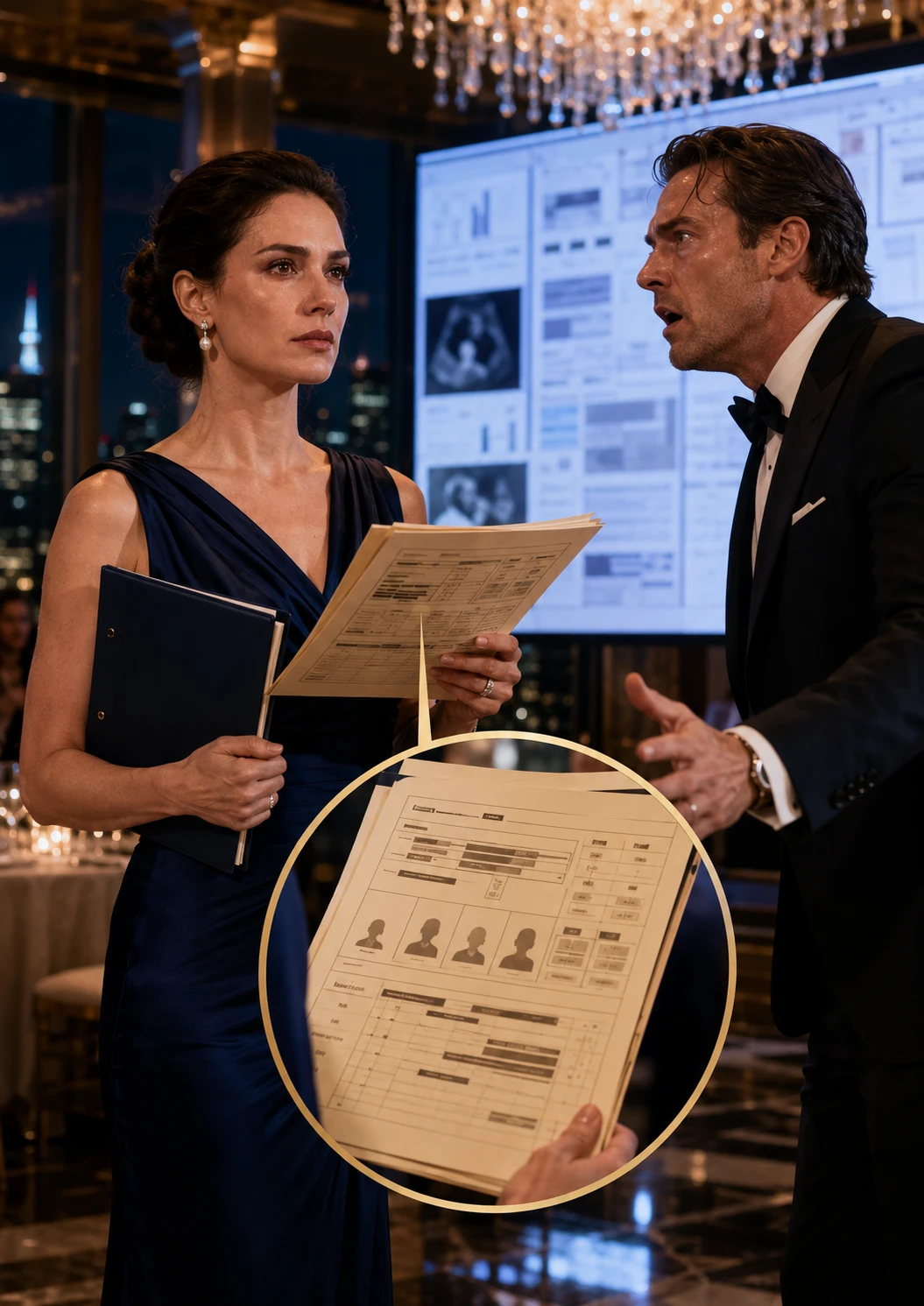
“Good evening,” she said into the second microphone. “My apologies for the interruption. As many of you know, Harborlight Partners holds a significant voting interest in Alden House Media. Earlier today, pursuant to emergency provisions in the shareholder agreement, Harborlight delivered formal notice calling a special board review of executive conduct, misuse of corporate funds, undisclosed related-party transactions, and reputational risk arising from active litigation involving the unauthorized use of a minor child in monetized promotional content.”
The room froze.
Not quiet.
Frozen.
Julian gripped the podium.
“This is not appropriate,” he said.
Camille did not look at him.
“The board packet has been distributed to directors and key investors. Pending review, Harborlight is also exercising its right to suspend approval of the family-lifestyle acquisition announced in tonight’s materials.”
Someone gasped.
I watched Blaire’s face change as the words reached her.
Family-lifestyle acquisition.
That was her deal.
Her company.
Her future.
Camille continued, “For transparency, the packet includes court filings entered this week, financial summaries prepared by independent forensic accountants, and communications reflecting knowledge of a parenting-order violation.”
Julian stepped toward her.
“Turn that off.”
A security guard moved quietly closer.
The jazz trio had stopped playing.
Camille finally looked at him.
“No.”
One word.
Beautifully done.
The screens changed again.
Not to scandalous pictures.
Not to intimate texts.
To documents.
Invoices. Transfers. Redacted emails. Court excerpts. A timeline so clean it felt surgical.
No emotion.
No adjectives.
Just facts.
$184,000 — personal wardrobe expenses categorized as talent development.
$76,500 — residential nursery design categorized as set construction.
$2,400,000 — payments to Bellwether Creative with no documented deliverables.
Text message: Evelyn won’t make trouble if she doesn’t know until after.
Court finding: troubling willingness to subordinate minor child’s emotional privacy to adult reputational concerns.
The room began to make sound again, but now it was the sound of wealthy people recalculating.
Investors whispering.
Lawyers rising.
Phones lighting up.
Blaire stepped backward as if the floor had tilted. Julian turned toward me, and the look on his face was almost worth the years.
Almost.
He understood then.
Not all of it.
But enough.
He understood that while he had been teaching his mistress how to stand in my garden, I had been reading the agreements.
He walked off the stage toward me, ignoring the hands trying to stop him.
“What did you do?” he said.
I stood.
The room watched us with shameless hunger.
I kept my voice low, which forced him to lower his or look hysterical.
“I protected my son.”
“You destroyed my company.”
“No. You used your company as a wallet and your child as a prop. I preserved value for the shareholders.”
His eyes burned.
“You’re Harborlight.”
I smiled faintly.
“My grandmother was Harborlight. I inherited her taste in quiet entrances.”
For a moment, he looked physically struck.
Then came the rage.
“You lied to me.”
“No, Julian. You never asked because you thought my money was ornamental.”
Around us, phones were definitely recording now. Not officially. Not visibly. But the tiny glint of lenses had begun to bloom.
Blaire appeared at his side.
“Julian,” she whispered. “Do something.”
He looked at her, and I watched the spell thin.
That is the cruelest part of public disgrace. It makes love show its receipts.
Blaire did not ask if he was okay.
She asked him to fix the scene.
Across the room, an investor I recognized from Boston was already on a call. Two board members huddled with Camille. Martin Voss, Julian’s lawyer, had turned the color of skim milk.
Julian leaned close enough that only I could hear.
“You think you won.”
“No,” I said. “I think Oliver did.”
His face changed at our son’s name. Something flickered there—anger, grief, maybe shame. I did not chase it. I had spent too many years chasing Julian’s better self through rooms where it refused to appear.
I picked up my clutch.
“Good night, Julian.”
As I passed Blaire, she grabbed my wrist.
Her fingers were cold.
“Please,” she said. “You don’t understand. This is my life.”
I looked down at her hand until she released me.
Then I looked at her.
“No,” I said. “It was my life. You made it content.”
I left her there beneath the gold ceiling, surrounded by the soft collapse of everything she had tried to curate.
Outside, Manhattan was wet and bright.
Lila followed me into the elevator and waited until the doors closed.
Then she whispered, “Evelyn.”
“Yes?”
“That was the most terrifyingly elegant thing I have ever seen.”
I leaned back against the mirrored wall.
For the first time all night, my knees felt weak.
Lila took my hand.
“Are you all right?”
I watched our reflections: two women in evening gowns, one furious, one finally tired.
“No,” I said. “But I’m free in the correct direction.”
By midnight, the story had broken.
Not because I leaked it.
Because rich people can keep secrets only when there is no advantage in telling them.
A business reporter posted about the governance action. A legal commentator found the public custody filing. Someone uploaded a shaky clip of Camille’s announcement. By morning, the internet had assembled its own courtroom.
The same strangers who called me bitter on Tuesday were calling me iconic on Friday.
This is why I do not trust public opinion.
It has no spine, only appetite.
But I will admit the captions were satisfying.
HE TRIED TO USE HER SON FOR HIS MISTRESS’S BABY REVEAL. SHE USED THE CALL SHEET IN COURT.
THE WIFE DIDN’T POST. SHE FILED.
QUIET LUXURY REVENGE IS JUST A LAWYER WITH RECEIPTS.
Lila sent the last one with eleven flame emojis.
Blaire deleted her spiritual warfare video.
Then she posted again.
A black screen. White text.
I am taking time offline to protect my peace and my baby.
Nina forwarded it to me.
Protecting peace is cheaper after discovery, she wrote.
I did not respond because I was at Oliver’s soccer game.
Julian did not come.
CHAPTER 5 — THE REVEAL THAT FINALLY FILMED
The final twist arrived three weeks later in a sealed envelope.
By then, Julian had been removed as CEO pending investigation. Alden House Media announced an interim leadership committee. Advertisers paused campaigns. Bellwether Creative hired criminal counsel. Blaire’s follower count dropped, then rose, then dropped again, because scandal is a tide pool where everyone comes to look at trapped things.
Family court moved faster than expected.
Judge Crowe appointed a child specialist. Oliver began seeing Dr. Hannah Reed, a warm woman with silver sneakers and a gift for making hard questions feel like puzzles. Julian’s parenting time continued under clear boundaries. He hated the boundaries, which proved their necessity.
He saw Oliver at the park. At supervised transition points. At soccer.
Not at Blaire’s condo.
Not on camera.
Not in any room where adults needed him to perform happiness.
I did not celebrate his reduction.
That surprised people.
Lila wanted champagne. Marisol offered to order cupcakes with tiny gavels on them. Nina said nothing, but I suspected she approved.
I declined.
Not because I was noble.
Because custody victories are not champagne moments.
They are seatbelt moments.
You are grateful the car stopped before the cliff. You do not toast the cliff.
Oliver missed his father.
That was the part strangers never understood.
Children do not stop loving people because those people behave badly. Often they love them harder, as if affection can repair adult fractures. Oliver asked why Daddy seemed sad. He asked when he could see the Sag Harbor house again. He asked if Blaire was the reason Daddy did not live with us anymore.
I answered carefully.
“Daddy made grown-up choices that hurt our family.”
“Did I make him?”
“No.”
“Can I fix it?”
“No, sweetheart. That is not your job.”
He thought about that.
Then he asked if dinosaurs had divorce.
I said probably not, because most of them had very small arms and couldn’t sign documents.
He laughed for almost a minute.
That laugh saved me more than revenge did.
The sealed envelope came on a Thursday.
Nina delivered it herself.
That alone told me it mattered.
We sat in my office at the foundation. Outside, Madison Avenue shone with late spring light. Tulips stood in planters. Women in sunglasses carried iced coffees and secrets.
Nina placed the envelope on my desk.
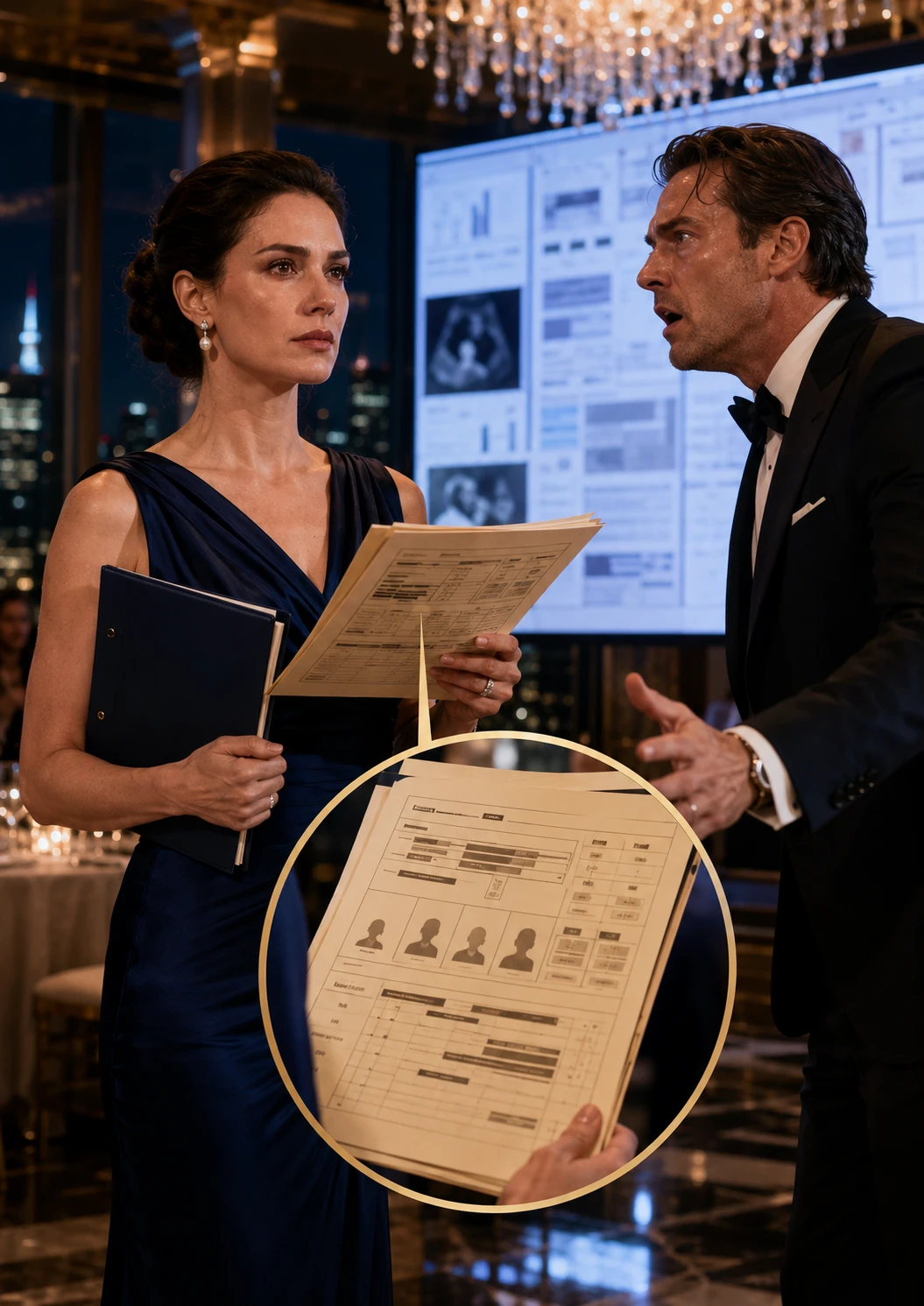
“This is from counsel for Marlowe Finch Films.”
“The videographer?”
“Yes.”
I touched the edge of the envelope.
“What is it?”
“A copy of the raw pre-production file their team preserved after the court order. Including audio from a location walk-through at Sag Harbor.”
I stilled.
“Audio.”
Nina nodded. “Apparently their cameras were rolling for light tests. Blaire, Julian, her manager, and the director were present. They were discussing how to get Oliver’s reaction.”
I felt the old cold return.
“Play it.”
“Evelyn—”
“Play it.”
Nina opened her laptop.
The audio was imperfect. Wind. Footsteps on stone. A woman laughing. Blaire’s voice first, breathy and excited.
“It has to feel like he’s surprised but happy. Like, not confused. Happy.”
The director said, “Kids are unpredictable. We can prompt him.”
Blaire’s manager: “The brand wants warmth. If he seems upset, we cut around it.”
Julian’s voice, impatient.
“He’ll do what I tell him.”
My hands curled in my lap.
Blaire again.
“What if he asks where Evelyn is?”
A pause.
Then Julian laughed.
Not kindly.
“Tell him Mommy wanted him to have a special day with Daddy.”
The garden wind hissed through the speakers.
Blaire’s manager said, “And if he mentions not knowing about the baby?”
Julian: “We reset. Get the sign in his hands first. Once he’s holding it, he’ll understand enough.”
Blaire, softer: “I don’t want him crying.”
Julian: “Then don’t make it weird. He’s six. Give him a cupcake.”
The audio ended.
For a while, neither Nina nor I spoke.
I had thought the call sheet was the violation.
I had thought the text was the cruelty.
I had not understood there was a deeper layer: not merely that Julian planned to use Oliver, but that he anticipated Oliver’s confusion and built production instructions around managing it.
Give him a cupcake.
I stood and walked to the window.
Madison Avenue blurred.
This time, I did cry.
Quietly.
Not for Julian. Not for Blaire. Not for myself.
For my son, who had been loved by me like breath and scheduled by his father like a scene.
Nina let me cry for exactly as long as dignity allowed.
Then she said, “There’s more.”
I turned.
She was watching me with an expression I could not read.
“What more?”
“The email.”
“The call sheet?”
“Yes.”
“What about it?”
“It wasn’t sent to you because someone mistyped.”
I stared at her.
“Marlowe Finch sent it intentionally.”
The room seemed to narrow.
“Why?”
“Because the owner recognized your name.”
“I don’t know the owner.”
“You do.”
Nina slid a second document across the desk.
Marlowe Finch Films, LLC.
Managing Member: Nathaniel Reed.
For a moment, the name did not fit anywhere.
Then it did.
Nate Reed.
My first almost-love.
Not first love, exactly. That belonged to a boy from Newport who kissed me behind a boathouse and later became a dermatologist. Nate was different. Nate had been my grandmother’s scholarship kid, the son of a housekeeper in Bar Harbor, brilliant with cameras, always seeing what other people missed. He spent one summer at our Newport house when we were nineteen, helping my grandmother catalog family photographs. We swam at night. We shared cigarettes we pretended not to hate. He once took a picture of me reading on the rocks and said, “You look like you’re waiting for a future that deserves you.”
I had kept that photo for years.
Then life separated us with the quiet efficiency of class, grief, and timing. He went west. I went to college, then foundation work, then Julian. I heard he had become a documentary filmmaker, then a commercial director. I had not known Marlowe Finch was his company.
“He was at the walk-through?” I asked.
“No. His team was. But when the file came through for final review, he saw Oliver Alden, Sag Harbor, Evelyn Whitmore Alden listed as emergency contact in an old internal note, and the consent line signed only by Julian. He reviewed the custody-sensitive language in their own release protocols and sent the call sheet to you directly.”
I sat down slowly.
“So not a mistake.”
“Not exactly.”
My mind went back to the subject line. FINAL CALL SHEET. The professional language. The absence of a note. The cleanness of it.
“He protected himself legally,” Nina said. “But yes. He also protected your son.”
I looked at the name again.
Nathaniel Reed.
The past is not dead. Sometimes it is simply waiting until you have enough evidence to survive it.
“Does Julian know?”
“No.”
“Does Blaire?”
“No.”
“Good.”
Nina studied me.
“There is one more strategic question. With this audio, we can seek a stronger custody order. We can also use it in the corporate investigation. But once it is filed, it may become part of the public narrative.”
“No,” I said.
Nina blinked.
“No?”
“Not unless the court requires it.”
“Evelyn, it is powerful.”
“That’s why we don’t feed it to strangers.”
Understanding dawned slowly on her face.
I continued. “The internet has enough pieces. The judge can review it under seal. Oliver does not need millions of people hearing his father discuss how to manipulate him.”
Nina smiled then.
Not dangerous this time.
Proud.
“That,” she said, “is the difference between revenge and protection.”
I thought of Blaire crying online about peace. Julian speaking at the Rainbow Room about family. Strangers calling me iconic because my pain had become entertaining.
The temptation was real.
I could release the audio and end them.
Not legally. Not financially.
Mythologically.
There would be no recovery from it. No rebrand. No soft comeback podcast. No exclusive interview about complicated love. The clip would live forever in the merciless archive of the internet, Julian’s voice saying, Give him a cupcake, every time Oliver’s name was searched.
And that was why I could not do it.
A mother’s revenge must never become another cage for her child.
So we filed it under seal.
Judge Crowe heard it in chambers.
I know because when she returned to the bench, she looked at Julian as if he had tracked mud across a nursery.
The final custody order came six weeks later.
I received primary residential custody. Joint legal custody remained in name only, with tie-breaking authority to me in all matters involving health, education, media, and emotional welfare. Julian was barred from posting Oliver, authorizing others to post him, discussing custody litigation publicly, or introducing him into promotional environments. Any future partner would be introduced only after therapeutic guidance. No monetized content involving Oliver. No staged family announcements. No public use of his name, image, voice, school, schedule, or likeness.
It was not total victory.
Family court rarely gives those, because children are not trophies and parents are not wars to be won.
But it was safety.
Safety is not glamorous.
It is better.
Julian signed the order with a face like stone.
Outside the courthouse, he stopped me.
For once, he was alone.
No Blaire. No publicist. No lawyer hovering close enough to bill by the breath.
He looked thinner. Still beautiful, because consequences do not erase bone structure. But diminished. The world had begun speaking to him in a tone he did not like.
“Evelyn,” he said.
I waited.
“I didn’t think it would go this far.”
It was the closest thing to an apology he had offered.
I did not accept it.
“Of course you didn’t,” I said. “You never think the damage should travel as far as the act.”
He flinched.
“Is Oliver okay?”
The question was so late it almost hurt more.
“He will be.”
“Does he hate me?”
“No.”
His eyes shone then, and for one brief, terrible moment, I saw the man who had cried when Oliver was born.
I softened.
Not enough to return.
Enough to tell the truth gently.
“He loves you,” I said. “That is why you have to become someone safer to love.”
Julian looked away.
Across the courthouse steps, spring moved through the trees with shameless beauty.
“Blaire left,” he said.
I had known, of course. Lila knew everything within six hours. Blaire had moved to Los Angeles “for privacy,” which was influencer language for new management. The pregnancy remained real, as far as I knew. The relationship did not.
“I’m sorry for the child,” I said.
His mouth twisted. “Not for me?”
“No.”
A laugh escaped him. It had no humor in it.
“I suppose I earned that.”
“You earned worse. Oliver saved you from worse.”
He looked at me then.
Maybe he understood. Maybe he didn’t.
Understanding was no longer my responsibility.
As I turned to leave, he said, “Did you ever love me?”
I stopped.
The old question.
The useless one.
I looked back at him.
“Yes,” I said. “That was never the problem.”
His face changed in a way I chose not to carry.
Then I walked away.
A month later, I took Oliver to Sag Harbor.
Not for Julian.
For us.
Mrs. Donnelly opened the house early. We aired out the rooms. We donated the furniture Blaire had chosen for the nursery setup. We scrubbed chalk marks from the patio. Oliver helped me plant new hydrangeas, white ones this time, because he said blue was “too expected.”
He wore old shorts and rain boots. Dirt streaked his cheek. He asked if plants got scared when you moved them.
“Maybe,” I said. “But they can still grow.”
He considered this with the seriousness of a six-year-old philosopher.
“Do people grow after scary stuff?”
“Yes.”
“Even daddies?”
I pressed soil around the roots.
“Even daddies, if they decide to.”
“Even mommies?”
I smiled.
“Especially mommies.”
That afternoon, while Oliver napped on the sofa with a book open on his chest, I found an envelope in the mailbox.
No return address.
Inside was a photograph.
Black and white.
Me, at nineteen, sitting on the rocks in Newport with a book in my lap, hair wild from saltwater, eyes lifted toward something beyond the frame.
On the back, in handwriting I remembered immediately:
Still waiting for a future that deserves you?
I stood in the kitchen for a long time, holding the past between two fingers.
My phone buzzed.
An unknown number.
This is Nate Reed. I hope sending the call sheet didn’t make things harder before it made them safer. I should have written sooner. I wasn’t sure I had the right.
I read it twice.
Then I looked into the living room at Oliver asleep beneath a quilt, safe from cameras, safe from strangers, safe for the moment in the small, holy way children can be when adults finally choose them over themselves.
I typed back.
You had the right when you protected my son.
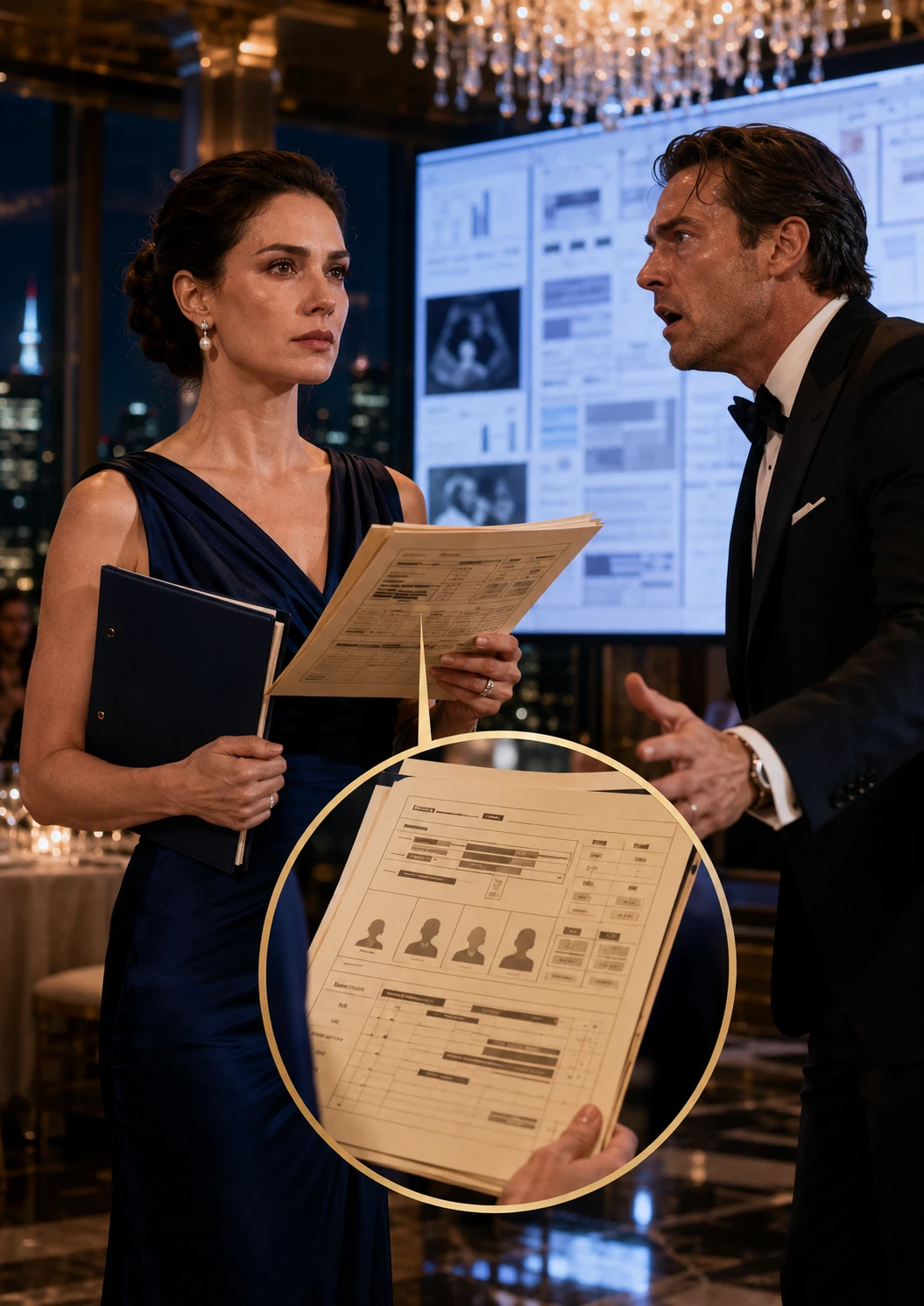
The reply came a minute later.
Coffee sometime? No cameras.
I smiled.
Not because it was romance.
Not yet.
Because it was a door that did not demand I walk through it bleeding.
Maybe someday I would sit across from a man who knew the difference between witnessing and taking. Maybe someday I would let myself be adored without becoming useful. Maybe someday love would not arrive as a storm to survive but as a lamp left on in a house where I was expected, not consumed.
For now, there was Oliver.
There were hydrangeas.
There was a kitchen full of afternoon light.
There was a future, not perfect, but finally mine.
WARM CONCLUSION — THE QUIET AFTER THE APPLAUSE
People think revenge is loud.
They imagine slammed doors, viral speeches, champagne thrown in beautiful faces. They imagine a woman in a black dress destroying a man under chandeliers while everyone watches.
And yes, sometimes revenge wears silk.
Sometimes it has a lawyer, a voting stake, and a screen full of documents.
Sometimes it enters a room so quietly that by the time anyone hears the blade, the cut has already been made.
But the best revenge is not the destruction.
It is the morning after.
It is making pancakes while your child tells you a dream about dinosaurs on skateboards. It is deleting social media apps because strangers have mistaken your custody battle for a season finale. It is sleeping through the night for the first time in months. It is realizing the bed is not empty; it is peaceful.
It is learning that being publicly humiliated does not make you public property.
It is watching a man who treated your silence as permission discover it was preparation.
It is choosing not to release the cruelest evidence because your child’s dignity matters more than the crowd’s hunger.
It is taking back the garden.
By summer, the hydrangeas bloomed white and enormous, soft as clouds against the gray shingles. Oliver named them all. One was Spike. One was Professor Leaf. One was Mr. Cupcake, which made me laugh harder than it should have.
Julian came for his scheduled weekends. He was quieter with Oliver. More careful. Sometimes careful is not redemption, but it is a start. He attended parenting therapy. He stopped bringing assistants to pickup. He learned to kneel when Oliver spoke.
I did not forgive him quickly.
I did not forgive him for his comfort.
But I stopped organizing my life around the shape of his failure.
Blaire had her baby in September, a girl. I sent a small white blanket with no card, because the child had done nothing wrong and warmth should not depend on adults deserving it.
Nina called me sentimental.
Lila called me terrifyingly evolved.
Marisol said my grandmother would have approved, then cried in the supply closet and denied it.
As for Nate, we had coffee.
Then another.
Then, months later, dinner in a small restaurant in the West Village where no one cared who I had married or how elegantly I had ruined him. Nate asked about Oliver before he asked about the scandal. He listened without reaching for ownership. When he walked me home, he did not try to kiss me at the door.
He said, “You don’t owe anyone a new love story just because the old one ended badly.”
I stood beneath the awning, rain silvering the street behind him, and felt something inside me unclench.
“No,” I said. “But I might want one someday.”
He smiled.
“Someday is a good place to start.”
That night, Oliver crawled into my bed during a thunderstorm. He pressed his cold feet against my legs and whispered, “Mommy, are we safe?”
I held him close.
“Yes,” I said.
Outside, thunder rolled over Manhattan.
Inside, my son slept.
I lay awake for a while, listening to his breathing, thinking of all the rooms I had survived. The ballroom. The courtroom. The boardroom. The garden. The apartment where I first opened the email that changed everything.
The world had called it revenge.
Maybe it was.
But to me, it was simpler.
A woman had tried to use my child to make betrayal look beautiful.
A man had trusted my silence more than he feared my intelligence.
A camera crew had prepared to film my son’s confusion and sell it as joy.
So I did what mothers have always done when the wolves dress well.
I locked the door.
I lit the house.
I kept the child.
And when the internet finally asked what happened, I let the documents answer.
She wanted a cute reveal. I revealed the violation.