
The Porch Before the Wedding
No one tells you the night before your wedding can be quiet enough to hear the truth through a door.
They tell you about nerves. They tell you about excitement. Your friends send jokes in the group chat. Your mother leaves a voicemail that starts with crying and ends with instructions about cuff links. Everyone assumes the night before a wedding is full of noise, champagne, last-minute texts, and sleep you cannot quite find because happiness is too close.
Nobody tells you that at 10:30 on a Friday night in Charlotte, North Carolina, you might sit alone in a hotel room staring at a popcorn ceiling, already dressed in jeans and a jacket you do not remember putting on, feeling something that is not doubt but is too heavy to call joy.
My name is Michael Bradley. I was thirty years old, a senior claims investigator for a commercial insurance company that handled apartment buildings, hotels, and office complexes across the Carolinas. I spent my workdays reading incident reports, maintenance logs, photographs, access records, and the kinds of emails people send when they are trying to make responsibility look smaller than it is. My job had taught me a simple truth: most disasters announce themselves long before anyone admits hearing the sound.
That night, I should have been sleeping.
My suit was pressed and hanging in the closet of my room at the Weston Charlotte on West Trade Street. The rings were with my best man, Phil Jackson, a man who would sooner hand over his left kidney than lose a wedding band. The rehearsal dinner had gone smoothly at Sullivan’s in SouthPark. I had shaken hands, made toasts, smiled for photographs, and laughed when my future mother-in-law, Patricia Bush, cried into a linen napkin because the dessert reminded her that her daughter was no longer a little girl.
Everything was ready.
Everything looked ready.

Still, something had been pulling at me for weeks.
Not about Janet. Never about Janet. I was certain about her in a way that had made every other decision in my life seem like a rough draft. Her name was Janet Bush, twenty-six years old, a graphic designer at a marketing firm in Uptown Charlotte. She had a laugh that arrived half a second too loud and a way of tilting her head slightly to the left when she was concentrating, as if the world made more sense from that angle. The first time I noticed it, I was done for.
We met at a birthday party for Phil in Dilworth, in a backyard strung with lights and crowded with people balancing paper plates of potato salad. I had been standing near the fence, pretending to enjoy a warm beer, when she walked up and said, “You look like someone doing math in his head at a party.”
“That sounds either impressive or sad,” I told her.
“You tell me.”
I laughed, and that was that.
Fourteen months of dating followed. Dinner at little restaurants on South Boulevard. Saturday mornings in Freedom Park. Rainy Sundays on my couch while she worked on design briefs with her laptop open and one foot tucked beneath her. She watched bad movies without shame and cried at commercials involving dogs. She sent me photos of signs with terrible fonts. I started noticing things because she noticed them first.
I proposed at Crowders Mountain on April 12, 2024. She thought we were only hiking. She wore old sneakers and no makeup, and the wind kept pulling loose strands of hair across her mouth. When I got down on one knee at the overlook, she covered her face with both hands and said yes before I reached the question.
We set the wedding for June 14, 2025.
Fourteen months of dating. Fourteen months engaged.
I liked the symmetry.
By the night before the wedding, the venue was ready, the flowers were ready, the guests had flown in, and the Grand Ballroom at the Valentine Hotel in South Charlotte had been transformed into the soft ivory-and-green dream Patricia had been planning since approximately five minutes after the proposal.
Only Janet did not feel ready.
She had not said that, not directly. Janet was not a woman who complained unless she could also offer three solutions and a better typeface for the problem. But in the final weeks before the wedding, she had gone quiet in small places. Her smile would flicker when someone mentioned vows. She would look at me across a crowded room with an expression I could not name before lowering her eyes. Twice, I found her staring at her phone long after the screen had gone dark.
“Wedding stress,” she said when I asked.
I believed her because I wanted to.
That night, alone in the hotel room, I stopped wanting to believe easy things.
At 10:42, I picked up my keys.
I told myself I was only going to drive past her parents’ house. Janet and her mother were spending the night there, following a family tradition Patricia took very seriously. The Bush house sat on Hermitage Court in Myers Park, a two-story colonial with black shutters, a wide porch, and a dogwood tree in the front yard that Patricia watered like it might one day testify in court about her devotion.
I was not going to knock.
That was the lie I told myself from the hotel elevator to the parking garage.
I drove down Tryon, turned through familiar streets, and watched Charlotte settle into that summer-night stillness where every porch light looks intentional. The closer I got to Hermitage Court, the more foolish I felt. You will see her tomorrow, I told myself. She will walk toward you in that dress. You will both laugh about this someday, about how you almost became the groom who showed up at his bride’s parents’ house before midnight because he missed her too much to be reasonable.
The living room lights were on when I arrived.
So was the upstairs light in the room that had been Janet’s bedroom growing up.
I parked at the curb and sat with the engine running.
Go home, Michael.
I almost did.
Then I turned off the car.
The porch steps creaked under my shoes. It was late, so I moved quietly. I remember that detail because later it felt like the whole shape of my life had balanced on the fact that I did not make noise. I walked up the porch with my hand half-raised, planning to knock softly, apologize for showing up, say I loved her, and leave.
I never knocked.
I was three feet from the door when I heard Janet crying.
Not sniffles. Not wedding tears. Not the kind of crying women do at rehearsal dinners when mothers talk about first steps and old photos.
This came from deeper. From a place that had been holding something too long.
Then I heard Patricia’s voice.
“Baby, you have to tell him. You cannot carry this into a marriage.”
I froze.
Janet said, “Mom, I can’t.”
Her father, Gary Bush, spoke next. He was a retired high school principal, a steady man with square shoulders and a voice that usually made people sit up straighter without knowing why.
“You say it the way you said it to us,” he told her. “You sit down with him and tell him the truth.”
“He’ll look at me differently,” Janet said.
The words were wet and broken.
“He won’t,” Patricia whispered.
“You don’t know that. He investigates things for a living. He notices everything. He’ll hear what happened, and he’ll start putting pieces together, and then he’ll look at me like I’m…”
She stopped.
Like I’m damaged.
She did not say the word, but I heard it anyway.
The porch seemed to fall away beneath me.
Janet’s voice dropped so low I had to lean closer to hear.
“What happened in that elevator wasn’t my fault. I know that. I do. But the medical condition it left me with… I have to manage it every day. And now Michael has to know before he marries me. He deserves to know. I know he does. But if I tell him tomorrow, he might not want me anymore.”
I sat down on the porch step.
I am not proud of listening. I need to say that plainly. There are moments a decent man walks away, and there are moments the ground gives out under him and he forgets the rules. My legs had stopped working. My hand was on the railing. The front door was three feet behind me, and on the other side of it, the woman I loved was crying about something she believed might make me leave.
Patricia murmured something about doctors. Gary said the word manageable. Janet said, “You don’t understand. I’ve been trying to say it for months, and every time I get close, I think about his face changing.”
Her face had been changing for months, and I had called it stress.
That is the sentence I still come back to.
I had seen the signs. Not the truth itself, but the outline of it. The cut-off conversations. The way she checked her purse before leaving my apartment, always making sure a small white pharmacy bag was inside. The doctor’s appointment she once called “routine” too quickly. The evening she flinched when a hotel elevator lurched between floors during a venue tour. I had noticed each piece and then filed it under wedding nerves because love can make a man observant and foolish at the same time.
I did not knock.
I walked back to my car.
For twenty minutes, I sat behind the wheel and looked at the Bush house through the windshield. The porch light glowed yellow. A moth bumped against it again and again, unable to understand that light is not always a way in.
I drove back to the hotel.
I did not sleep.
By morning, I had made two decisions.
First, I would not pretend I had not heard what I heard.
Second, I would not let Janet walk down an aisle carrying that secret alone for one more hour.
At 7:15, my phone lit up with a text from Phil.
You alive over there?
I typed back: Barely. I need to talk to Janet before the ceremony. Private.
Three dots appeared. Disappeared. Appeared again.
Michael, the ceremony is at 2. Hair and makeup are already moving like a military operation.
I stared at the message, then typed: Phil, I need to talk to her.
A minute passed.
Then: I’ll make it happen.
By nine o’clock, I was standing in Patricia Bush’s kitchen.
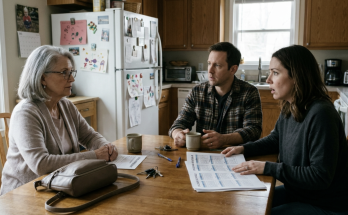
It was the kind of kitchen people gather in because every other room feels too formal. White cabinets, brass pulls, a blue-and-white bowl of lemons on the island. A stack of wedding-day schedules sat beside the coffee maker, each one printed in Patricia’s neat font. Through the back window, I could see Gary’s smoker covered in a black tarp by the patio.
Patricia made coffee without asking. Her hands were steady until she set the mug in front of me, and then the spoon rattled lightly against the saucer. Gary stood by the window with his arms folded, looking at me the way fathers look at men they are deciding whether to trust with something more valuable than their own pride.
Janet came downstairs in a robe, her hair loosely pinned for makeup, her face bare and pale.
She saw me and knew.
Color left her cheeks.
“Michael,” she said.
I stood, then sat again because standing made the moment feel like a confrontation, and I did not want her cornered in her mother’s kitchen on the morning of our wedding.
“I came by last night,” I said. “I was on the porch.”
The silence that followed had weight.
Patricia closed her eyes. Gary’s jaw tightened. Janet looked down at her hands, then back at me.
“How much did you hear?”
“Enough to know you’ve been alone with something you should not have had to carry alone.”
One tear slid down her face. She did not wipe it away.
“So now you know.”
“I know part of it,” I said. “I want to hear the rest from you. Not because I investigate things. Because I’m supposed to marry you in five hours, and I want the truth between us before we say anything in front of everybody else.”
She sat across from me.
For a moment, I could hear the refrigerator hum, the soft tick of the wall clock, Patricia’s controlled breathing beside the sink.
Then Janet began.
It had happened in November 2023, before she and I met. She had been living alone in an apartment building on East 7th Street in NoDa, the kind of renovated building developers describe as historic when they mean the pipes complain and the locks need more attention than the exposed brick. Residents had been reporting problems with the exterior door for months. Sometimes it latched. Sometimes it did not. Management kept saying parts were delayed.
That night, Janet came home late from a client dinner in Uptown. She carried a portfolio bag, a paper cup of coffee gone cold, and a small grocery bag with the next morning’s yogurt because she was the sort of person who prepared breakfast after an exhausting day. The lobby was quiet. The elevator arrived with a maintenance sign folded against the wall inside, though the elevator was still running.
A building employee was there.
She knew his face only vaguely. A maintenance supervisor. The kind of person you see pushing a cart, replacing filters, signing off on service tickets.
The elevator stopped between floors.
The camera inside had been disabled.
Janet told me the next part plainly, without unnecessary detail, the way people speak when they have rehearsed a hard truth in therapy and do not want it made more dramatic by someone else’s imagination. She was trapped in that elevator long enough for something to happen that left her frightened, disoriented, and medically affected. A service chemical had been misused. The details were later argued over by people in suits, but her body had never been confused about the result.
She made it to her apartment and called the emergency line listed in her lease packet before calling her parents. Gary drove her to Carolina Medical Center. Patricia brought clean clothes and sat beside her under fluorescent lights until sunrise.
A medical report was created.
An incident complaint was filed with the property manager.
Residents’ earlier emails about the broken exterior door were attached.
The building promised a review.
Then weeks became months.
The employee’s name was never confirmed to Janet. The property management company said access logs were incomplete. They said the camera issue was unrelated. They said service records were unavailable because of a vendor transition. They said, in four different ways, that what had happened to her was unfortunate but difficult to prove.
Three months later, her doctor confirmed a long-term respiratory condition connected to the exposure and stress her body had endured that night. It was manageable with medication, monitoring, and caution. It was not a life sentence in the way fear had made it feel. But it was permanent enough that Janet began carrying an inhaler, filling prescriptions, keeping appointments, and building an invisible wall of shame around something that had never been her fault.
“I was going to tell you,” she said. “At first I thought it was too early. Then you were so kind, and I thought if I said it, everything would change. Then you proposed, and I should have told you that night, but I was so happy for five minutes that I wanted to stay there. And then every week after that, it got harder.”
She looked at me as though waiting for the face she feared.
I kept my hands on the table because if I reached too quickly, she might think I was trying to fix what had only just been trusted to the air.
“Where are the records?” I asked.
Her expression crumpled slightly.
“That’s the first thing you want to know?”
“No,” I said. “The first thing I want you to know is that I still intend to marry you. The second thing I want to know is where the records are, because if there is a company in this city that ignored a broken door, lost access logs, and let you carry the consequences alone, then the quiet part of their life ends now.”
Patricia made a sound behind her hand.
Gary crossed the kitchen and sat beside his daughter.
Janet stared at me.
“You still want to marry me?”
I almost laughed, but it would have come out wrong.
“I was on a mountain last April, and I asked you to marry me because I knew. I still know. The thing that happened before I met you does not change what I know.”
Her face folded into her hands, and the crying that came then was different from what I had heard through the door. That crying had been fear. This was release.
I let her cry.
Then she stood, wiped her face, and went upstairs.
When she came back, she carried a blue folder.
It was soft at the corners from being opened and closed too many times. Inside were copies of medical reports, prescription summaries, emails to the building office, screenshots of maintenance requests, and a handwritten note from Patricia on hospital stationery listing times, names, and who said what. Janet had kept the folder buried in the bottom drawer of her childhood dresser, beneath old yearbooks and a pair of soccer cleats she had not worn since high school.
She placed it on the kitchen table between us.
That folder changed the room.
Not because it explained everything. It did not. But because pain with paper around it becomes harder for other people to dismiss.
I opened the folder only after she nodded.
The first page was a discharge summary. The second was a leaseholder incident form stamped received by Harrow Residential Services. The third was an email from Janet dated two days after the incident, asking for the elevator camera records and access logs. The reply was short and polished.
We are reviewing the matter internally and will respond as appropriate.
I had read that sentence a hundred times in other cases.
It never meant what frightened people hoped it meant.
“Do you have a lawyer?” I asked.
“Not anymore,” Gary said. “We talked to one briefly. Without the access logs, he said it would be difficult.”
“Difficult is not the same as impossible.”
Janet watched me closely.
“This can’t become your job,” she said.
“No,” I said. “It becomes our life for a while. That’s different.”
We talked for nearly two hours.
We talked about her doctor. Her therapist. The medication. What she needed from me. What I needed from her. I told her gently but clearly that marriage could not begin with a secret large enough to change the air in every room. She nodded. She said she knew. She said fear had taught her silence and she had mistaken silence for control.
“You have to trust me with the hard things,” I told her.
“I wanted to.”
“I know.”
“What if I get scared again?”
“Then we talk scared.”
Gary looked away toward the window, pretending the morning light required his full attention.
At 11:30, Patricia knocked on the kitchen doorway and said, “Honey, I need to get your hair finished, or the photographer is going to find me and throw me into a centerpiece.”
Janet laughed.
It was small, but it was hers.
I drove back to the Weston with the blue folder copied into a secure envelope, Janet’s permission written on a yellow legal pad in her own hand, and a text from Phil waiting on my phone.
Still getting married?
I typed: Absolutely.
Then: Need a favor Monday.
Phil replied: I’m afraid of that sentence, but yes.
The ceremony was at two o’clock.
The Grand Ballroom at the Valentine Hotel looked exactly the way Patricia had imagined. Ivory flowers. Long taper candles. Pale green ribbons on the chairs. A string quartet playing softly while guests turned and whispered. My mother cried before anything had even happened. Phil stood beside me with the rings and kept glancing at my face like he was making sure I had not lost consciousness.
When the doors opened, everyone stood.
Janet walked in on Gary’s arm wearing ivory lace, her hair pinned up, her eyes bright but steady. She had cried that morning. You would not have known unless you loved her. Gary placed her hand in mine and held on a second longer than the ceremony required.
I looked at him.
He gave me a small nod.
I’ve got her, my eyes said.
I know, his answered.
During the vows, my voice caught once, not because I was uncertain, but because I understood for the first time what vows are actually for. Not flowers. Not photographs. Not the pretty parts of love.
They are for the doors you do not walk away from.
When the pastor pronounced us husband and wife, Janet leaned her forehead against mine before I kissed her.
“I told you,” I whispered.
She smiled through tears.
“I know.”
We postponed the honeymoon.
The seven-day cruise out of Charleston to Nassau and Grand Cayman was moved to October. Janet called the travel agent. I called my supervisor and requested personal leave. Nobody asked too many questions because weddings make people polite, and polite people are easier to keep at a distance.
On Monday morning, Janet and I went to see Karen Sims.
Karen was not law enforcement. She was a building-liability attorney in South End who had spent fourteen years handling injury claims and safety failures before opening her own practice. She had close-cropped hair, reading glasses she wore on a chain, and an office that looked like a library had been asked to prepare for cross-examination. Janet had met with her once the previous year, then stopped returning calls when the case seemed to stall.
Karen did not scold her.
She simply opened a drawer and pulled out a file thicker than I expected.
“I wondered if you’d come back,” she said to Janet.
Janet’s hand tightened around mine.
“I wasn’t ready.”
Karen nodded as if readiness had never been a requirement for truth.
Then she looked at me.
“And you are?”
“Her husband.”
Karen’s eyes moved from Janet’s wedding band to mine. Something softened by one degree.
“Congratulations,” she said. “Now let’s talk about Harrow Residential.”
The file told a story I recognized immediately.
A building door that had been reported faulty by twelve residents over five months.
An elevator camera listed as “intermittent” on an internal maintenance spreadsheet.
A service ticket opened eleven days before Janet’s incident and closed as resolved without a corresponding parts order.
A maintenance supervisor named Terry Booth, thirty-four, assigned to Janet’s building that week.
A property manager who wrote, in an email Karen had obtained from a former employee, “Do not escalate East 7th door issue until Q1 budget review.”
A company that had not misplaced its records so much as arranged them in a fog.
“This is not a clean case,” Karen said. “But it is not a dead one.”
Janet looked down at the file.
“I don’t want my whole life dragged through a conference room.”
“Then we will be careful,” Karen said. “You decide how much room this takes. But they have been relying on your silence. That is different from innocence.”
That sentence changed Janet’s posture.
Only slightly.
But I saw it.
We sent preservation letters. Karen requested archived access logs from Harrow’s third-party security vendor. The management company responded slowly, then defensively, then with the kind of polished irritation that usually means someone has found a problem in a drawer they hoped stayed closed.
Phil helped me organize a timeline, not as a legal actor but as a friend who knew spreadsheets better than any human should. We built a chronology from Janet’s emails, maintenance tickets, weather reports, pharmacy receipts, medical visits, and the building newsletter that cheerfully reminded tenants to renew leases while ignoring the broken front door.
Janet watched from the kitchen table one evening as I lined up printed pages.
“You don’t have to do this tonight,” she said.
“I know.”
“You’re angry.”
“I am.”
“At me?”
I looked up.
“Never.”
She pressed her lips together and nodded, but I could tell some part of her still expected love to change its mind.
That was the hardest part of those months. Not the paperwork. Not the phone calls. Not Harrow’s attorney sending letters that managed to be both vague and condescending. The hardest part was watching Janet learn, slowly and reluctantly, that she could tell me the truth and still find me at the table the next morning making coffee.
Trust does not return like a light switch.
It returns like weather.
A little warmer one day. Less wind the next.
By August, Karen had the access logs.
The company had insisted they were not retained. That was technically true inside Harrow’s own system. It was not true inside the vendor’s archived backups, which existed because a technician had once been more diligent than his employer expected. The logs showed Terry Booth’s staff keycard entering the building at 9:41 p.m. on the night Janet came home. They showed elevator service access at 9:46. They showed the camera going offline at 9:48 through a maintenance override. They showed no corresponding emergency work order.
Terry had claimed he was across town.
His own company phone told a different story through location check-ins attached to service software he apparently forgot was still running.
When Karen placed the printed log on her conference table, Janet stared at it for a long time.
“He was there,” she said.
“Yes,” Karen said.
“Everyone kept saying maybe I remembered wrong.”
“You didn’t.”
Janet closed her eyes.
I watched the sentence enter her body.
You didn’t.
Sometimes the most powerful evidence is not what it proves to other people. It is what it gives back to the person who was made to doubt herself.
The formal meeting happened in September.
Not a trial. Not a spectacle. A private civil conference in a courthouse annex downtown, the kind of room with a long walnut table, bottled water no one drinks, a muted wall clock, and carpet designed to hide every stain ever made by human stress.
Harrow Residential sent two attorneys, a regional vice president named Mark Ellison, and a risk manager who smiled too often. Terry Booth did not attend in person. His sworn statement sat in a white binder on their side of the table. Janet sat beside Karen. I sat on Janet’s other side, quiet because this was her room before it was mine. Patricia and Gary sat behind us.
The first hour was exactly what I expected.
Harrow expressed concern.
Harrow expressed sympathy.
Harrow did not express responsibility.
Their lead attorney, a man with silver hair and a wedding ring he kept turning, said, “There are gaps in Ms. Bush’s recollection that complicate causation.”
Janet went still.
I felt it before I saw it. Her hand moved toward her purse, toward the place where she kept medication, tissues, and now a small card her therapist had written for grounding exercises. I wanted to speak. Every part of me wanted to speak.
Karen touched the corner of Janet’s folder.
Janet looked at her.
Then my wife sat straighter.
“I remember enough,” Janet said.
The attorney paused.
“I’m not suggesting otherwise.”
“You just did.”
The room changed.
Small, but real.
The risk manager stopped smiling.
Karen opened the blue folder. Not the copy. The original. Janet had brought it herself, soft corners and all. She placed the hospital summary on the table. Then the first email. Then the second. Then the resident complaint log. Then the access report. Then the maintenance override record. Each paper landed gently, but the sound gathered.
“Your company was notified of the door issue in June,” Karen said.
She placed a page down.
“Again in July.”
Another page.
“Again in August.”
Another.
“And again six days before the incident.”
Mark Ellison leaned forward.
“Our understanding is that the door was functional at the time.”
Karen slid a photograph across the table. It showed the latch taped by a resident because it had failed again the morning after Janet’s incident.
“Your understanding appears to have been budget-friendly.”
No one laughed.
That made it better.
Then Karen opened the binder containing Terry Booth’s statement. He claimed he had closed the elevator service ticket remotely because the issue “self-resolved.” He claimed the camera override was automatic. He claimed he did not remember being in the building that night.
Karen placed the vendor log beside his statement.
“His keycard remembered.”
The silver-haired attorney looked at the page.
For the first time, his face lost its polish.
Mark Ellison turned to the risk manager, who looked down at her tablet and did not look back up.
Janet was breathing carefully beside me. I could hear each inhale. Controlled. Measured. Present.
The attorney tried one more door.
“Mrs. Bradley, you waited many months to pursue this matter fully. From our position, that delay complicates—”
“No,” Janet said.
One word.
Not loud.
But it cut cleanly.
“I waited because I was afraid. I waited because your company answered my emails with soft sentences that made me feel like a problem they planned to outlast. I waited because every time I opened that folder, I remembered a night I wanted to forget. But waiting does not turn your missing repairs into good maintenance. Waiting does not turn your access logs into blank pages. Waiting does not make him less present in that building.”
She placed her hand flat on the blue folder.
“And my silence is not your defense.”
Gary lowered his head.
Patricia cried without sound.
I did not move. I did not trust myself to.
Across the table, Mark Ellison looked smaller than he had when he entered.
That was the power shift.
Not dramatic. Not cinematic in the way people imagine. No one shouted. No one stormed out. But the room rearranged itself around the truth. Harrow had come in expecting to manage an emotional woman and her inconvenient medical file. They found a documented timeline, a stubborn attorney, and a woman no longer willing to be grateful for being doubted politely.
The agreement did not happen that day, but the collapse did.
Within three weeks, Harrow entered a formal settlement that included long-term medical support for Janet, reimbursement for therapy, a written admission of safety failures, and mandatory repairs across every building under that regional management portfolio. Terry Booth lost his position and was barred from working in residential maintenance under the company’s contractor network. The professional board that oversaw his certification opened its own review. Harrow’s regional vice president resigned before Thanksgiving, citing “personal reasons,” which is what corporate men call consequences when they want to keep a LinkedIn profile clean.
Janet did not celebrate.
That surprised some people. It did not surprise me.
When the final documents arrived, she set them on our kitchen island and looked at them for almost a minute.
“Is it awful that I don’t feel happy?”
“No.”
“I thought I would.”
“You might feel other things first.”
She nodded.
Then she opened the junk drawer, pulled out a magnet shaped like a tiny peach from a trip we had taken to Georgia, and pinned the first page of the settlement summary to the refrigerator.
“Not forever,” she said. “Just today.”
It stayed there for three days.
Then she took it down and replaced it with a grocery list.
That felt like healing too.
Marriage after a secret does not become simple because the secret is told. It becomes honest, which is harder and better.
Janet continued therapy twice a month with Dr. Angela Houston, whose office on Providence Road had a blue couch Janet hated and a window she loved. She stayed on her medication plan. She kept her appointments. She learned to say “my condition” without whispering. She learned that management was not the same as shame. She learned that a body can carry evidence of a hard thing and still belong fully to the person living in it.
I learned too.
I learned not to turn every fear into a project. I learned that asking “What do you need?” is sometimes braver than saying “Here is what we should do.” I learned that love does not mean solving another person’s pain before they finish describing it. Some nights, Janet wanted records and strategy. Other nights, she wanted a blanket, tea, and no questions until morning.
We kept the blue folder.
For a while, it lived in the bottom drawer of our desk, the same way it had once lived in her childhood dresser. Then, on a rainy Sunday in January, Janet pulled it out and sorted it page by page. She kept the medical records, the settlement, the repair admission, and the first email she had sent to Harrow because, as she put it, “I want proof that I spoke before anyone listened.”
The rest went into the shredder.
She fed the pages slowly. The machine hummed. Thin white strips filled the bin.
When she finished, she looked lighter and exhausted.
I made pancakes for dinner because adulthood is full of opportunities to repair the day with breakfast food.
We finally took the cruise in October.
Seven days out of Charleston, sunlight on the water, Janet in a yellow sundress on the first afternoon, her hair loose and her face turned toward the wind. She ate conch fritters in Nassau from a street cart and got powdered sugar on her wrist from a pastry in Grand Cayman. On the third night, she stood on the balcony of our cabin while the ship moved through dark water and said, “This is the first time in a long time I feel unguarded.”
“That’s a high bar,” I said.
“I expect you to keep clearing it.”
“I’ll do my best.”
“You always sound like you’re giving testimony.”
“You married me.”
“I was emotional.”
She laughed then, too loud, unapologetic.
That laugh is still my favorite sound.
We have been married over a year now. Not long enough to pretend we are experts. Long enough to know that the life we saved on that porch was not only the wedding. It was everything after it. The grocery runs. The medical appointments. The arguments about thermostat settings. The Sunday mornings when she reads on the couch and I make coffee badly enough that she insists on taking over. The ordinary things that secrets try to steal before you notice they are gone.
Janet’s parents still live on Hermitage Court. Patricia still waters the dogwood tree as if it is personally responsible for family stability. Gary still makes ribs too early in the morning and pretends not to enjoy being praised for them.
I have sat on those porch steps many times since.
Janet thinks it is strange that I like it out there. She says porches are for people who cannot decide whether they are inside or outside.
I have never told her the full reason.
That porch is where I heard the woman I loved say she was afraid I would leave.
It is also where I decided what kind of man I was going to be.
Not the kind who needed a perfect past.
Not the kind who mistook fear for dishonesty or pain for weakness.
Not the kind who stood outside a door and made himself the injured party because the truth had arrived late.
I decided to be the kind of man who understood that the hardest truths are often the ones people rehearse alone for months, trying to find a version that will not cost them love.
The rest of my life is the work of living up to that decision.
There is one photograph from our wedding that I keep on my desk. Not the formal portrait. Not the kiss. Not the dance floor or the cake or Patricia’s centerpieces, though she would be pleased to know they photographed beautifully.
It is a candid Phil took on his phone right before the ceremony.
Janet and I are standing in a side hallway near the ballroom doors. Her dress is gathered in one hand so it will not drag. My tie is slightly crooked. She is looking at me with red-rimmed eyes and a small smile. I am holding the blue folder under one arm, because we had not yet decided where to put it.
At first, I hated that it was in the picture.
Now I love it.
Because that was the truth of us that day.
Not perfect. Not untouched. Not free of fear.
But standing together, with the evidence of the hard thing held in plain sight, walking toward the room anyway.
People think trust is built by never having secrets.
That is not true.
Trust is built in the moment after the secret arrives, when both people are standing in the wreckage of what was not said, deciding whether to protect pride or protect each other.
Janet chose truth.
I chose to stay.
And the door I did not knock on became the doorway into our real marriage.